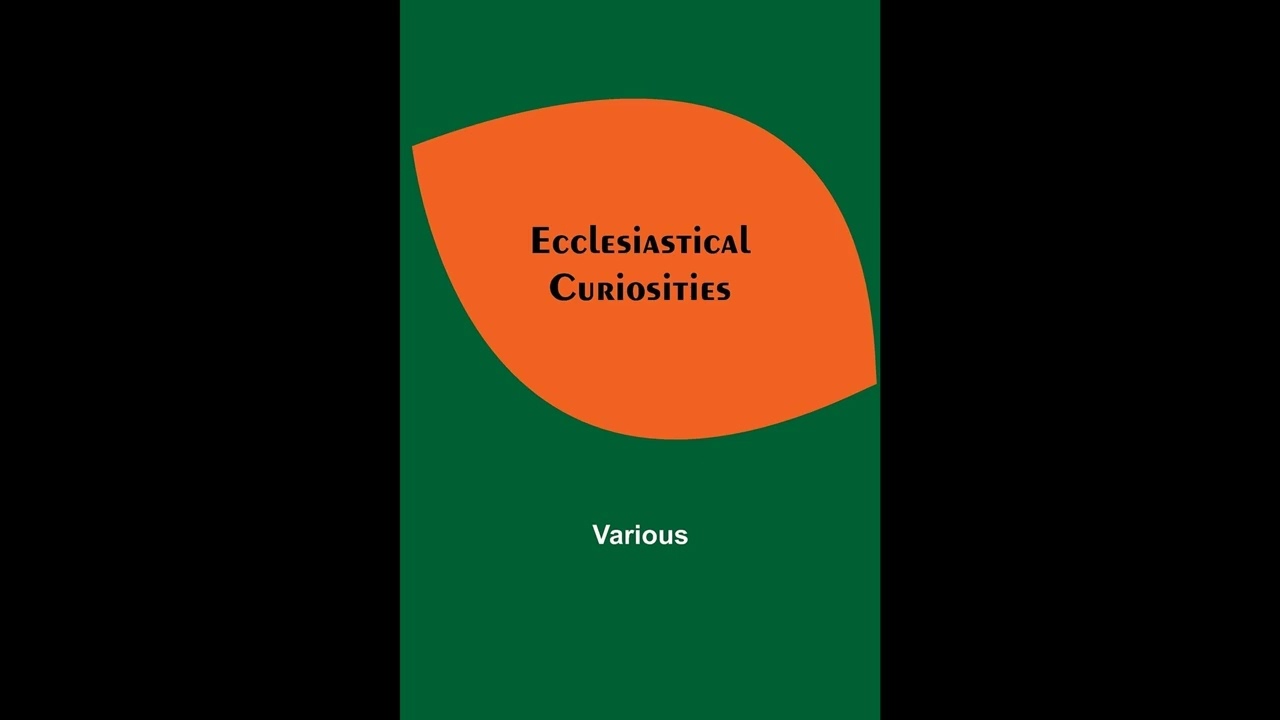
Ecclesiastical Curiosities
Imagine a chronicle spanning the breadth of human experience within the sacred, a collection that peels back the layers of solemnity to reveal the surprising, the peculiar, and the profoundly human elements nestled within religious institutions. Ecclesiastical Curiosities is not a conventional narrative but rather an illuminating compilation of observations, anecdotes, and historical snippets that offer an unconventional lens through which to view the spiritual endeavors of humankind. It stands as a quiet testament to the enduring tension between the divine ideal and the very human reality that has always characterized organized faith. This remarkable compendium speaks to us today because it reminds us that while the forms of worship and the structures of belief may change, the human heart—with all its virtues, foibles, and occasional absurdities—remains remarkably constant, offering both solace and a wry smile across the chasm of centuries. The work unfolds not as a single, sweeping drama with a defined protagonist, but as a mosaic of vignettes, each a distinct window into the less commonly recounted aspects of religious life. Imagine stepping into the hushed cloisters of an ancient monastery, not to witness profound contemplation, but perhaps to overhear a petty squabble over seating arrangements at supper, or to observe a revered abbot with an unexpected penchant for collecting rare stamps. The settings vary wildly, traversing geographical and temporal boundaries: from the early Christian catacombs where devotion mingled with fear, to the sun-drenched scriptoria of the medieval age, to the grand cathedrals whose spires touch the heavens while mundane human concerns play out below. The "characters" are as diverse as the settings: the ascetic hermit whose piety is questioned by an overly indulgent diet of exotic fruits, the earnest preacher whose sermons accidentally reveal more about his own domestic woes than the path to salvation, the local saint whose miraculous acts have surprisingly prosaic explanations, or the institutional functionary whose zeal for rules eclipses all spiritual purpose. The overarching "plot" in Ecclesiastical Curiosities is the ongoing, often comical, sometimes poignant interaction between the lofty aspirations of faith and the grounding realities of human nature. There is no central conflict in the traditional sense, but rather a recurring thematic tension: the persistent clash between the spiritual ideal and the earthly execution. We encounter figures whose devotion borders on the eccentric, whose pursuit of holiness leads to unintended consequences, or whose attempts to enforce doctrine result in surprisingly human missteps. The book subtly charts the ebb and flow of these interactions, presenting them without judgment, but with an eye for the telling detail. Each curiosity serves as a standalone moment, yet collectively they build a panoramic impression of the human spirit’s capacity for both profound faith and profound absurdity within the sacred confines. The narrative thread weaves together these disparate moments, creating a cumulative effect that illuminates the enduring paradoxes of religious institutions without ever resolving them into a neat conclusion. The origins of a work like Ecclesiastical Curiosities are shrouded in the mists of time, its authorship uncredited, its precise genesis a matter of speculation. This absence of a named author is, in itself, a significant detail, placing the text within a long tradition of works that have emerged from collective human observation and oral transmission. Such texts often transcend individual genius, becoming instead a repository of cultural memory and shared experience. They are born not of a single desk, but from the whispers of generations, from the notes of anonymous scribes, from the compiled wisdom and wit of scholars and laypeople alike who sought to record the peculiar facets of life around them. We can envision this material being gathered over centuries—perhaps from monastic annals, forgotten local histories, or even the commonplace books of erudite observers who delighted in cataloging the quirks of their contemporaries within the church. This compilation, therefore, stands as a testament to the enduring human fascination with the sacred and the profane, acting as a window into how people observed, criticized, and reflected upon their spiritual institutions long before formalized historical or sociological studies existed. It is a work that belongs to no single literary movement but rather to the enduring human tendency to record and share stories, especially those that illuminate the gaps between appearance and reality. Its place in the broader literary canon is as a unique artifact, a reminder that the informal, the anecdotal, and the subtly satirical have always played a role in shaping our understanding of even the most august human endeavors. It is an act of collective remembrance, distilling countless fleeting moments into a lasting record. One of the central themes running through Ecclesiastical Curiosities is human fallibility within sacred spaces. The text provides countless examples of how even the most devout or powerful figures in religious life are subject to the same petty vanities, ambitions, and shortcomings as anyone else. Consider, for instance, a passage recounting a particularly learned bishop who, while delivering a sermon on humility, meticulously adjusts his elaborate vestments, inadvertently drawing attention to their splendor rather than his message. Another recurring theme is the ironic gap between ideal and reality. This is often illustrated through the presentation of an institution's lofty stated goals contrasted with the mundane or even absurd methods employed to achieve them. We might encounter a scene describing a grand theological debate meticulously planned to resolve a doctrinal point, only to devolve into an argument about who holds precedence in speaking, thus demonstrating the human ego’s persistent intrusion into spiritual matters. Further, the work highlights the subtle absurdity inherent in strict adherence to tradition, showing how practices intended to foster piety can sometimes lead to comically rigid or illogical behaviors. Picture a monastic order so fixated on a particular ancient rule that they meticulously preserve a crumbling, non-functional bell tower simply because the founding charter mentioned "the bell," even as a modern, perfectly good bell hangs elsewhere. Finally, Ecclesiastical Curiosities often touches upon the unexpected manifestations of faith, illustrating how genuine belief can express itself in ways that confound conventional expectations, sometimes bordering on the bizarre but nonetheless sincere. An example might be a layperson who, through a series of misinterpretations, creates a unique personal ritual that, while unorthodox, genuinely deepens their spiritual connection, suggesting faith's resilience beyond formal structures. The cultural and political landscape surrounding the emergence of such a collection of "curiosities" is vast, spanning eras when religious institutions were not merely centers of worship but the very backbone of society, influencing everything from governance to education, art, and daily life. While Ecclesiastical Curiosities lacks a precise publication date, its subject matter firmly places it within the long sweep of human history from antiquity through the medieval period and beyond, when the church, in its various forms, was an all-encompassing presence. Such a work would naturally emerge from societies deeply invested in their religious structures, where observation of clerical life was common, and where a critical—or at least an amused—eye could discern the human drama unfolding within sacred walls. It reflects a societal moment when the internal workings of religious life were visible to all, prompting both reverence and a certain amount of wry commentary. This work stands as a historical counterpoint to purely hagiographical accounts, offering a more rounded, often less reverent, but perhaps more honest portrayal of religious life as it was lived. It suggests a culture mature enough to look at its most sacred institutions with both respect and a discerning sense of humor. Listening to Ecclesiastical Curiosities as an audiobook transforms it into an intimate, revealing experience, akin to having an erudite friend share fascinating, whispered secrets from the past. With several hours of content, it offers a substantial yet digestible companion for quiet evenings, long commutes, or moments of thoughtful reflection. The narration style becomes paramount here, needing a voice that can convey both the gravity of the subject matter and the subtle humor inherent in many of the anecdotes. Listen for the narrator’s pacing, how they allow each "curiosity" to breathe, giving the listener space to ponder its implications before moving on. The voice itself should be authoritative but not overly dramatic, possessing a certain learned quality, perhaps with a touch of wry amusement that underlines the human comedy without diminishing the underlying respect for the subject. Any occasional snippets of dialogue, though perhaps rare, would be rendered with a light touch, drawing the listener further into these historical moments. The overall atmosphere cultivated by the narration invites a sense of discovery, like sifting through ancient scrolls to uncover hidden insights into the persistent nature of faith and humanity.
Enjoyed Ecclesiastical Curiosities? A few ways to support us
Audible & Amazon links are affiliate; we may earn a small commission at no extra cost.
About this production
Human narration by a volunteer reader from LibriVox.org, the public-domain audiobook project. LibriVox volunteers record literary works whose copyright has expired in the United States, releasing the resulting recordings into the public domain.
Ecclesiastical Curiosities by William Andrews. The underlying text is in the U.S. public domain. We do not republish any modern copyrighted edition, translation, or commentary.
The 4K cinematic visuals accompanying this audiobook are generated by an AI image model from prompts derived from the source text. No copyrighted photos, paintings, or stock footage are used. AI generation is disclosed on every video on our YouTube channel as required by YouTube's altered/synthetic content policy.
English subtitles are transcribed from the LibriVox recording with OpenAI Whisper. Translations into the 11 other supported languages are produced by Meta's NLLB-200 neural translation model. No human translator's copyrighted translation is used.
Questions about sourcing or rights? See our DMCA & Sourcing policy or contact us.
View 10 famous quotes from this book →
Enjoyed this audiobook?
If you'd like to own a copy of Ecclesiastical Curiosities or hear a professionally produced edition, the links below help support free audiobook production at no extra cost to you.
As an Amazon Associate we earn from qualifying purchases. Audible / print links are affiliate.