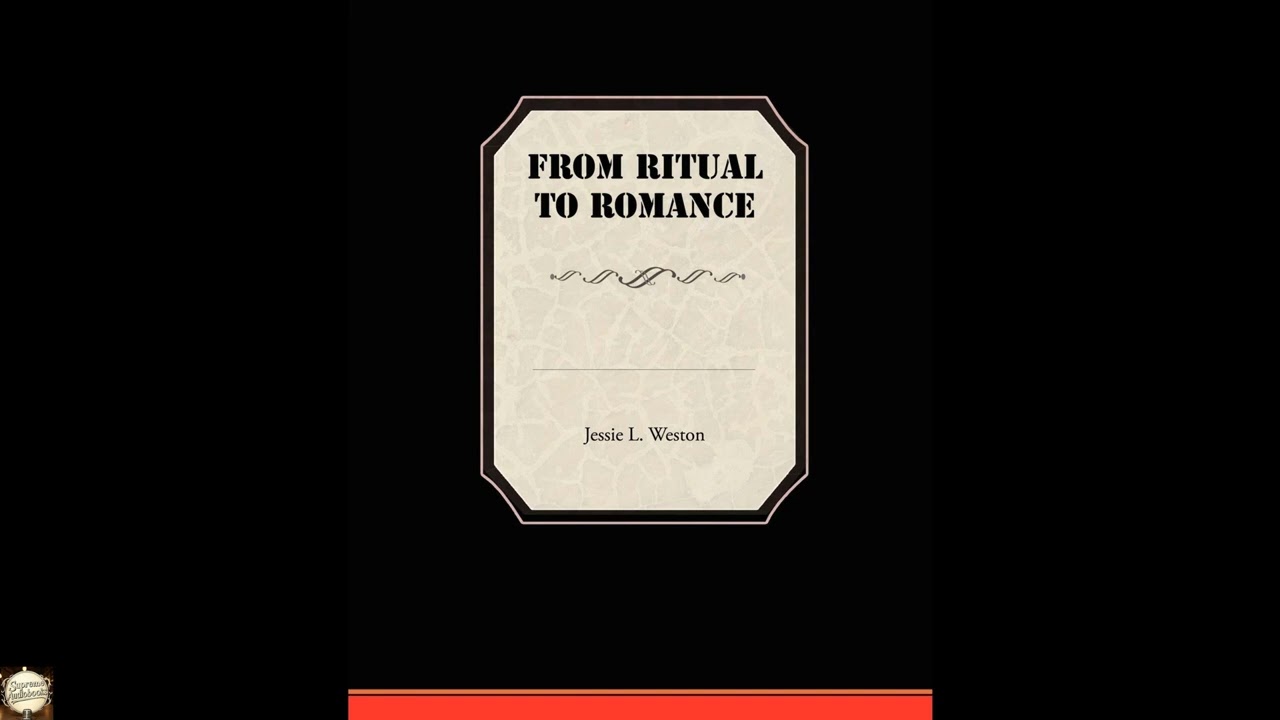
From Ritual to Romance
For centuries, the enigmatic legends of the Holy Grail have stirred the human imagination, inspiring quests, poems, and profound spiritual speculation. But what if these tales, seemingly rooted in Christian mysticism, held secrets far older, echoing the forgotten rites of a pre-Christian world? Jessie L. Weston’s seminal study, From Ritual to Romance, offers a revolutionary answer, drawing back the veil on the Arthurian cycles to reveal their deep connections to ancient fertility cults, vegetation myths, and initiation ceremonies. Published in 1920, this work is more than an academic treatise; it is an intellectual adventure that challenged prevailing interpretations, provided a foundational text for modernism, and continues to offer listeners a potent lens through which to understand the enduring power of myth and its surprising resonance in contemporary storytelling. Instead of presenting a conventional narrative with characters and a linear plot, Weston’s study unfolds as a meticulously constructed intellectual argument. She begins by meticulously examining the various versions of the Grail legends—from Chrétien de Troyes to Wolfram von Eschenbach—identifying puzzling inconsistencies and recurring motifs that do not quite fit a purely Christian framework. The wounded Fisher King, whose suffering inexplicably renders his land barren, the mysterious Grail vessel itself, and the trials faced by the questing knight all raise questions about their true origins. Weston points to the persistent presence of objects like the Bleeding Lance, the Sword, and the Cup, noting their parallel appearances in different accounts and suggesting they point to a unified, symbolic system. Weston then systematically traces these enigmatic elements back through comparative folklore, early religious practices, and the nascent field of anthropology. Her central thesis posits that the Arthurian Grail stories are not solely Christian allegories but rather a sophisticated literary survival of ancient, possibly pagan, initiation rituals centered around fertility, death, and rebirth. She dedicates significant attention to the concept of the “Waste Land”—a desolate kingdom afflicted by the infirmity of its ruler—and how this mirrors ancient cults of the dying and reviving god, whose health was intrinsically linked to the land’s fruitfulness. Her methodical approach builds a compelling case, inviting the listener to witness the fascinating intellectual detective work involved in uncovering these hidden layers of meaning. Jessie L. Weston, born in 1850 and passing in 1928, was a remarkable independent British scholar whose rigorous research helped redefine the study of medieval literature. Without holding a formal academic post, she dedicated her life to the meticulous investigation of Arthurian romance, bringing a then-unconventional interdisciplinary approach to her work. Educated privately, Weston possessed an insatiable curiosity and a gift for languages, which allowed her to translate and critically engage with original medieval texts. Her most significant contributions before From Ritual to Romance included The Legend of Sir Perceval (1901) and The Quest of the Holy Grail (1913), both demonstrating her early focus on the pagan and folk elements underlying the Christian narratives. Weston's influence extended far beyond the academic halls. Her singular vision placed her at the forefront of what would become myth criticism and comparative literature, earning her correspondence and respect from leading scholars across Europe. She challenged the prevailing Victorian tendency to view medieval literature as purely moralistic or chivalric, instead demonstrating its profound connections to universal human experiences and ancient religious thought. Her work effectively paved the way for future generations of scholars to apply anthropological and psychological insights to literary analysis, cementing her place as a pivotal figure in modern literary studies. At the heart of From Ritual to Romance lie several enduring themes that continue to resonate. One central idea is the persistence of ancient rituals and myths within later cultural forms. Weston demonstrates how seemingly disparate stories and symbols from the Grail legends can be traced back to the practices of fertility cults and mystery religions, showing that old beliefs do not simply vanish but often adapt and transmute. For instance, the Fisher King, a wounded monarch whose vitality directly impacts the barrenness of his land, serves as a powerful illustration of an archaic king-god figure whose suffering mirrors the natural cycle of death and rebirth. Another key theme is the syncretism and transformation of beliefs across different eras. Weston skillfully argues that the Christian elements of the Grail story were often superimposed upon, or even absorbed, much older pagan symbolism. The Grail chalice itself, venerated as Christ's cup, might have roots in ancient vessels of abundance, healing, or initiation, embodying how new layers of meaning are added to venerable forms over time. A third significant theme is the archetypal nature of story and symbol, suggesting that certain patterns of human experience—the quest for restoration, the sacred object, the wounded healer—recur across diverse cultures and historical periods. Weston’s methodical comparisons highlight these deep structures, arguing they speak to fundamental aspects of the human psyche and its relationship with the natural world. Her emphasis on the direct link between the king's health and the land's fertility also powerfully underlines the interconnectedness of humanity and nature, a concept that feels particularly urgent in our contemporary ecological awareness. The "Waste Land" motif, a stark depiction of environmental and spiritual desolation, serves as a poignant reminder that human well-being is often inseparable from the health of the natural world, demanding a ritualistic or spiritual remedy to restore balance. From Ritual to Romance emerged at a pivotal moment in intellectual and cultural history. Published in 1920, it arrived in the wake of the devastating First World War, a period marked by profound disillusionment, spiritual questioning, and a widespread sense of fragmentation and loss. This era saw a burgeoning interest in comparative religion, anthropology—particularly figures like James George Frazer, whose The Golden Bough had a significant impact—and the nascent fields of psychology, with the groundbreaking theories of Freud and Jung beginning to gain traction. People were searching for deeper, often primal, truths beneath the shattered facade of modern society. In the literary world, modernism was in full swing, characterized by experimentation, a rejection of traditional forms, and a profound engagement with myth and symbol as a means to express the complexities and disarray of contemporary life. Jessie L. Weston's work resonated deeply within this context, providing a scholarly framework for understanding the powerful, ancient undercurrents beneath Western literature. Its most famous literary progeny, T.S. Eliot’s landmark poem The Waste Land (1922), explicitly acknowledges its debt to Weston, drawing heavily on her analysis of the Fisher King and the barren land to articulate the spiritual decay of post-war Europe. Weston’s ability to bridge seemingly disparate fields of knowledge—mythology, anthropology, and literature—made her work uniquely suited to the intellectual currents of her time, offering a new way to synthesize ancient wisdom with modern consciousness. Listening to From Ritual to Romance as an audiobook offers a uniquely immersive experience, perfectly suited to its scholarly yet profoundly evocative content. A clear, measured, and thoughtful narration is crucial for a work that guides the listener through intricate arguments and vast historical and mythical landscapes. The several hours of run time allow for deep concentration, making it ideal for attentive listening during commutes, quiet study sessions, or reflective walks, where the complex ideas can truly settle and ferment. The narrator's voice becomes a calm and authoritative guide, ensuring that Weston's meticulous research and compelling connections are absorbed without feeling rushed or overwhelming. This atmospheric approach fosters contemplation, allowing the listener to fully engage with the ancient world, the scholarly pursuit of truth, and the surprising revelations about the stories that continue to shape us.
Enjoyed From Ritual to Romance? A few ways to support us
Audible & Amazon links are affiliate; we may earn a small commission at no extra cost.
About this production
Human narration by a volunteer reader from LibriVox.org, the public-domain audiobook project. LibriVox volunteers record literary works whose copyright has expired in the United States, releasing the resulting recordings into the public domain.
From Ritual to Romance by Jessie L. Weston. The underlying text is in the U.S. public domain. We do not republish any modern copyrighted edition, translation, or commentary.
The 4K cinematic visuals accompanying this audiobook are generated by an AI image model from prompts derived from the source text. No copyrighted photos, paintings, or stock footage are used. AI generation is disclosed on every video on our YouTube channel as required by YouTube's altered/synthetic content policy.
English subtitles are transcribed from the LibriVox recording with OpenAI Whisper. Translations into the 11 other supported languages are produced by Meta's NLLB-200 neural translation model. No human translator's copyrighted translation is used.
Questions about sourcing or rights? See our DMCA & Sourcing policy or contact us.
Enjoyed this audiobook?
If you'd like to own a copy of From Ritual to Romance or hear a professionally produced edition, the links below help support free audiobook production at no extra cost to you.
As an Amazon Associate we earn from qualifying purchases. Audible / print links are affiliate.
More Audiobooks
A Medieval Mystic: A Short Account of the Life and Writings of Blessed John Ruysbroe- Full Audiobook
Stories of The Prophets Before The Exile
Bible Studies: Essays on Phallic Worship and Other Curious Rites and Customs
Hesiod, the Homeric Hymns, and Homerica (Loeb Classical Library #57) (English, Anci- Full Audiobook