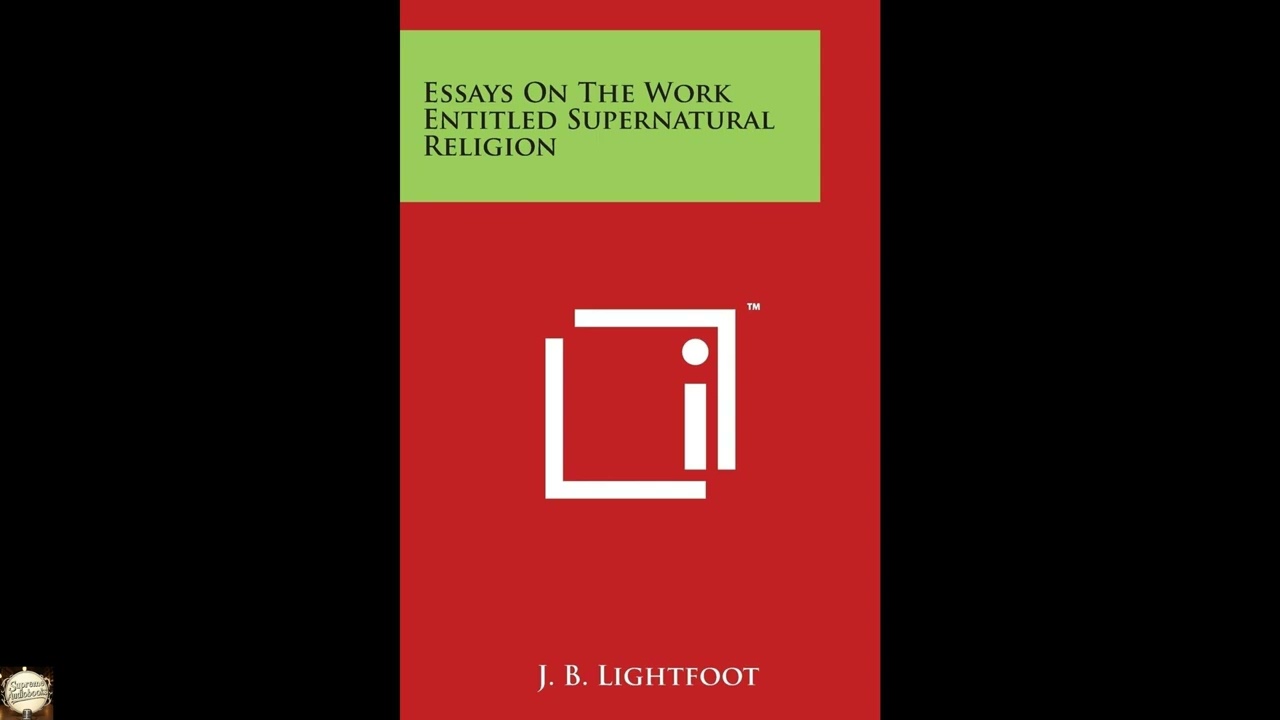
Essays on the Work Entitled Supernatural Religion
In the intellectual ferment of the late nineteenth century, as traditional beliefs faced the scrutiny of burgeoning scientific and historical criticism, few figures stood as formidable and respected as Joseph Barber Lightfoot. His collection, “Essays on the Work Entitled Supernatural Religion,” represents not merely a series of academic critiques, but a monumental intellectual confrontation. This is a foundational text in Christian apologetics and historical theology, a testament to rigorous scholarship deployed in defense of contested truths. It asks listeners to consider the very nature of evidence, the integrity of ancient sources, and the methods by which we reconstruct the past—questions that remain profoundly relevant in an era still wrestling with historical claims and the authority of foundational texts. For anyone interested in the enduring dialogue between faith and reason, or the precise art of scholarly debate, Lightfoot’s meticulous dismantling of a widely influential skeptical argument offers both profound insight and a compelling intellectual experience. The central narrative of Lightfoot's "Essays" is an intellectual duel, fought not with swords but with citations and reasoned arguments. The setting is the academic and theological landscape of Victorian England, a period when the burgeoning fields of textual criticism and historical analysis were challenging established religious frameworks. The principal combatants are J. B. Lightfoot himself, representing meticulous, orthodox scholarship, and the anonymous author of the highly controversial three-volume work, "Supernatural Religion," which advanced a sweeping skeptical critique of early Christianity and the authenticity of New Testament writings. This anonymous work had gained considerable traction, unsettling many by claiming that early Christian literature, particularly the Gospels, was not as ancient or reliable as traditionally believed, and that supernatural elements were later accretions. Lightfoot’s objective, then, is to systematically respond to and refute these claims. The arc of his "Essays" follows a process of forensic intellectual investigation. He scrutinizes the anonymous author's evidence, sources, and conclusions with unparalleled precision. Listeners witness Lightfoot dissecting arguments concerning the dates of early Christian texts like the Gospels and the Pauline Epistles, examining the testimony of early Church Fathers such as Ignatius of Antioch, Polycarp of Smyrna, and Clement of Rome. He demonstrates how "Supernatural Religion" frequently misinterprets ancient writers, misquotes texts, or overlooks crucial historical context to support its skeptical theories. It is a sustained, methodical refutation, building its case through painstaking detail and comprehensive scholarship, ultimately revealing the vulnerabilities in the edifice of the opposing argument. Joseph Barber Lightfoot (1828–1889) was a towering figure in Victorian scholarship and a leading light of the Church of England. Born in Liverpool, he was educated at Trinity College, Cambridge, where he distinguished himself as an exceptionally brilliant classicist and theologian. His academic career at Cambridge was marked by a steady ascent through various positions, culminating in his appointment as Lady Margaret's Professor of Divinity in 1861. A scholar of immense erudition, Lightfoot devoted his life to patristic studies and New Testament textual criticism, becoming renowned for his profound knowledge of Greek, Latin, and the historical context of early Christianity. His scholarly reputation was cemented by a series of monumental commentaries on the Pauline Epistles, including those on Galatians, Philippians, Colossians, and Philemon. These works set a new standard for biblical scholarship, combining rigorous philological analysis with deep historical and theological insight. Lightfoot was not merely an academic but also an influential churchman, serving as Bishop of Durham from 1879 until his death. In this role, he was known for his administrative acumen and his pastoral care, continuing his scholarly work even amidst his episcopal duties. He was also a prominent member of the New Testament Revision Committee, which produced the Revised Version of the New Testament in 1881, a testament to his expertise in textual matters and his commitment to accurate biblical translation. One of the central themes running through Lightfoot’s "Essays" is the paramount importance of intellectual rigor and meticulous scholarship. He exemplifies this through his painstaking examination of primary sources. For instance, when addressing the question of the early Church Fathers and their knowledge of the New Testament, Lightfoot doesn't just assert a viewpoint. He brings forth specific passages from Ignatius, Polycarp, and Clement, scrutinizing the anonymous author's interpretations line by line, comparing them against the original Greek, and demonstrating where contextual nuances were missed or outright misconstrued. This careful method serves as a powerful argument for scholarly integrity, showing how historical truth is best served by detailed engagement with evidence rather than sweeping generalizations. Another significant theme is the defense of historical Christianity through apologetics. Lightfoot understood the pressing need to respond to criticisms that sought to undermine the foundational documents of the Christian faith. His work is an intellectual shield, meticulously crafted from historical data, textual analysis, and logical reasoning. He shows how the dating of early Christian texts, often pushed much later by the author of "Supernatural Religion" to suggest their mythical nature, is actually supported by a consistent stream of early references and citations. By reconstructing the intellectual environment of the first and second centuries, Lightfoot illustrates the authenticity and early acceptance of many New Testament writings, thereby reinforcing the historical reliability of the Christian narrative against skeptical attacks. Lightfoot’s "Essays" emerged during a period of intense intellectual upheaval in Victorian England. The mid-to-late 19th century was marked by seismic shifts in scientific thought, most notably Darwin's theory of evolution, which challenged traditional understandings of creation. Simultaneously, "higher criticism"—a methodological approach developed primarily in Germany that subjected biblical texts to the same historical and literary scrutiny as any other ancient document—began to gain currency. This critical approach, often skeptical of supernatural elements and traditional authorship claims, deeply unsettled many within the established Church. "Supernatural Religion" itself was a product of this intellectual environment, reflecting a widespread desire to reconcile Christianity with modern critical thought, often by stripping away its miraculous elements and re-evaluating its historical foundations. Lightfoot's essays, therefore, were not isolated academic exercises. They were direct interventions in a heated cultural and theological debate, offering a robust defense of traditional Christian belief from a position of impeccable scholarship. He aimed to show that intellectual honesty and rigorous historical inquiry did not necessarily lead to skeptical conclusions but could, in fact, strengthen the case for orthodox faith. His work was a crucial counter-narrative, affirming that meticulous scholarship could serve the cause of historical truth, even in the face of profound skepticism. Listening to "Essays on the Work Entitled Supernatural Religion" as an audiobook offers a unique opportunity to engage with a profound intellectual argument in a sustained and immediate way. The spoken word allows the listener to absorb the meticulous logic and the careful unfolding of Lightfoot’s counter-arguments without the visual distraction of footnotes or cross-references. A skilled narrator brings clarity and emphasis to the precise language, highlighting the nuanced distinctions Lightfoot makes between accurate historical accounts and speculative claims. You can almost hear the intellectual sparring in the careful cadence, the subtle shifts in tone as Lightfoot dissects a faulty premise or illuminates a forgotten historical detail. The run length, several hours, encourages prolonged engagement, perfect for thoughtful reflection during commutes, walks, or quiet evenings. This isn't merely a recounting of facts; it's an invitation to participate in a historically significant intellectual debate, appreciating the power of a well-reasoned argument brought to life through performance.
Enjoyed Essays on the Work Entitled Supernatural Religion? A few ways to support us
Audible & Amazon links are affiliate; we may earn a small commission at no extra cost.
About this production
Human narration by a volunteer reader from LibriVox.org, the public-domain audiobook project. LibriVox volunteers record literary works whose copyright has expired in the United States, releasing the resulting recordings into the public domain.
Essays on the Work Entitled Supernatural Religion by J B Lightfoot. The underlying text is in the U.S. public domain. We do not republish any modern copyrighted edition, translation, or commentary.
The 4K cinematic visuals accompanying this audiobook are generated by an AI image model from prompts derived from the source text. No copyrighted photos, paintings, or stock footage are used. AI generation is disclosed on every video on our YouTube channel as required by YouTube's altered/synthetic content policy.
English subtitles are transcribed from the LibriVox recording with OpenAI Whisper. Translations into the 11 other supported languages are produced by Meta's NLLB-200 neural translation model. No human translator's copyrighted translation is used.
Questions about sourcing or rights? See our DMCA & Sourcing policy or contact us.
Enjoyed this audiobook?
If you'd like to own a copy of Essays on the Work Entitled Supernatural Religion or hear a professionally produced edition, the links below help support free audiobook production at no extra cost to you.
As an Amazon Associate we earn from qualifying purchases. Audible / print links are affiliate.