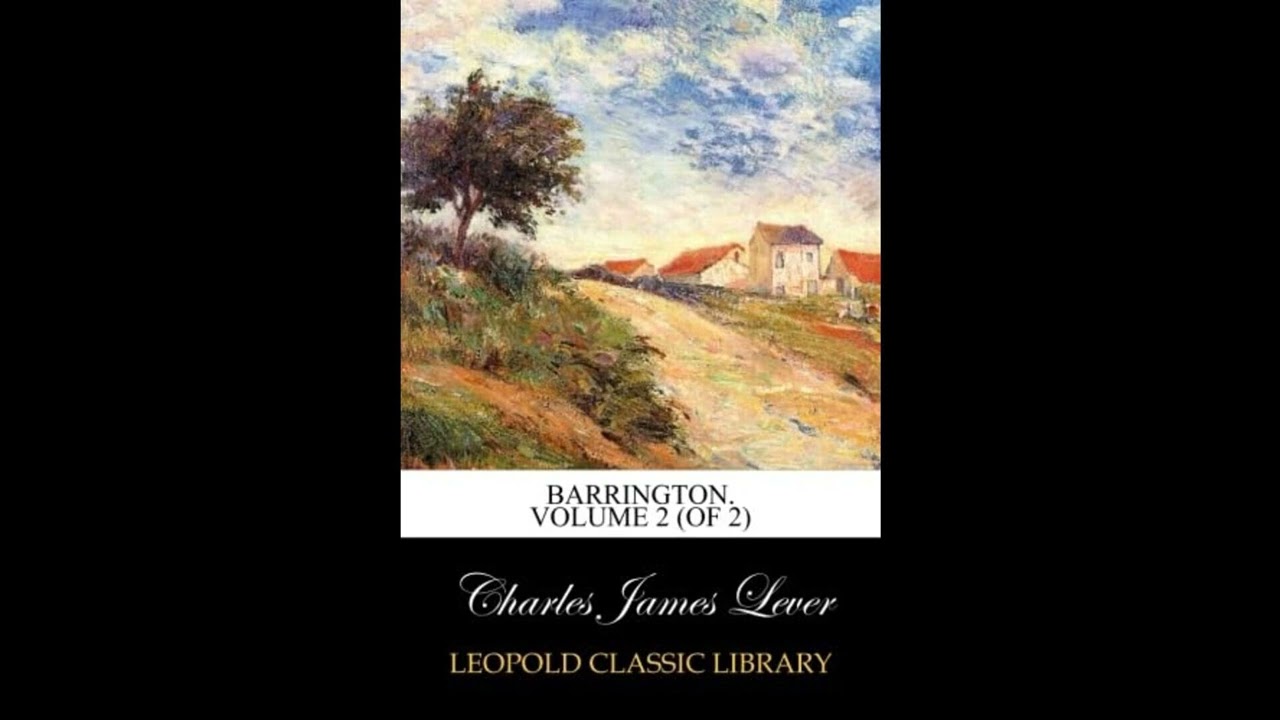
Barrington. Volume 2
Step into a world where wit and social maneuvering are high arts, where personal ambition clashes with the rigid expectations of society, and where the echoes of Ireland’s unique character resonate through every scene. Charles James Lever’s Barrington. Volume 2 continues an engaging narrative, offering a spirited observation of the human condition wrapped in the appealing garb of a nineteenth-century Anglo-Irish tale. This is more than a historical curiosity; it is a lively examination of status, love, and identity that, despite its period setting, speaks to the universal struggles of finding one's place and fortune. Whether you are familiar with Lever’s boisterous humor and keen eye for detail or discovering his work for the first time, this continuation promises an engrossing experience that illuminates a past era while reflecting on enduring human concerns. As Volume 2 unfolds, listeners find themselves once more amidst the familiar, often charming, yet sometimes precarious world of its titular character, Barrington. Having grappled with initial challenges and perhaps made a name for himself, Barrington now faces a fresh wave of social and personal entanglements. The setting likely oscillates between the spirited drawing-rooms of the Anglo-Irish gentry—perhaps in Dublin or a country estate—and the more staid, politically charged atmosphere of London. Key figures from Volume 1, including his potential romantic interest or rivals for affection, reappear, their destinies further intertwined with Barrington's own as he navigates the complex dance of societal expectations and heartfelt desires. New personalities may emerge, adding fresh dynamics and complicating the existing relationships. The central conflict escalates, perhaps involving a significant inheritance at stake, a political machination that threatens Barrington’s reputation, or a tangled web of romantic misunderstandings that could make or break his future. Lever’s narratives often hinge on the protagonist’s ability to charm, outwit, or persevere through the trials set before him. Listeners can anticipate Barrington confronting difficult choices, facing down adversaries both overt and subtle, and learning more about himself and the world around him as the stakes grow higher. The story’s arc in this volume propels the characters deeper into their predicaments, building towards a more profound understanding of their circumstances, all while maintaining a lively pace and the author’s characteristic blend of humor and earnest drama. We are drawn into a world where reputation is paramount, and a misstep can have far-reaching consequences, leaving Barrington to rely on his intelligence and connections to forge his path. The author, Charles James Lever (1806–1872), was an Irish novelist and physician, celebrated in his time for his spirited and often humorous portrayals of Irish life, particularly among the gentry and military. Born in Dublin, Lever initially trained as a doctor, even serving as a medical commissioner during the cholera epidemic of 1832. His experiences in Ireland and later on the Continent—where he served as a British diplomat, first in Florence and then as Consul at Spezia—deeply informed his writing. Lever’s novels gained popularity through serial publication, a common method of the era, allowing him to connect with a wide readership over time. He spent significant portions of his life abroad, but his heart and the subjects of his most memorable fiction remained firmly rooted in his homeland. Lever began his literary career with The Confessions of Harry Lorrequer (1839) and swiftly followed with Charles O'Malley, The Irish Dragoon (1841), which cemented his reputation for lively adventure and vivid characterizations. Other notable works include Tom Burke of Ours (1844) and The Dodd Family Abroad (1854). He stands as a significant figure in Victorian literature, particularly within the tradition of Anglo-Irish writing. While he might not always receive the same academic scrutiny as some of his contemporaries like Dickens or Thackeray, Lever’s unique voice—a blend of picaresque energy, social satire, and affectionate observation of Irish character—ensures his enduring place in the canon. He excelled at sketching distinct personalities and creating engaging narratives that often balanced lighthearted escapades with underlying critiques of societal norms. Among the specific themes Lever enacts in Barrington. Volume 2 is the intricate dance of social mobility and class distinction. Characters constantly measure each other by birth, wealth, and connections, often making desperate attempts to ascend the social ladder or maintain their precarious position. For example, we might observe Barrington himself navigating a gathering where his wit is a greater asset than his current fortune, or witness another character’s attempts to secure a favorable marriage, viewing it as a pragmatic transaction rather than a matter of affection. The novel also powerfully renders the complexities of Irish identity within the Anglo-Irish context. Lever often details the distinctive mannerisms, speech patterns, and worldviews of his Irish characters, providing insight into their pride, their struggles, and their unique brand of humor, often contrasting it with English sensibilities. The subtle ways characters assert their heritage or distance themselves from it, depending on the company, reveal much about the political and cultural currents of the time. Another prominent theme is the conflict between appearance and reality. Lever’s narratives are frequently populated by individuals who present a carefully constructed facade to the world, masking their true intentions, financial difficulties, or emotional vulnerabilities. A seemingly jovial and generous character might, upon closer inspection, be revealed as deeply calculating, or a figure of outward confidence might conceal a profound inner anxiety. This tension between what is shown and what is hidden drives much of the narrative’s suspense and character development. Furthermore, the intertwining of romance and ambition is central. Love interests are rarely simple matters of the heart; they are often weighed against practical considerations of status, wealth, and family influence. A protagonist might find themselves genuinely drawn to someone, yet pressured by family or societal expectations to pursue a more advantageous match, highlighting the era's often-pragmatic view of marriage. Barrington. Volume 2 first appeared in serial form around 1862–1863, a period of significant change and reflection in Victorian Britain and Ireland. Culturally, the novel was firmly situated in the mid-Victorian literary landscape, where serialized fiction was at its height, allowing authors to publish lengthy works incrementally and build a loyal following. The decade saw rapid industrial and social progress, but also a growing awareness of class disparities and the lingering effects of the Great Famine in Ireland, although Lever's focus often remained on the Anglo-Irish gentry. Politically, Ireland continued to grapple with its relationship to the British Crown, with calls for land reform and greater autonomy beginning to gain momentum. Lever’s works often served as a window into a specific segment of Irish society—the Protestant ascendancy—capturing its idiosyncrasies, its social rituals, and its often-complicated place within the wider British Empire. The novel emerged in an era fascinated by character studies and social commentary, often presented with a generous dose of humor, and Lever’s distinct voice offered a popular take on these prevailing interests. Listening to Barrington. Volume 2 as an audiobook offers a particularly immersive way to experience Lever’s prose. The novel’s length, several hours long, makes it ideal for sustained listening, allowing the story to unfold gradually and deeply. A skilled narrator can truly bring Lever’s lively dialogue to life, distinguishing the varied voices of his characters—from the quick-witted Irish gentry to the more formal English officials—and capturing the precise nuances of their speech. The pacing of the narration is crucial for conveying Lever’s often satirical yet affectionate tone, moving effortlessly between moments of high drama, witty banter, and poignant reflection. The descriptive passages detailing lavish ballrooms, rustic Irish landscapes, or bustling city streets can be rendered with an evocative atmosphere, transporting the listener directly into the nineteenth-century world Lever so deftly conjured. Pay close attention to how the narration highlights the subtle shifts in mood, the underlying ironies, and the sheer joy Lever often takes in human foibles, all contributing to a rich and rewarding listening experience.
Enjoyed Barrington. Volume 2? A few ways to support us
Audible & Amazon links are affiliate; we may earn a small commission at no extra cost.
About this production
Human narration by a volunteer reader from LibriVox.org, the public-domain audiobook project. LibriVox volunteers record literary works whose copyright has expired in the United States, releasing the resulting recordings into the public domain.
Barrington. Volume 2 by Charles James Lever. The underlying text is in the U.S. public domain. We do not republish any modern copyrighted edition, translation, or commentary.
The 4K cinematic visuals accompanying this audiobook are generated by an AI image model from prompts derived from the source text. No copyrighted photos, paintings, or stock footage are used. AI generation is disclosed on every video on our YouTube channel as required by YouTube's altered/synthetic content policy.
English subtitles are transcribed from the LibriVox recording with OpenAI Whisper. Translations into the 11 other supported languages are produced by Meta's NLLB-200 neural translation model. No human translator's copyrighted translation is used.
Questions about sourcing or rights? See our DMCA & Sourcing policy or contact us.
Enjoyed this audiobook?
If you'd like to own a copy of Barrington. Volume 2 or hear a professionally produced edition, the links below help support free audiobook production at no extra cost to you.
As an Amazon Associate we earn from qualifying purchases. Audible / print links are affiliate.