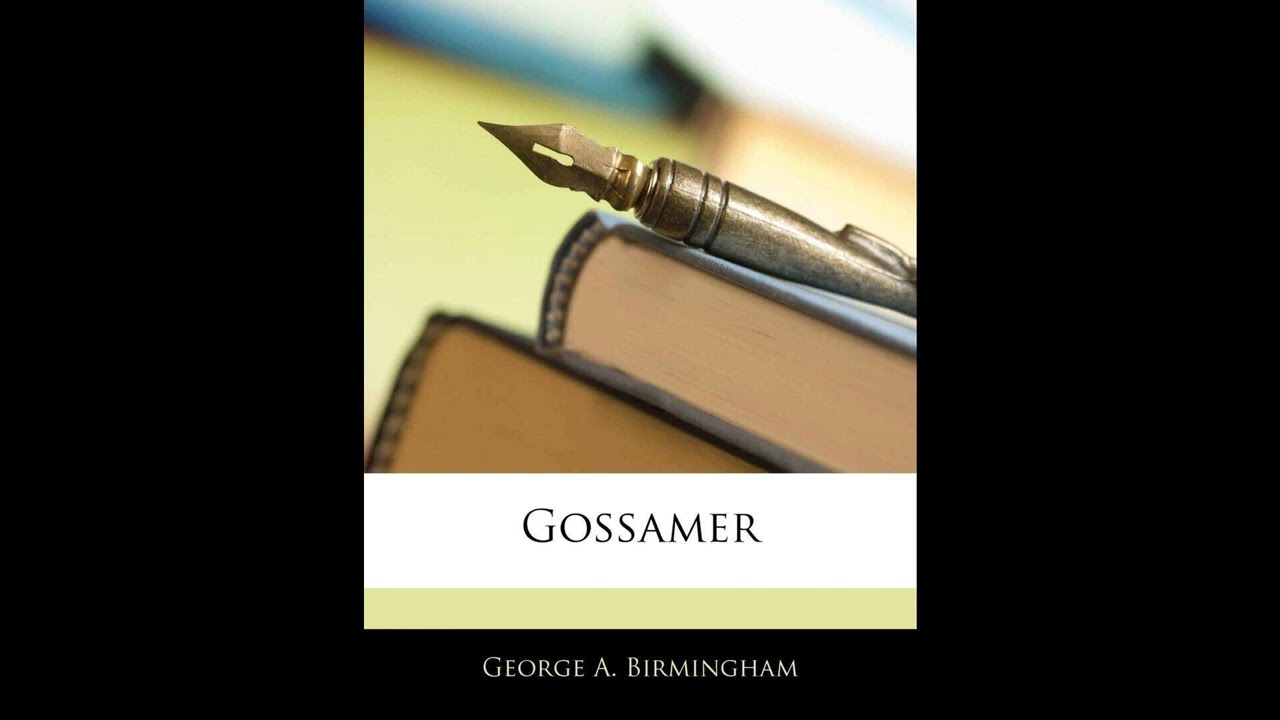
Gossamer
Step into the bustling, politically charged landscape of early twentieth-century Ireland with George A Birmingham’s "Gossamer," a novel that weaves together finance, national identity, and human ambition with a deft, often satirical, touch. Published in 1915, this classic literary work offers far more than a simple period piece; it presents a nuanced examination of how grand ideals and personal fortunes become inextricably linked, and often compromised, under the pressures of a rapidly changing world. Listeners today will find its sharp observations on political opportunism, the fragility of financial systems, and the complex interplay of personal ethics with public life remarkably resonant, proving that some aspects of the human condition, particularly those involving money and power, remain stubbornly consistent across the decades. The story centers on Robert Gossett, a man whose professional life is built on the seemingly insubstantial yet immensely powerful threads of international finance. Gossett, a figure of considerable charm and ambition, becomes entangled in a high-stakes scheme that stretches from the London stock exchange to the turbulent political currents of Ireland. His work, which relies heavily on speculation and the manipulation of market perceptions – an apt reflection of the book’s title – soon brings him into contact with various factions vying for influence and control in a nation on the brink of significant change. Birmingham masterfully sets the scene in a period where the very concept of Irish nationhood was being fiercely debated, creating a backdrop against which personal greed and national aspirations often clash with surprising results. As Gossett’s financial manipulations grow, so too do their political ramifications, drawing in characters from across the social and political spectrum. We meet figures like Mr. Knox, an Irish politician whose idealism or pragmatism (depending on one's view) makes him a pivotal player in Gossett's plans, and Paul Gossen, a clerk who observes the machinations with a mix of awe and apprehension. The central conflict intensifies as Gossett's intricate financial dealings begin to fray, threatening not only his personal wealth but also the fragile political balance he has unwittingly—or perhaps, knowingly—disturbed. The novel’s arc follows the accelerating consequences of Gossett’s actions, revealing how the seemingly weightless strands of finance can become a powerful, sometimes destructive, force, pulling individuals and nations into unforeseen predicaments without resorting to a simplistic villain-hero dynamic. George A Birmingham was the pen name of James Owen Hannay, a Church of Ireland clergyman born in Belfast in 1865. Educated at Trinity College Dublin, Hannay was ordained in 1888 and served as a rector in various parishes, most notably in Westport, County Mayo, for many years. It was during his time in rural Ireland that he gathered much of the material and inspiration for his prolific literary output. Hannay’s career as a writer began in earnest in the early 1900s, and he quickly established himself as a keen observer and satirist of Irish life and politics. His novels, often infused with a distinctive blend of humor and keen social commentary, offered a unique perspective on the complexities of Irish identity, religion, and the ongoing debates surrounding Home Rule. Hannay, writing as Birmingham, became a significant voice in Anglo-Irish literature, known for his ability to poke fun at the foibles of both British officialdom and various factions within Irish society itself. He was not afraid to challenge conventional wisdom or political dogma, often deploying wit and irony to expose hypocrisy or absurdity. His other notable works, such as "The Seething Pot" (1904) and "Spanish Gold" (1908), solidified his reputation as a master of the comedic novel, though his humor often carried a serious underlying critique. Though perhaps less celebrated than some of his contemporaries today, Birmingham’s place in the literary canon is secured by his honest, often biting, portrayal of Ireland during a period of immense change, offering a window into the cultural and political currents of his era that few others matched with such consistent comedic flair. "Gossamer" addresses several core themes, providing rich ground for reflection. One prominent theme is the fragility of financial systems and human ambition. Robert Gossett's entire professional existence is built upon leveraging perceived value, moving enormous sums of money based on rumors, future prospects, and calculated risks. The novel makes clear how easily these seemingly robust structures, much like gossamer itself, can be torn apart by unforeseen events or the weight of their own speculative nature. Another central theme is political expediency versus national ideals. Through characters like Mr. Knox, Birmingham illustrates the tension between the passionate rhetoric of nationalism and the practical, often compromising, realities of political action. The book shows how personal and financial interests can subtly, or overtly, manipulate patriotic fervor for less noble ends. The novel also functions as a sharp social satire, a hallmark of Birmingham’s style. He gently mocks the pretenses and absurdities of various social classes and political groups, never allowing any one faction to escape his critical gaze. His characters, whether the ambitious financier or the earnest politician, are portrayed with a degree of human fallibility that makes their motivations understandable, even when their actions are questionable. Furthermore, "Gossamer" touches upon the theme of identity and belonging, particularly in the context of a nation grappling with its future. Characters are forced to confront what it means to be Irish, or British, or simply a citizen of the world, in an era where those definitions were fiercely contested. "Gossamer" was published in 1915, a year into the Great War, and at a time of profound unrest and uncertainty in Ireland. The Home Rule crisis, which had dominated Irish politics for years, was technically suspended due to the war, but the underlying tensions and divisions within the country were as strong as ever. Unionists and Nationalists held vastly different visions for Ireland's future, and paramilitary groups like the Ulster Volunteer Force and the Irish Volunteers were already established. This charged atmosphere, just a year before the Easter Rising, formed the essential backdrop for Birmingham’s narrative. The novel emerged from a period when questions of loyalty, national sovereignty, and economic independence were not abstract debates but urgent, daily realities shaping the lives of everyone in Ireland, making the intertwining of finance and politics in "Gossamer" particularly poignant and relevant to its original readership. Listening to "Gossamer" as an audiobook allows the listener to fully immerse themselves in the world George A Birmingham created. The narrative, with its blend of sophisticated dialogue, character-driven humor, and intricate plot points, truly shines when brought to life by a skilled narrator. You can appreciate the specific rhythms of early 20th-century prose, the subtle inflections that convey character and intent, and the distinct voices of the Irish and English characters. The measured pacing of the story, unfolding over several hours, is ideal for extended listening sessions, whether during a long commute, a contemplative walk, or simply as a comforting presence in your home. The audiobook format invites you to slow down, absorb the witty observations, and truly feel the undercurrents of political tension and financial risk that give "Gossamer" its enduring appeal.
Enjoyed Gossamer? A few ways to support us
Audible & Amazon links are affiliate; we may earn a small commission at no extra cost.
About this production
Human narration by a volunteer reader from LibriVox.org, the public-domain audiobook project. LibriVox volunteers record literary works whose copyright has expired in the United States, releasing the resulting recordings into the public domain.
Gossamer by George A Birmingham. The underlying text is in the U.S. public domain. We do not republish any modern copyrighted edition, translation, or commentary.
The 4K cinematic visuals accompanying this audiobook are generated by an AI image model from prompts derived from the source text. No copyrighted photos, paintings, or stock footage are used. AI generation is disclosed on every video on our YouTube channel as required by YouTube's altered/synthetic content policy.
English subtitles are transcribed from the LibriVox recording with OpenAI Whisper. Translations into the 11 other supported languages are produced by Meta's NLLB-200 neural translation model. No human translator's copyrighted translation is used.
Questions about sourcing or rights? See our DMCA & Sourcing policy or contact us.
Enjoyed this audiobook?
If you'd like to own a copy of Gossamer or hear a professionally produced edition, the links below help support free audiobook production at no extra cost to you.
As an Amazon Associate we earn from qualifying purchases. Audible / print links are affiliate.