Sir Brook Fossbrooke
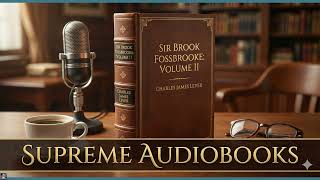
Step into the mid-Victorian world with Charles James Lever’s Sir Brook Fossbrooke, a novel that charms and surprises with its unique blend of wit, adventure, and profound human insight. At its heart lies a character unlike any other in English literature: Sir Brook Fossbrooke, an aging Irish baronet whose unconventional wisdom and boundless benevolence often lead him into – and out of – predicaments, offering a refreshing counterpoint to the rigid social structures of his time. This is not merely a historical curiosity; Lever’s perceptive examination of character, his light touch with satire, and his commitment to highlighting true goodness over mere reputation resonate just as strongly today, inviting listeners to reflect on the virtues of kindness, integrity, and genuine connection in a world still too often preoccupied with appearances. The story opens in the tranquil setting of a small English village, swiftly introducing us to the titular Sir Brook, a man past his prime yet brimming with an indefatigable spirit and an almost reckless generosity. He finds himself drawn into the lives of two young people, Lucy and Tom Lendrick, children of a stern judge, whose earnest desires are constantly thwarted by circumstance and societal expectation. Tom, a spirited but perhaps too impulsive young man, grapples with mounting gambling debts and a seemingly insurmountable legal challenge, while Lucy struggles with the quiet despair of unrequited love and the pressures of her family’s social standing. Sir Brook, with his keen eye for human nature and his willingness to disregard convention, takes it upon himself to be their unlikely guardian angel, often employing methods that raise eyebrows among the more respectable members of society. As the narrative unfolds, we follow Sir Brook’s varied attempts to aid his young proteges, efforts that soon sweep them from the quiet English countryside to the bustling social scene of Dublin and further still to the diplomatic circles of continental Europe. Entanglements arise with other memorable characters, including the aristocratic but self-serving Lord Glengariff and the sharp-witted Lady Augusta, whose machinations and prejudices often complicate Sir Brook’s well-intentioned interventions. The central conflict frequently revolves around the clash between sincere emotion and pragmatic social arrangements, between reputation and true character. Sir Brook’s journey is one of constant movement, both geographical and emotional, as he navigates a world where his open heart is often met with suspicion, yet ultimately proves to be his greatest strength. Charles James Lever, born in Dublin in 1806, was a prodigious and popular novelist of the Victorian era, whose life was as colorful and well-traveled as many of his fictional creations. After training as a doctor, Lever practiced briefly before dedicating himself to a literary career that would see him become one of the most widely read authors of his time. His early works, such as Harry Lorrequer and Charles O'Malley, The Irish Dragoon, established his reputation for lively, picaresque tales often set in the military or among the Anglo-Irish gentry. Lever served as editor of the Dublin University Magazine for several years, a significant platform that showcased his talent for both fiction and commentary. His literary output was prolific, often serialized in periodicals before book publication, a common practice of the day. Lever’s later career took a turn towards diplomacy, and he spent many years living abroad, holding consular positions in Florence, Spezia, and ultimately Trieste, where he passed away in 1872. This extended exposure to continental European society profoundly influenced his novels, imbuing them with a cosmopolitan flair and a nuanced understanding of different cultures that set him apart from many of his contemporaries. Though sometimes categorized with other Irish novelists, his later works, including Sir Brook Fossbrooke, often transcended purely Irish themes to offer broader social commentary on the manners and morals of an increasingly interconnected European elite. Lever’s Sir Brook Fossbrooke is particularly notable for its thoughtful engagement with several enduring themes. One prominent idea is the contrast between benevolence and social pragmatism. Sir Brook embodies a profound, almost reckless, generosity that stands in stark opposition to the calculating self-interest and rigid decorum expected in Victorian society. His attempts to help others are rarely conventional, as when he disregards official channels to secure an advantage for Tom Lendrick, demonstrating that true kindness sometimes requires bending or even breaking societal rules. Another significant theme is the often-fraught relationship between reputation and true character. Characters like Lord Glengariff are adept at maintaining a polished public image while harboring less admirable intentions, whereas Sir Brook’s eccentricities and financial carelessness often lead to misunderstandings and damage his standing, despite his unimpeachable moral core. The novel invites listeners to question the superficiality of social judgment and to value integrity over mere appearance. Further, the story skillfully navigates themes of Irish identity within a European context and the sometimes-disillusioning realities of romantic idealism. Sir Brook, with his unique blend of charm, impulsiveness, and resilience, represents a certain facet of Irish character that Lever often celebrated, contrasting it with the more reserved or calculating demeanors of his English and continental acquaintances. His experiences abroad highlight the cultural nuances and challenges of navigating different social worlds. Simultaneously, the romantic entanglements of Lucy and Tom explore the gap between youthful dreams of love and the often-harsh practicalities of marriage, class divides, and familial obligations, painting a vivid picture of the constraints placed upon young people in the mid-19th century. Lever shows how love must contend with societal pressures, financial realities, and the sometimes-cruel machinations of others. Published in serial form between 1864 and 1865, and then as a complete book in 1866, Sir Brook Fossbrooke emerged during a fascinating period in Victorian England. The mid-Victorian era was a time of immense social change, marked by rapid industrialization, growing imperial power, and increasing anxieties about class structure and moral rectitude. The strictures of Victorian morality were deeply ingrained, dictating proper behavior, social expectations, and the roles of men and women. In the literary world, the novel was firmly established as the dominant form of popular entertainment, with authors like Dickens, Thackeray, and George Eliot shaping the landscape. Lever's work, while perhaps less overtly focused on grand social issues than some of his contemporaries, nonetheless offered a shrewd commentary on the manners, foibles, and aspirations of a society grappling with tradition and modernity, reflecting the widespread interest in social satire and character studies. His unique perspective as an Irish author living abroad provided a valuable lens through which to observe and subtly critique both British and European high society. Listening to Sir Brook Fossbrooke as an audiobook transforms Lever’s lively prose into an immediate and engaging experience. The "several hours" run length allows ample time to become thoroughly immersed in the novel’s unfolding drama, perfect for long commutes or leisurely afternoons. A skilled narrator will bring Lever's distinctive dialogue to life, providing unique voices for Sir Brook’s genial but sometimes exasperated pronouncements, the youthful anxieties of the Lendricks, and the cutting wit of Lady Augusta. The pacing of the narration can beautifully capture the leisurely explorations of character and setting, while also building tension during moments of crisis and revelation. The rich atmosphere of both the English countryside and the diplomatic salons of Europe gains an added dimension through spoken delivery, allowing listeners to fully appreciate the novel’s humor, its gentle pathos, and its ultimately optimistic view of human kindness.
Enjoyed Sir Brook Fossbrooke? A few ways to support us
Audible & Amazon links are affiliate; we may earn a small commission at no extra cost.
About this production
Human narration by a volunteer reader from LibriVox.org, the public-domain audiobook project. LibriVox volunteers record literary works whose copyright has expired in the United States, releasing the resulting recordings into the public domain.
Sir Brook Fossbrooke by Charles James Lever. The underlying text is in the U.S. public domain. We do not republish any modern copyrighted edition, translation, or commentary.
The 4K cinematic visuals accompanying this audiobook are generated by an AI image model from prompts derived from the source text. No copyrighted photos, paintings, or stock footage are used. AI generation is disclosed on every video on our YouTube channel as required by YouTube's altered/synthetic content policy.
English subtitles are transcribed from the LibriVox recording with OpenAI Whisper. Translations into the 11 other supported languages are produced by Meta's NLLB-200 neural translation model. No human translator's copyrighted translation is used.
Questions about sourcing or rights? See our DMCA & Sourcing policy or contact us.
Enjoyed this audiobook?
If you'd like to own a copy of Sir Brook Fossbrooke or hear a professionally produced edition, the links below help support free audiobook production at no extra cost to you.
As an Amazon Associate we earn from qualifying purchases. Audible / print links are affiliate.