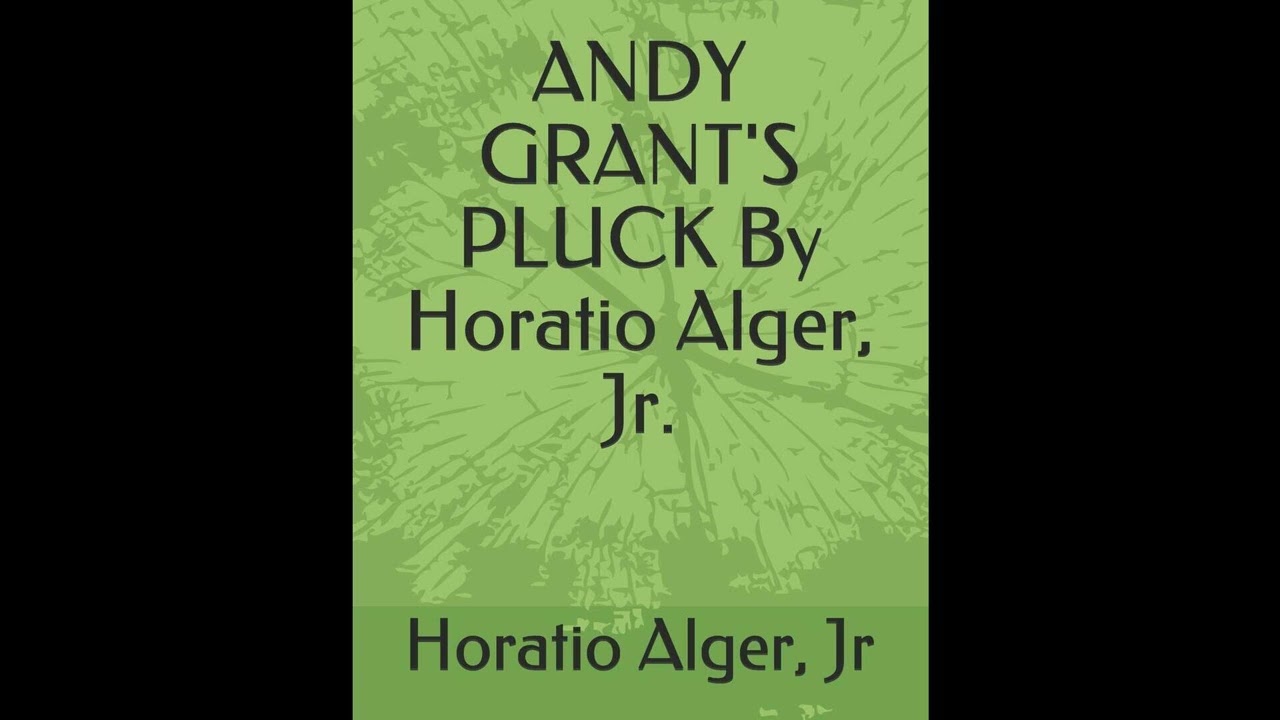
ANDY GRANT'S PLUCK By Horatio Alger, Jr.
Step into the world of Gilded Age America, a landscape of immense change and often stark disparity, through the compelling story of Andy Grant's Pluck. This classic of American literature, written by the prolific Horatio Alger, Jr., stands as a powerful testament to the enduring American ideal: that hard work, honesty, and perseverance can lift an individual from the humblest beginnings to a position of respect and comfort. More than a simple period piece, Andy Grant's struggles and triumphs offer a blueprint for resilience that speaks directly to anyone facing obstacles today, reminding us that character and diligence remain universal keys to unlocking potential, regardless of the era. It's a story that asks what true success means and how it's genuinely earned, a question as relevant now as it was over a century ago. Our story introduces us to young Andy Grant, a boy living in circumstances of severe poverty in a bustling, rapidly industrializing American city. Orphaned or abandoned, Andy finds himself alone in the world, responsible for his own survival with little to no resources. His days are a constant struggle to earn enough to eat and find a safe place to sleep. He is, by all measures, at the bottom rung of society's ladder, navigating a world that often seems indifferent, if not outright hostile, to his plight. Despite these harsh realities, Andy possesses an unwavering moral compass and an unshakeable belief in the value of honest labor. He refuses to resort to begging or stealing, choosing instead to seek out any legitimate means of making a living, however meager. As the narrative unfolds, Andy's commitment to integrity and his relentless work ethic begin to attract the attention of various individuals, some benevolent, others less so. He might find temporary employment as a newsboy, a bootblack, or an errand runner, always giving his best effort. Along the way, he encounters a spectrum of characters typical of Alger's universe: the cruel landlord, the conniving street ruffian, the kindly benefactor, and the upright merchant. Andy's inherent goodness often leads him to act charitably towards others even when he himself has little to spare, or to perform acts of honesty that could easily go unnoticed. These small, consistent demonstrations of character gradually pave the way for opportunities that initially seemed unimaginable, as his reputation slowly but surely grows in his community. The story follows Andy through a series of challenges and small victories, showcasing how each principled decision, each act of kindness, and each moment of sustained effort builds upon the last, inching him closer to a secure and respectable life. The author behind Andy Grant's Pluck is Horatio Alger, Jr., an American writer whose name became synonymous with the "rags-to-riches" narrative. Born in Chelsea, Massachusetts, in 1832, Alger began his career as a Unitarian minister after graduating from Harvard Divinity School. However, his ministerial tenure was brief, ending amidst scandal. He subsequently moved to New York City in the 1860s and dedicated his life to writing stories for boys. Alger spent much of his time observing and interacting with the newsboys and street children of New York, whose lives and struggles deeply influenced his fiction. He died in Natick, Massachusetts, in 1899, leaving behind a prodigious body of work. Alger's output was astonishing, publishing over 100 books during his lifetime, many of which followed a predictable but immensely popular formula. Beyond Andy Grant's Pluck, his most famous titles include Ragged Dick, published in 1868, which first introduced many readers to the archetype of the virtuous street urchin, and Luck and Pluck, another foundational text in his canon. His works were instrumental in shaping the popular imagination of what constituted the "American Dream" during the late 19th century, portraying a path to success built on moral rectitude and industriousness. Though often criticized in later years for their formulaic plots and simplistic characterizations, Alger's books nevertheless captured the spirit of an age and left an undeniable mark on American popular culture and its self-perception. Andy Grant's Pluck enacts several key themes that resonate powerfully within American literary tradition. Foremost among them is the idea of self-reliance and hard work. Andy never waits for handouts; he actively seeks out opportunities, no matter how menial, to better his situation. For example, he might spend hours diligently shining shoes or running errands, demonstrating that consistent effort, even in small tasks, is the foundation of progress. This theme is often contrasted with characters who resort to idleness or dishonesty, highlighting the moral superiority and eventual rewards of honest labor. Another central theme is virtue rewarded. Andy's unwavering honesty and kindness are consistently shown to lead to positive outcomes. Perhaps he returns a lost wallet to its rightful owner, or intervenes to protect a weaker child from bullies. These seemingly small acts of integrity do not immediately guarantee a fortune, but they earn him a good reputation and the trust of influential individuals, who in turn offer him chances he might otherwise never receive. This reinforces the notion that moral character is a form of capital, a precious commodity that ultimately yields dividends. The book also implicitly addresses social mobility, offering a hopeful vision that even those born into extreme poverty can ascend the social ladder through sheer force of will and good conduct. This idea provided comfort and aspiration in an era of rigid class structures and immense wealth disparity. The era in which Andy Grant's Pluck emerged — the late nineteenth century — was a period of profound transformation in the United States. Following the Civil War, America experienced rapid industrialization, leading to massive urbanization and an influx of immigrants seeking new opportunities. This Gilded Age was characterized by both immense wealth accumulation among a few industrialists and widespread poverty in cities, with many children and families struggling to survive. There was a pervasive anxiety about economic security and the future of the nation, coupled with a strong belief in individual enterprise. In this context, Alger's stories offered a comforting and prescriptive narrative. They served as a form of moral instruction for young readers, emphasizing traditional American values of self-help, temperance, thrift, and respectability. His books provided a powerful counter-narrative to the harsh realities many faced, suggesting that success was not solely the domain of the privileged, but accessible to anyone with enough moral fiber and determination. Andy Grant's Pluck provided reassurance that the American Dream was indeed attainable, even for the most disadvantaged, if one only cultivated the right character traits. To experience Andy Grant's Pluck as an audiobook is to gain direct access to the earnest voice and moral clarity of Alger's storytelling. A skilled narrator breathes life into Andy's quiet determination, the bluster of his antagonists, and the wisdom of his eventual mentors. The several hours of listening provide ample time to immerse oneself in the daily grind of 19th-century street life, to feel Andy's frustrations and celebrate his small triumphs. Listen for the subtle shifts in the narrator's tone as Andy encounters different characters, conveying the subtle nuances of social class and intention. The pacing allows the listener to fully absorb the period dialogue and the often straightforward but impactful prose, making the moral lessons feel immediate and resonant. It's an opportunity to hear a foundational piece of American literary culture, delivered with an intimacy that only the spoken word can provide.
Enjoyed ANDY GRANT'S PLUCK By Horatio Alger, Jr.? A few ways to support us
Audible & Amazon links are affiliate; we may earn a small commission at no extra cost.
About this production
Human narration by a volunteer reader from LibriVox.org, the public-domain audiobook project. LibriVox volunteers record literary works whose copyright has expired in the United States, releasing the resulting recordings into the public domain.
ANDY GRANT'S PLUCK By Horatio Alger, Jr. by Horatio Alger Jr.. The underlying text is in the U.S. public domain. We do not republish any modern copyrighted edition, translation, or commentary.
The 4K cinematic visuals accompanying this audiobook are generated by an AI image model from prompts derived from the source text. No copyrighted photos, paintings, or stock footage are used. AI generation is disclosed on every video on our YouTube channel as required by YouTube's altered/synthetic content policy.
English subtitles are transcribed from the LibriVox recording with OpenAI Whisper. Translations into the 11 other supported languages are produced by Meta's NLLB-200 neural translation model. No human translator's copyrighted translation is used.
Questions about sourcing or rights? See our DMCA & Sourcing policy or contact us.
Enjoyed this audiobook?
If you'd like to own a copy of ANDY GRANT'S PLUCK By Horatio Alger, Jr. or hear a professionally produced edition, the links below help support free audiobook production at no extra cost to you.
As an Amazon Associate we earn from qualifying purchases. Audible / print links are affiliate.