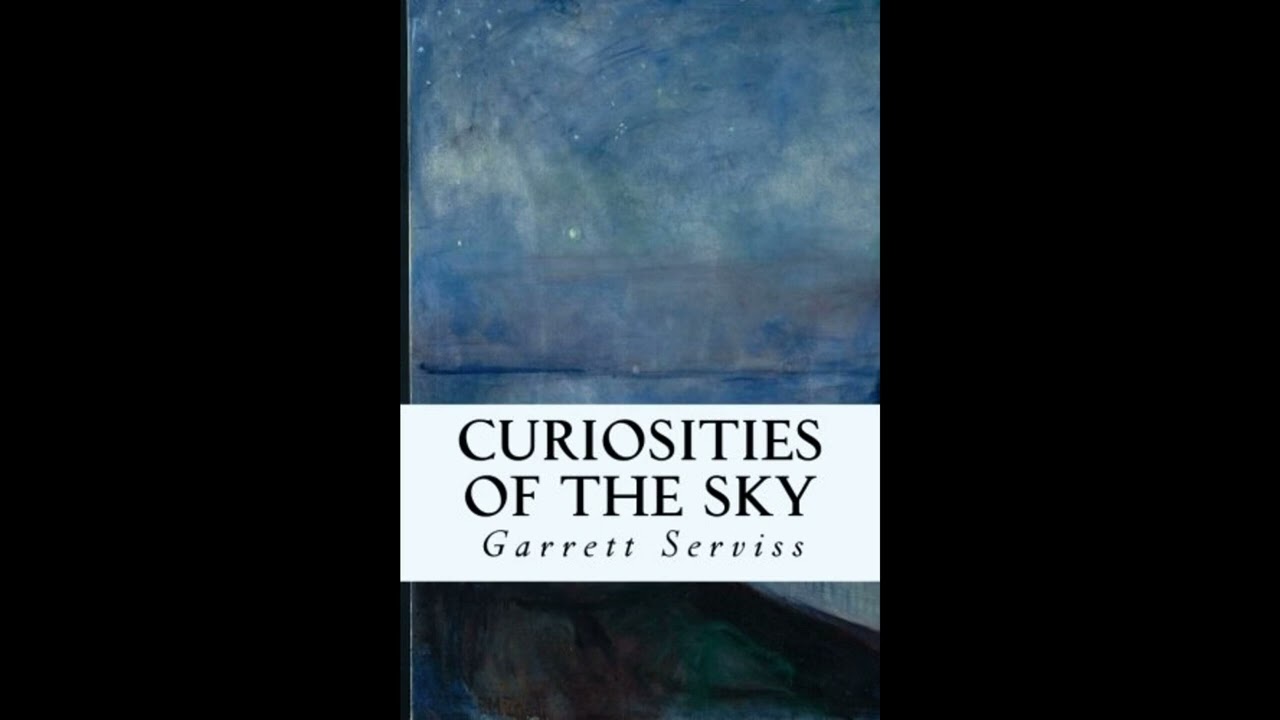
Curiosities of the Sky
Step into a moment in time when the universe, though increasingly understood, still held vast, uncharted realms of wonder and speculation. Garrett Serviss’s Curiosities of the Sky, first published in 1909, serves as a remarkable portal to this era, offering a profound yet accessible window into the cosmos as seen through the eyes of a brilliant popularizer of science. This is not merely a historical document of early 20th-century astronomy; it is an invitation to share in the intellectual excitement of uncovering the universe's most astounding phenomena, presented with a lyrical quality that speaks to both the scientist and the poet within us. For listeners today, it provides not only a perspective on how our understanding of space has evolved but also an enduring appreciation for the human capacity to observe, question, and marvel at the celestial canvas above. Serviss guides his audience through a comprehensive survey of astronomical marvels, ranging from the familiar to the deeply mysterious. He begins by orienting the observer, perhaps with discussions of the moon’s unique features or the planets visible to the naked eye, before drawing attention to less obvious but equally compelling sights. The text systematically addresses a panoply of celestial objects and events: the ethereal glow of nebulae, those immense clouds of gas and dust where stars are born and die; the unpredictable grandeur of comets, those "celestial wanderers" that sweep into our solar system from its distant fringes; and the sudden, spectacular flashes of meteors and meteor showers, which Serviss explains as cosmic debris interacting with Earth’s atmosphere. He details the sun's astonishing power and its effects on our world, along with the shifting mysteries of variable stars, whose brightness fluctuates in patterns that once baffled astronomers. Beyond mere description, Serviss engages with the pressing questions of his time, using the best available scientific data to consider possibilities that still resonate. He dedicates significant attention to the concept of other worlds, particularly Mars, discussing the famous "canals" observed by Percival Lowell and musing on the potential for life beyond Earth. While avoiding definitive conclusions, he fosters an open-minded engagement with the boundaries of human knowledge, inviting contemplation on whether we are truly alone in the vastness. His presentation of these "curiosities" is always grounded in observation and scientific reasoning, yet it never loses sight of the profound awe these phenomena inspire, moving from the tangible facts of observation to the philosophical implications of our place within a boundless cosmos. Garrett Putnam Serviss, born in 1851 in upstate New York, carved a distinctive niche for himself in American letters and public science education. A Yale graduate who initially pursued a career in law, Serviss quickly transitioned into journalism, working for the New York Sun. It was there that his passion for astronomy found its true calling, leading him to become one of the most respected and widely read popularizers of science during the late 19th and early 20th centuries. He possessed a rare gift for translating complex scientific concepts into clear, engaging prose that captivated a general readership hungry for knowledge about the universe. Serviss was not only an astronomer but also an accomplished science fiction writer, bridging the gap between scientific exposition and imaginative narrative. His early works, such as Astronomy with an Opera Glass (1888), established him as an authority in making the night sky accessible to amateur observers. His science fiction novels, including Edison's Conquest of Mars (1898), a unauthorized sequel to H.G. Wells' The War of the Worlds, and The Moon Metal (1900), demonstrated his ability to blend scientific speculation with adventure. Serviss’s role was crucial in an era when scientific understanding was rapidly advancing, yet largely inaccessible to the average citizen. He stood alongside other influential figures of the period, interpreting the universe for a curious public and inspiring generations with the wonders of the cosmos. One central theme permeating Curiosities of the Sky is the enduring human impulse to observe and comprehend the universe. Serviss consistently highlights how scientific advancement springs from patient observation and intellectual rigor. He details the process of telescopic discovery, showing how astronomers meticulously gather data and refine theories, illustrating humanity's unwavering drive to pierce the veil of the unknown. For example, his descriptions of the arduous work involved in mapping constellations or tracking cometary orbits provide concrete illustrations of this intellectual quest, demonstrating how each new piece of information contributes to a broader, more coherent picture of our surroundings. Another prominent idea is the overwhelming sense of the sublime that the cosmos evokes. Despite Serviss’s scientific explanations, he never diminishes the sheer scale and beauty of celestial objects. His lyrical descriptions of nebulae as "cosmic maternity wards" or the silent, majestic progress of a comet emphasize that even with understanding, the universe retains its capacity for wonder and inspires profound philosophical reflection on existence. This blend of scientific clarity with poetic appreciation ensures that the text appeals not just to the intellect but also to the spirit, reminding the audience that science can deepen, rather than diminish, our sense of awe. The early 20th century, the period in which Curiosities of the Sky was published, was a particularly fertile ground for popular science. It was a time when technological advancements, especially in optics and photography, were rapidly expanding humanity’s view of the universe. New celestial bodies were being charted, and theoretical physics was beginning to challenge established Newtonian paradigms, though these revolutionary ideas were still largely confined to scientific circles. Culturally, there was a widespread optimism about science and progress, fueled by the industrial age and a growing literacy rate. Serviss's work emerged from this environment, meeting a public demand for accessible explanations of these exciting discoveries and speculations, effectively serving as a bridge between the esoteric world of astronomical research and the eager minds of the general public. Listening to Curiosities of the Sky as an audiobook offers a uniquely immersive way to experience Serviss's blend of scientific fact and poetic reflection. The spoken word allows the narrator to emphasize the cadence of Serviss’s prose, bringing to life the grandeur of his descriptions and the clarity of his explanations. Listeners can savor the careful pacing of the text, allowing sufficient time to absorb the scientific details while also appreciating the evocative language that paints vivid mental images of distant nebulae and wandering comets. The approximately eight-hour length provides ample opportunity for extended contemplation, making it an ideal companion for quiet evenings or long commutes, where the narrator's voice can transport you directly into the intellectual and imaginative cosmos of over a century ago.
Enjoyed Curiosities of the Sky? A few ways to support us
Audible & Amazon links are affiliate; we may earn a small commission at no extra cost.
About this production
Human narration by a volunteer reader from LibriVox.org, the public-domain audiobook project. LibriVox volunteers record literary works whose copyright has expired in the United States, releasing the resulting recordings into the public domain.
Curiosities of the Sky by Garrett Serviss. The underlying text is in the U.S. public domain. We do not republish any modern copyrighted edition, translation, or commentary.
The 4K cinematic visuals accompanying this audiobook are generated by an AI image model from prompts derived from the source text. No copyrighted photos, paintings, or stock footage are used. AI generation is disclosed on every video on our YouTube channel as required by YouTube's altered/synthetic content policy.
English subtitles are transcribed from the LibriVox recording with OpenAI Whisper. Translations into the 11 other supported languages are produced by Meta's NLLB-200 neural translation model. No human translator's copyrighted translation is used.
Questions about sourcing or rights? See our DMCA & Sourcing policy or contact us.
Enjoyed this audiobook?
If you'd like to own a copy of Curiosities of the Sky or hear a professionally produced edition, the links below help support free audiobook production at no extra cost to you.
As an Amazon Associate we earn from qualifying purchases. Audible / print links are affiliate.