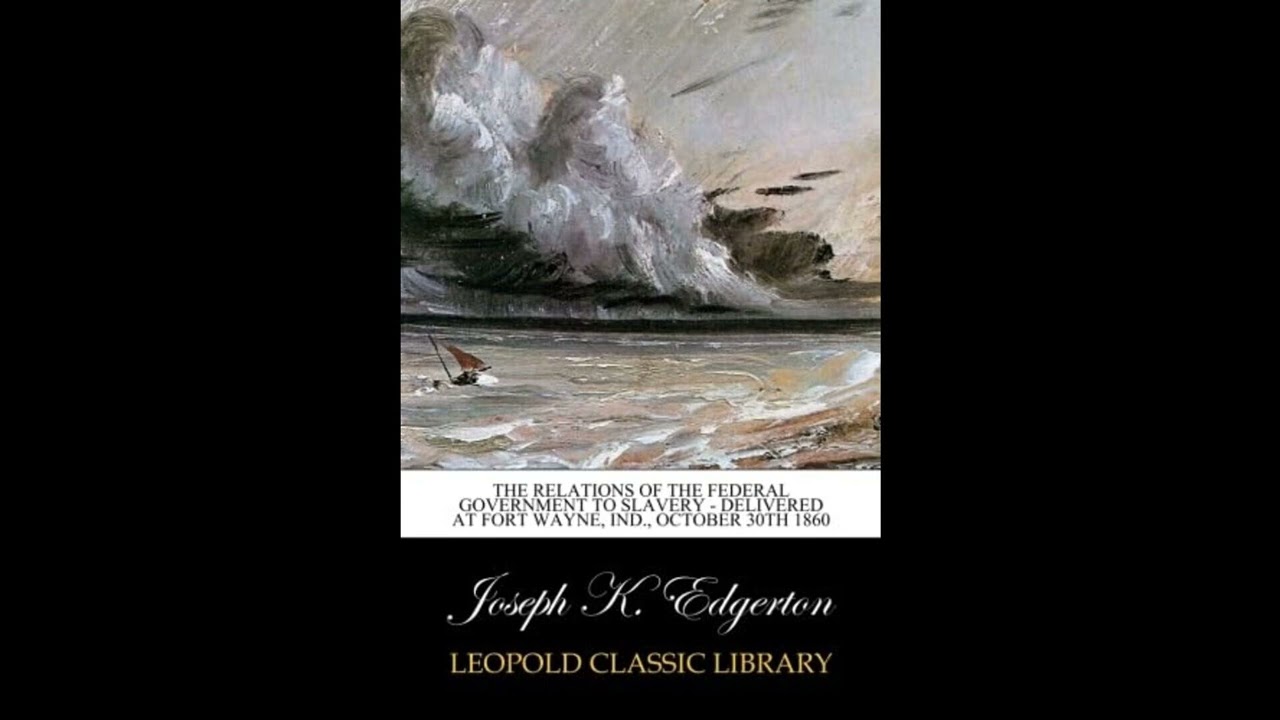
The Relations of the Federal Government to Slavery - Delivered at Fort Wayne, Ind- Full Audiobook
The very title, "The Relations of the Federal Government to Slavery," instantly transports us to a pivotal, deeply troubled period in American history, an era when the nation teetered on the brink of an irreversible fracture. This audiobook captures a direct, unfiltered voice from that time—a public address delivered in Fort Wayne, Indiana, illuminating the fierce constitutional, legal, and moral arguments surrounding human bondage. Listening to this historical document today offers more than a mere academic exercise; it presents a direct conduit to the foundational conflicts that shaped the United States, forcing us to confront the enduring legacy of federal power, states' rights, and the struggle for human dignity. It is a vital piece of the national dialogue, offering stark clarity on how these debates played out in real-time, in real places, among real citizens. The narrative of this address unfolds not through fictional characters, but through the intricate and often contradictory legal landscape of the antebellum United States. Imagine the speaker standing before a crowd in Fort Wayne, a city in a free state, yet surrounded by the anxieties and controversies emanating from both abolitionist fervor and the entrenched institution of slavery just across the Ohio River. The central "character" is arguably the U.S. Constitution itself, scrutinized and interpreted from myriad angles regarding its provisions—or silences—on slavery. The "setting" is therefore both the physical meeting hall in Indiana and the broader intellectual battlefield of American political thought. The conflict driving the speech is the irreconcilable tension between the principles of liberty and equality upon which the nation was founded, and the deeply rooted economic and social system of chattel slavery. The address likely dissects various legislative compromises and judicial rulings of the time, such as the Fugitive Slave Acts, the Missouri Compromise, or the debates surrounding the expansion of slavery into new territories acquired from Mexico. The speaker would have meticulously outlined differing viewpoints on whether the federal government possessed the authority to restrict or abolish slavery, or if such powers remained solely within the purview of individual states. The arc of the "story" is the progression of these arguments, building a case for a particular understanding of federalism and its relationship to the "peculiar institution," culminating in a powerful articulation of the era's gravest national dilemma. Given that the author of this seminal speech is listed as "Unknown," the work itself takes on a heightened significance as a collective voice or a representative argument from its specific historical moment. This anonymity is not uncommon for public addresses of the 19th century, particularly those transcribed by local newspapers or preserved in collections where the orator's personal identity was considered secondary to the content and impact of their words. It speaks to a tradition where ideas circulated widely, often debated in town halls, lecture circuits, and political rallies across the country. This specific address from Fort Wayne thus becomes an artifact of the vigorous public discourse that defined antebellum America. Oratory was a powerful medium, capable of swaying public opinion, galvanizing movements, and dissecting complex legal and ethical quandaries. The unknown speaker represents the thousands of voices, both prominent and everyday, who grappled with the moral and political catastrophe of slavery, contributing to the intellectual ferment that ultimately led to the Civil War. It belongs to the tradition of American political rhetoric, where speeches were not merely informative but performative, designed to persuade, enlighten, and occasionally provoke. The document enacts several crucial themes. Foremost among them is Constitutional Interpretation and Federalism, as the speaker undoubtedly grapples with the specific clauses and amendments of the U.S. Constitution—or the lack thereof—pertaining to slavery. For instance, the speaker might have analyzed the three-fifths compromise, arguing how it both acknowledged and obfuscated the status of enslaved people, or discussed the contentious fugitive slave clause, debating the extent of federal enforcement in free states. A second theme is The Nature of Compromise and its Failures, as the speech would have been delivered in an era marked by attempts to reconcile irreconcilable differences. The speaker might describe how previous legislative efforts, intended to resolve the issue, instead inflamed it, highlighting the growing chasm between North and South. A third significant theme is Moral Authority versus Legal Precedent. Even if not overtly abolitionist, any discussion of slavery's "relations" with the government inevitably brings forth the ethical dimensions of human bondage. The speaker might have weighed legal arguments based on property rights against emerging or deeply held moral convictions about human liberty, revealing the profound tension within the national conscience. Finally, the address showcases The Power of Rhetoric in Public Life, demonstrating how complex arguments were structured, presented, and designed to resonate with a listening audience, shaping opinions and driving political action in an age before widespread mass media. The historical context for this address is the escalating crisis of the 1840s and 1850s, a period of intense political turmoil preceding the Civil War. The nation had recently expanded its territory significantly through the Mexican-American War, igniting furious debates over whether slavery would be permitted in these new lands. This period saw the passage of the Compromise of 1850, which included a stricter Fugitive Slave Act that deeply angered Northerners, and the Kansas-Nebraska Act of 1854, which introduced "popular sovereignty" and led to violent conflicts in Kansas. Judicial rulings, most notably the Dred Scott decision, further exacerbated tensions by declaring that Black individuals could not be citizens and that Congress had no power to prohibit slavery in the territories. In this charged atmosphere, public addresses like the one delivered in Fort Wayne were critical forums for citizens to understand and engage with the existential threat facing the Union. These were not mere academic lectures but urgent interventions in a rapidly deteriorating political landscape, aimed at informing, persuading, and mobilizing public opinion as the nation hurtled toward disunion. The work emerged from a profound need to articulate, defend, or challenge the government's role in perpetuating or curtailing slavery, reflecting the desperate search for solutions that ultimately proved elusive. Listening to this as an audiobook provides an unparalleled opportunity to connect directly with the past. The several hours of content allow for an immersive experience, inviting listeners to absorb the meticulous argumentation and the rhetorical rhythms that defined 19th-century public speaking. A skilled narrator brings to life the intellectual vigor and emotional weight of such an address, capturing the deliberate pacing, the measured cadences, and the persuasive voice characteristic of the era. One can discern the careful structure of the arguments, the use of historical precedent, and the appeals to constitutional principles that shaped the American mind during its most challenging hour. It's a chance to hear the very ideas that defined a generation, presented as they were meant to be heard—aloud, with purpose, and with the full force of human conviction.
Enjoyed The Relations of the Federal Government to Slavery - Delivered at Fort Wayne, Ind- Full Audiobook? A few ways to support us
Audible & Amazon links are affiliate; we may earn a small commission at no extra cost.
About this production
Human narration by a volunteer reader from LibriVox.org, the public-domain audiobook project. LibriVox volunteers record literary works whose copyright has expired in the United States, releasing the resulting recordings into the public domain.
The Relations of the Federal Government to Slavery - Delivered at Fort Wayne, Ind- Full Audiobook. The underlying text is in the U.S. public domain. We do not republish any modern copyrighted edition, translation, or commentary.
The 4K cinematic visuals accompanying this audiobook are generated by an AI image model from prompts derived from the source text. No copyrighted photos, paintings, or stock footage are used. AI generation is disclosed on every video on our YouTube channel as required by YouTube's altered/synthetic content policy.
English subtitles are transcribed from the LibriVox recording with OpenAI Whisper. Translations into the 11 other supported languages are produced by Meta's NLLB-200 neural translation model. No human translator's copyrighted translation is used.
Questions about sourcing or rights? See our DMCA & Sourcing policy or contact us.
Enjoyed this audiobook?
If you'd like to own a copy of The Relations of the Federal Government to Slavery - Delivered at Fort Wayne, Ind- Full Audiobook or hear a professionally produced edition, the links below help support free audiobook production at no extra cost to you.
As an Amazon Associate we earn from qualifying purchases. Audible / print links are affiliate.