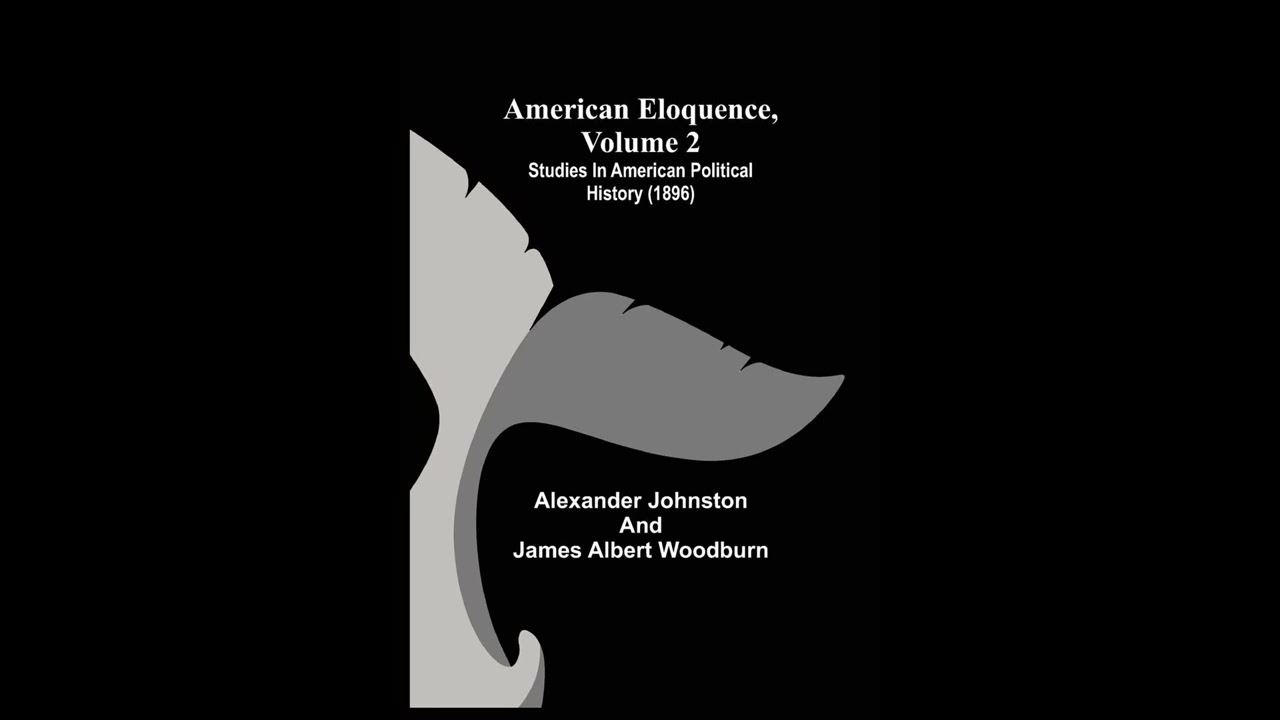
American Eloquence, Volume 2; Studies In American Political History (1896)
"American Eloquence, Volume 2; Studies In American Political History" from 1896 offers a rare, unfiltered window into the very debates that forged the United States. This isn't merely a collection of old speeches; it is an active archive of conviction, strategy, and the profound struggles of a nation in constant definition. Imagine sitting in the legislative halls, crowded public squares, or impassioned conventions of a century ago, listening directly to the figures who wrestled with the most pressing issues of their time—issues that, remarkably, echo in our present conversations about national identity, economic justice, and social progress. Listening to these carefully preserved addresses allows us to trace the lineage of ideas, to understand the roots of our current political landscape, and to appreciate the enduring power of language to shape a country's destiny. It provides an indispensable foundation for anyone seeking to understand the complexities of American political thought and the dynamic forces that have always shaped its trajectory. This particular volume, the second in a series, offers a curated overview of significant American political discourse, likely focusing on the period of intense transformation following the Civil War and Reconstruction. While it does not present a conventional narrative with fictional characters, its structure creates a compelling progression, charting ideological battles across various historical arenas. The "setting" shifts with each address, transporting the listener from the solemn chambers of Congress, where senators argued over tariff policies or civil rights legislation, to the impassioned stages of public rallies, where figures grappled with the implications of industrialization and nascent labor movements. The "main characters" are the real historical figures whose words are presented: eloquent orators, pragmatic politicians, and fervent reformers. We encounter the foundational "conflict" of American politics: the constant tension between federal authority and states' rights, the struggle for economic equity in a rapidly industrializing nation, and the evolving definitions of citizenship. Each speech represents a strategic maneuver, a carefully constructed argument designed to persuade, challenge, or defend a particular vision of America. The underlying "arc" reveals how arguments shifted over time, how new challenges prompted new rhetoric, and how the nation grappled with its legacy and future. This progression, from debates about Reconstruction to the anxieties of the Gilded Age, illustrates a nation perpetually in dialogue with itself, laying bare the profound differences that have always fueled the American experiment. The individual or editorial collective responsible for compiling American Eloquence, Volume 2 remains unnamed, a common practice for many foundational historical anthologies from the late nineteenth century. Such works were often conceived not as expressions of a single authorial voice, but as communal scholarly endeavors, designed to preserve and disseminate vital primary source material for public enlightenment and academic study. This collection stands as a testament to the period's commitment to documenting and understanding the nation's political evolution through the very words of its key players, rather than from a singular creative vision. It is likely the compilers operated with an acute sense of historical purpose, selecting speeches representing pivotal moments, influential figures, or illustrative arguments defining the American political landscape. Their uncredited editorial method would have involved meticulous research through legislative records, newspaper archives, and historical documents. The absence of a named author invites listeners to focus entirely on the substance of the oratory, hearing the historical voices speaking directly, unmediated. This anonymity elevates the content itself, positioning the words of senators, presidents, and social reformers as the true core of the work, emphasizing their power and historical import. Within these historical utterances, several profound themes surface repeatedly, offering a penetrating look at America's enduring concerns. One prominent theme is the struggle for national unity and identity, particularly in the aftermath of the Civil War. Listeners encounter heated debates over how to heal a fractured nation, whether through leniency or punitive measures, and what principles should define the reunited states. A congressman might passionately argue for federal intervention to protect the rights of former slaves, framing it as essential to the nation's moral fabric, while another might defend states' autonomy, portraying federal power as an overreach. These speeches illustrate the arduous work of redefining "American" in a dramatically altered landscape. Another compelling theme is the dynamic interplay between economic progress and social justice. As the nation industrialized rapidly in the late 19th century, creating immense wealth but also widespread labor unrest and social inequality, speakers grappled with the responsibilities of government and industry. Debates might focus on regulating nascent monopolies, ensuring fair wages, or addressing the plight of farmers. A senator might advocate for robust protectionist tariffs to foster domestic industry, promising prosperity, while a populist orator might decry the concentration of wealth, calling for more equitable distribution. These arguments reveal foundational tensions that continue to define American economic policy, demonstrating the enduring challenge of balancing individual opportunity with collective well-being. The year 1896, when American Eloquence, Volume 2 was published, places the collection squarely within the tumultuous Gilded Age. This period, following Reconstruction, saw unprecedented industrial expansion, rapid urbanization, and significant demographic shifts. Politically, the nation grappled with the rise of powerful industrial trusts, widespread labor unrest like the Pullman Strike, and the burgeoning Populist movement. It was also a time of significant social change, with the women's suffrage movement gaining momentum and Jim Crow segregation becoming entrenched in the South. The emergence of American Eloquence at this precise moment reflects a broader societal need to take stock of the nation's political past and present. As America stood on the cusp of becoming a global power, with debates over imperialism already simmering, there was a clear impulse to understand the historical arguments that had shaped its domestic character. This collection provided an essential civic resource, offering insights into the rhetorical strategies and ideological foundations that had brought the nation to its complex state, allowing reflection on ongoing challenges of governance, democracy, and social equity. To experience American Eloquence, Volume 2 as an audiobook offers a uniquely immersive connection to the past. The written word, while potent, cannot fully convey the force and nuance of spoken oratory. A skilled narrator brings these historical addresses to life, transforming silent text into an expressive, audible performance. Imagine hearing the deliberate pauses, the rising inflection of conviction, or the impassioned cadences that once moved legislative bodies or swayed public opinion. The several-hours run length provides ample time to absorb complex arguments and varied rhetorical styles. Listen for the narrator's ability to differentiate between speakers, subtly conveying distinct personalities and the atmosphere of their historical contexts—be it the measured tone of a constitutional scholar or the fiery indignation of a social reformer. This oral presentation allows a deeper appreciation for not just what was said, but how it was said, granting insight into the persuasive artistry at the heart of American political history.
Enjoyed American Eloquence, Volume 2; Studies In American Political History (1896)? A few ways to support us
Audible & Amazon links are affiliate; we may earn a small commission at no extra cost.
About this production
Human narration by a volunteer reader from LibriVox.org, the public-domain audiobook project. LibriVox volunteers record literary works whose copyright has expired in the United States, releasing the resulting recordings into the public domain.
American Eloquence, Volume 2; Studies In American Political History (1896) by Various. The underlying text is in the U.S. public domain. We do not republish any modern copyrighted edition, translation, or commentary.
The 4K cinematic visuals accompanying this audiobook are generated by an AI image model from prompts derived from the source text. No copyrighted photos, paintings, or stock footage are used. AI generation is disclosed on every video on our YouTube channel as required by YouTube's altered/synthetic content policy.
English subtitles are transcribed from the LibriVox recording with OpenAI Whisper. Translations into the 11 other supported languages are produced by Meta's NLLB-200 neural translation model. No human translator's copyrighted translation is used.
Questions about sourcing or rights? See our DMCA & Sourcing policy or contact us.
Enjoyed this audiobook?
If you'd like to own a copy of American Eloquence, Volume 2; Studies In American Political History (1896) or hear a professionally produced edition, the links below help support free audiobook production at no extra cost to you.
As an Amazon Associate we earn from qualifying purchases. Audible / print links are affiliate.