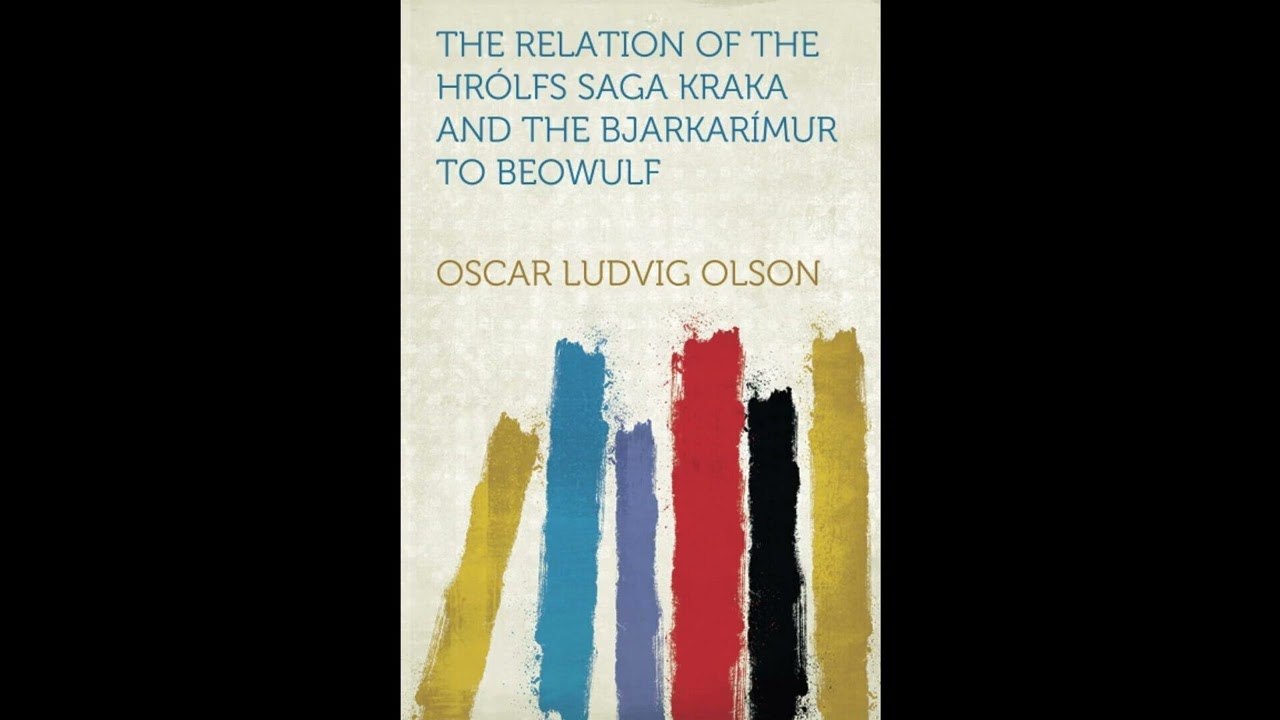
The Relation of the Hrólfs Saga Kraka and the Bjarkarímur to Beowulf
In the shadowy halls of ancient legend, where heroes faced monstrous foes and fate shaped the destinies of kings, stories echoed across the North Sea, binding disparate cultures in a shared heritage. Among these venerable tales stand Beowulf, the monumental Old English epic, and its Norse cousins, the Hrólfs Saga Kraka and the Bjarkarímur. For anyone drawn to the fundamental myths that underpin Western literature, or those curious about the deep roots of storytelling itself, Oscar Ludvig’s magisterial study offers a clarifying lens. This book doesn't merely analyze these texts; it reveals the profound, often startling, connections between them, showing how variations on heroic themes, character archetypes, and narrative structures persisted and evolved across languages and time. It’s an essential bridge for understanding the true scope of Germanic heroic tradition, inviting listeners to witness the scholarly detective work that uncovers these literary secrets. Ludvig’s work lays bare the compelling narrative of Hrólfs Saga Kraka, a pivotal Icelandic saga that recounts the adventures of King Hrólfr Kraki of Denmark and his loyal champions, notably the formidable Bjarki. The saga paints a picture of a legendary court, rife with intrigue, feuds, and heroic deeds, establishing Bjarki as a central figure, a powerful warrior often associated with bear-like strength and ferocity. This prose narrative, rich in characterization and dramatic events, provides a vivid window into a heroic age. Following this, Ludvig introduces the Bjarkarímur, a cycle of Icelandic rímur, or rimed narrative poems, which retell and expand upon the exploits of Bjarki and Hrólfr. These rímur showcase a distinct poetic style, employing elaborate kennings and a particular metrical structure, offering a fascinating example of how sagas could be reimagined and adapted into different poetic forms, often adding layers of detail and emphasis. The true intellectual centerpiece of Ludvig’s argument arrives with his meticulous comparison of these Norse narratives to Beowulf. He systematically draws parallels that illuminate shared elements of a pan-Germanic heroic tradition. Listeners will find themselves immersed in the meticulous process of textual analysis as Ludvig points out striking similarities: the presence of a powerful hero who serves a king, battles against monstrous threats, and exhibits extraordinary physical prowess. Consider the figure of Bjarki, whose strength and bear-like qualities echo aspects of Beowulf himself, especially in his youthful vigor and solitary confrontations with formidable adversaries. Ludvig presents these connections not as mere coincidences but as evidence of a deep-seated cultural exchange and a common wellspring of heroic lore that transcended linguistic boundaries. His goal is to demonstrate how these narratives, though separated by geography and language, are deeply intertwined, each reflecting and refracting aspects of a greater legendary cycle. Oscar Ludvig, a scholar whose intellectual pursuits consistently aimed at illuminating the complex interrelationships of early medieval literature, occupied a significant place in the comparative philology of his era. Though specific dates for his life and publications are not broadly available, his intellectual contribution aligns with the groundbreaking academic efforts of the late nineteenth and early twentieth centuries. This was a period characterized by an fervent dedication to uncovering the linguistic and literary origins of European cultures. Ludvig’s methodology, evident in this substantial analysis, reflects the rigorous training and meticulous textual engagement that defined the best scholarship of his time. His work is a testament to the pursuit of knowledge through careful scrutiny of primary sources, demonstrating a deep respect for the nuanced differences while passionately seeking unifying threads. Ludvig’s career, like many pioneering philologists, likely involved extensive study of Old Norse, Old English, and other Germanic languages, along with a deep immersion in historical linguistics and mythology. Scholars like Ludvig were not merely translators or literary critics; they were intellectual cartographers, mapping the ancient literary landscape. Their work often involved reconstructing proto-narratives, tracing thematic developments, and understanding the social and cultural contexts from which these powerful stories emerged. Ludvig’s approach here, drawing together the Hrólfs Saga Kraka, the Bjarkarímur, and Beowulf, exemplifies the kind of monumental comparative study that laid the groundwork for subsequent generations of medievalists, solidifying his standing as a foundational figure in the comparative study of Germanic heroic traditions. This profound study brings forth several core themes that resonate through the texts it scrutinizes. Foremost among them is the shared heritage of Germanic heroic poetry. Ludvig doesn't just list similarities; he demonstrates how the very concept of heroism, loyalty to a lord, and the facing of insurmountable odds were cultural ideals that permeated various Germanic-speaking peoples. For instance, the archetypal strong champion who defends a royal court against threats, whether human or monstrous, appears repeatedly. Bjarki's heroic service to Hrólfr in the saga, marked by his ferocity and cunning, finds a parallel in Beowulf's unwavering defense of Hrothgar's hall, Heorot, against Grendel. Both characters embody an ideal of warrior virtue and self-sacrifice for the greater good of their people and king. Another compelling theme is the transformation and adaptation of narrative. Ludvig illustrates how stories evolve as they are retold across generations, cultures, and even media—from prose saga to rimed poetry, and from oral tradition to written epic. The Bjarkarímur, for example, is not a mere transcription of the saga; it reworks the material, emphasizing certain episodes, altering perspectives, and employing a distinct poetic language that reflects its later Icelandic context. This process highlights the dynamic nature of ancient storytelling, showing that these tales were not static artifacts but living traditions constantly being reshaped. Ludvig also touches on the enduring power of mythological archetypes, revealing how figures like the bear-human hybrid or the monstrous adversary are not confined to a single story but are foundational elements of a wider mythological framework that speaks to universal human fears and aspirations. The intellectual environment in which Oscar Ludvig undertook this monumental work was one of fervent academic inquiry, particularly within the nascent fields of comparative philology and Germanic studies. The late nineteenth and early twentieth centuries witnessed an explosion of interest in the linguistic and literary heritage of Northern Europe. Scholars across the continent were driven by a desire to understand the shared ancestry of Germanic languages and the cultural connections between peoples like the Anglo-Saxons and the Norse. This period was marked by a rigorous approach to textual criticism, an increasing availability of previously obscure manuscripts, and a growing understanding of historical linguistics. Ludvig's deep comparative analysis emerged precisely from this intellectual ferment. It was an era when scholars sought to establish scientific methods for tracing literary influence, identifying common narrative motifs, and mapping the evolution of myths and legends across diverse but related cultures. The pursuit of understanding foundational texts like Beowulf was seen as crucial not only for literary history but also for shedding light on the broader cultural identity of Germanic nations. Ludvig’s rigorous scholarship contributed significantly to this grand project, solidifying the connections between sagas, rímur, and epics, and helping to shape the very foundation of medieval studies as we know it today. His book is a product of its time, but its insights remain profoundly relevant for understanding the interconnectedness of ancient literary traditions. Listening to this insightful work as an audiobook offers a singular advantage, especially given the academic rigor of Ludvig's presentation. The narrator guides listeners through intricate arguments with clarity and precision, allowing the complex scholarly discourse to unfold naturally. This isn’t a quick casual listen; it’s an immersive academic experience, several hours in length, perfect for extended listening sessions during focused study or quiet contemplation. The pacing of the narration is deliberate, giving ample space for the listener to absorb the detailed textual comparisons and the nuanced points of scholarly contention. Listen for the careful articulation of names and Old English or Old Norse terms, which are handled with an expert touch, ensuring that even listeners new to these languages can follow along without difficulty. The spoken word brings a dimension of accessibility to Ludvig’s meticulous research, making his powerful arguments resonate with an immediate impact that might otherwise be overlooked in printed form. The auditory experience transforms a dense academic text into an engaging intellectual conversation, allowing the rich connections between these ancient legends to truly come alive.
Enjoyed The Relation of the Hrólfs Saga Kraka and the Bjarkarímur to Beowulf? A few ways to support us
Audible & Amazon links are affiliate; we may earn a small commission at no extra cost.
About this production
Human narration by a volunteer reader from LibriVox.org, the public-domain audiobook project. LibriVox volunteers record literary works whose copyright has expired in the United States, releasing the resulting recordings into the public domain.
The Relation of the Hrólfs Saga Kraka and the Bjarkarímur to Beowulf by Oscar Ludvig. The underlying text is in the U.S. public domain. We do not republish any modern copyrighted edition, translation, or commentary.
The 4K cinematic visuals accompanying this audiobook are generated by an AI image model from prompts derived from the source text. No copyrighted photos, paintings, or stock footage are used. AI generation is disclosed on every video on our YouTube channel as required by YouTube's altered/synthetic content policy.
English subtitles are transcribed from the LibriVox recording with OpenAI Whisper. Translations into the 11 other supported languages are produced by Meta's NLLB-200 neural translation model. No human translator's copyrighted translation is used.
Questions about sourcing or rights? See our DMCA & Sourcing policy or contact us.
View 10 famous quotes from this book →
Enjoyed this audiobook?
If you'd like to own a copy of The Relation of the Hrólfs Saga Kraka and the Bjarkarímur to Beowulf or hear a professionally produced edition, the links below help support free audiobook production at no extra cost to you.
As an Amazon Associate we earn from qualifying purchases. Audible / print links are affiliate.
More Audiobooks
Legends of the Middle Ages - Narrated with Special Reference to Literature and Art
Kalevala: The Epic of the Finnish People
Hesiod, the Homeric Hymns, and Homerica (Loeb Classical Library #57) (English, Anci- Full Audiobook
Die Schwestern: Roman Von Georg Ebers English Edition