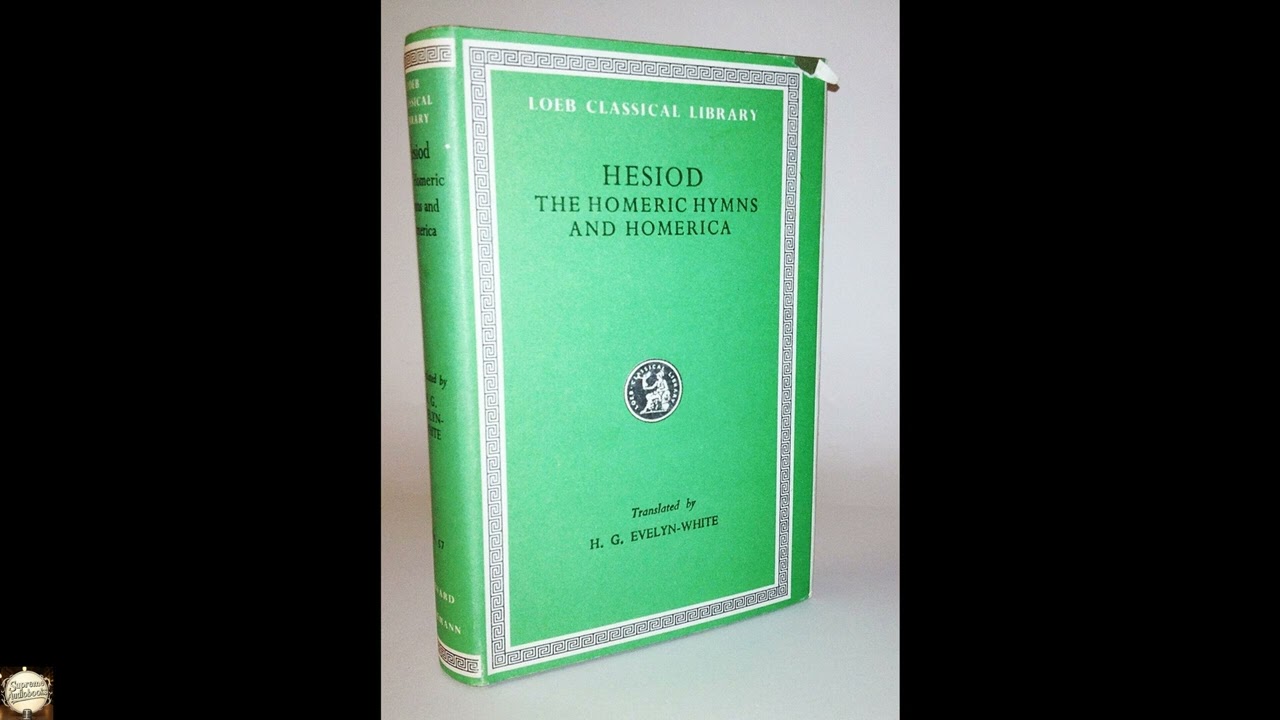
Hesiod, the Homeric Hymns, and Homerica (Loeb Classical Library #57) (English, Anci- Full Audiobook
Step into the crucible of Western civilization, a time when gods walked the earth, heroes shaped destinies, and the very fabric of the cosmos was being sung into existence. This collection, pairing the foundational verses of Hesiod with the resonant echoes of the Homeric Hymns and other early Greek epics, offers a direct portal to the creative dawn of European thought. Before philosophy solidified, before history was meticulously recorded, these poems were the wellsprings of understanding—explaining the origins of the world, the nature of divine power, and the complex human condition. Listening to these ancient voices is not merely a literary exercise; it is an encounter with the very bedrock of our shared cultural memory, a chance to hear the stories that first articulated humanity's place in a universe governed by powerful, often capricious, deities. Hesiod's Theogony unfolds as a sweeping narrative of creation, beginning with primordial Chaos and tracing the generations of gods, from Earth (Gaia) and Sky (Uranus) through the violent succession of Cronus and finally to the establishment of Zeus's cosmic order. It is an epic account of birth, struggle, and divine power, painting a vivid picture of Mount Olympus's volatile hierarchy and the powerful forces that shaped the world. Alongside this grand cosmic tale stands Works and Days, a more grounded and intensely personal poem addressed to Hesiod's brother, Perses. Here, the narrative shifts to the human realm, offering moral wisdom and practical advice for a life of honest labor and justice. This text interweaves didactic instructions on agriculture and seafaring with profound myths, such as the tale of Pandora's box—her release of ills upon humanity—and the progression of the five Ages of Man, detailing humanity's decline from a golden age to the current, arduous iron age. The collection then moves to the Homeric Hymns, a series of individual poems dedicated to specific Olympian gods, often recounting pivotal moments in their mythology. The longer hymns offer complete narratives in miniature. For instance, the Hymn to Demeter vividly portrays the goddess's desperate grief and furious search for her abducted daughter, Persephone, after Hades drags her to the underworld. This narrative details Demeter's withdrawal of fertility from the earth, causing widespread famine, and the subsequent divine intervention that leads to Persephone's seasonal return, thereby explaining the cycle of seasons and the Eleusinian Mysteries. Similarly, the Hymn to Apollo details the god's birth, his wanderings in search of a suitable place for his oracle, and the establishment of the famous sanctuary at Delphi. Other hymns, like those to Hermes, Aphrodite, and Dionysus, further flesh out the personality and exploits of the Olympian pantheon, often with humor, pathos, and divine grandeur. Finally, the "Homerica" section gathers fragments and summaries of other archaic Greek epics—known broadly as the Epic Cycle—which expanded upon the narratives of the Trojan War and its aftermath, providing glimpses into stories like the origins of the conflict or the arduous returns of other heroes, filling in the mythological gaps around the more famous Iliad and Odyssey. The question of authorship for these texts is complex, particularly for a collection spanning centuries of composition. Hesiod, in Works and Days, presents himself as a Boeotian shepherd from Ascra, divinely inspired by the Muses on Mount Helicon. He is often considered a near-contemporary of Homer, living perhaps in the 8th century BCE, representing a slightly different, more overtly didactic tradition of epic poetry. His work contrasts with Homer's heroic focus by providing moral instruction and detailing the lives of ordinary people, solidifying his place as a foundational voice in ancient Greek literature, the first identifiable author to grapple with the ethics of daily life and the cosmic order. The Homeric Hymns, despite their name, were not composed by Homer himself but by various poets over several centuries, from the Archaic to the early Classical periods (roughly 8th to 5th century BCE). They imitate the epic style and meter, serving as preludes or invocations often performed at festivals and public gatherings, demonstrating the widespread and evolving nature of Greek epic tradition beyond its most famous practitioners. The "Homerica" comprises remnants of lost epics from the broader "Epic Cycle," which were attributed to various poets and functioned to complete the grand mythological narrative arcs that Homer's works merely touched upon. These texts are preserved through fragments quoted by later authors and prose summaries, a testament to their enduring cultural importance even after their original forms vanished. The meticulous scholarship of the Loeb Classical Library, which presents these works with facing-page Greek text and English translation, ensures their accessibility and scholarly integrity for new generations of readers and listeners. Across these diverse poems, several overarching themes emerge with powerful clarity. One prominent theme is divine justice and retribution, particularly evident in Hesiod's Works and Days. He argues vehemently that Zeus oversees human affairs, rewarding the righteous and punishing the wicked, frequently through agricultural bounty or famine. The story of Pandora, who unleashes sorrows upon humankind as punishment for Prometheus's transgression, directly illustrates the consequences of challenging divine will. A second central theme is the origin and order of the cosmos. Hesiod's Theogony offers a systematic account of creation, establishing a hierarchy among the gods and explaining the genesis of the physical world. This narrative attempts to impose order on a universe that could otherwise seem chaotic, providing a mythological framework for understanding existence. A third significant theme, particularly evident in the Homeric Hymns, is the nature of divinity and its interaction with the mortal world. The gods are portrayed as immensely powerful, yet also possessing human-like emotions—anger, jealousy, love, and grief. Demeter's profound sorrow over Persephone's abduction, for instance, transforms the very earth, demonstrating the gods' immense power, but also their capacity for suffering and their complex engagement with human fates. The hymns also frequently enact the establishment of cults and rituals, showing how divine acts or pronouncements led directly to specific forms of worship or sacred sites, such as Apollo's oracle at Delphi. These poems were vital in shaping the Greeks' understanding of their religious practices and the mythological justifications behind them. The emergence of these works during the Greek Archaic Age, roughly from the 8th to the 6th centuries BCE, corresponds to a period of profound cultural and societal transformation. It was a time when the Greek city-states were coalescing, colonization was spreading Greek influence across the Mediterranean, and writing systems, particularly the adaptation of the Phoenician alphabet, were becoming more widespread. This era saw the transition from purely oral traditions to the increasing use of written texts, though oral performance remained central. These poems arose to fulfill a variety of crucial functions: they provided a shared mythological framework that unified disparate Greek communities, explained natural phenomena and human suffering, offered moral guidance, and served as entertainment during festivals and gatherings. They codified the prevailing religious beliefs and the genealogies of the gods, giving structure to the Greeks' understanding of their origins and their place in the world, effectively building a cultural memory for a burgeoning civilization. They were not merely stories; they were explanations, moral compasses, and communal touchstones in a rapidly developing world. Listening to this collection as an audiobook offers an unparalleled means of connecting with these ancient voices, as Greek epic poetry was fundamentally an oral art form, designed to be heard rather than silently read. A skilled narrator breathes life into the rhythmic meter and sonorous language, allowing the listener to appreciate the cadence and flow that were central to their original impact. The experience makes the grand genealogies of the gods in Hesiod's Theogony more digestible, the moral urgings of Works and Days more direct, and the dramatic narratives of the Homeric Hymns—like Demeter's lament or Apollo's majestic birth—resonate with their intended emotional power. The length of this audiobook provides ample opportunity for gradual immersion, allowing the ancient words and concepts to sink in over time. Pay close attention to how the narration delineates distinct voices, captures the awe-inspiring power of the gods, or delivers Hesiod's pragmatic advice, letting the atmosphere of ancient Greece unfold around you through the enduring power of the human voice.
Enjoyed Hesiod, the Homeric Hymns, and Homerica (Loeb Classical Library #57) (English, Anci- Full Audiobook? A few ways to support us
Audible & Amazon links are affiliate; we may earn a small commission at no extra cost.
About this production
Human narration by a volunteer reader from LibriVox.org, the public-domain audiobook project. LibriVox volunteers record literary works whose copyright has expired in the United States, releasing the resulting recordings into the public domain.
Hesiod, the Homeric Hymns, and Homerica (Loeb Classical Library #57) (English, Anci- Full Audiobook. The underlying text is in the U.S. public domain. We do not republish any modern copyrighted edition, translation, or commentary.
The 4K cinematic visuals accompanying this audiobook are generated by an AI image model from prompts derived from the source text. No copyrighted photos, paintings, or stock footage are used. AI generation is disclosed on every video on our YouTube channel as required by YouTube's altered/synthetic content policy.
English subtitles are transcribed from the LibriVox recording with OpenAI Whisper. Translations into the 11 other supported languages are produced by Meta's NLLB-200 neural translation model. No human translator's copyrighted translation is used.
Questions about sourcing or rights? See our DMCA & Sourcing policy or contact us.
Enjoyed this audiobook?
If you'd like to own a copy of Hesiod, the Homeric Hymns, and Homerica (Loeb Classical Library #57) (English, Anci- Full Audiobook or hear a professionally produced edition, the links below help support free audiobook production at no extra cost to you.
As an Amazon Associate we earn from qualifying purchases. Audible / print links are affiliate.
More by Unknown
Cyclopedia of Telephony & Telegraphy Vol. 1 A General Reference Work on Telephony
Frauds And Follies Of The Fathers: With A Review Of The Worth Of Their Testimony
Mohammedanism: Lectures On Its Origin, Its Religious And Political Growth And Its P