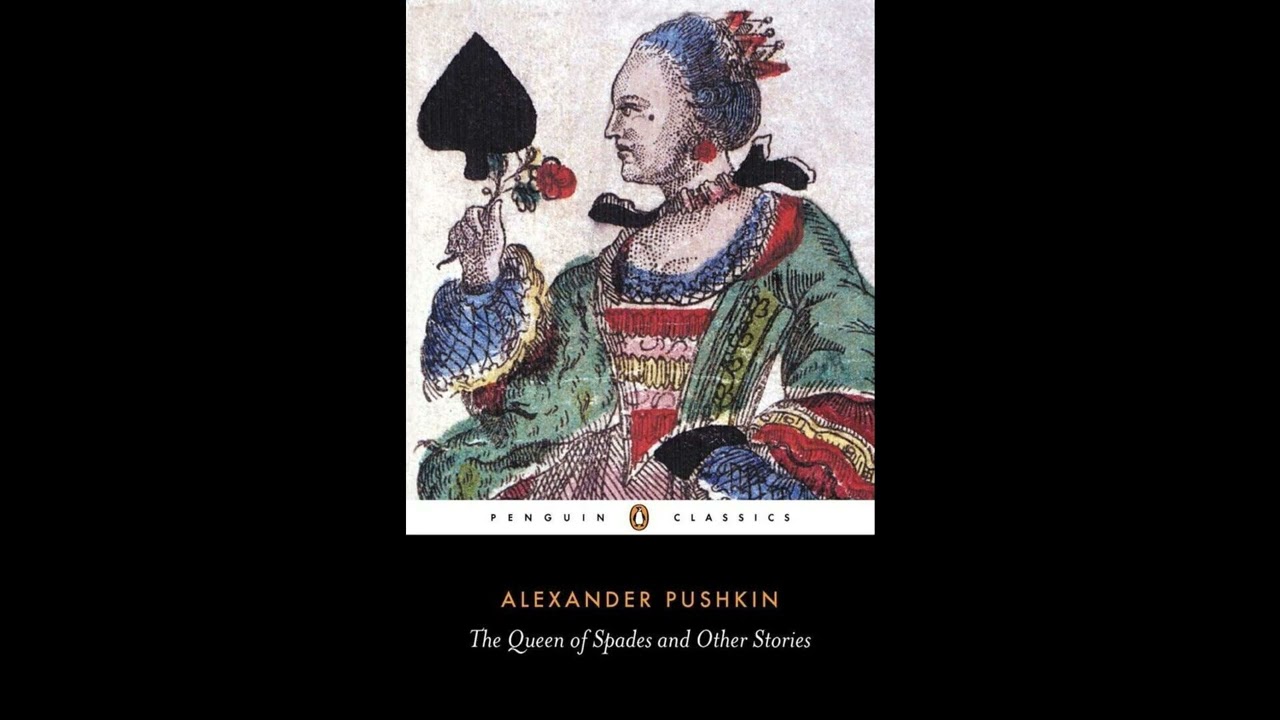
The Queen of Spades and Other Stories
Step into the grand, yet often unsettling, world of 19th-century Russia with Aleksandr Sergeevich Pushkin's The Queen of Spades and Other Stories. This collection showcases the astonishing range and piercing insight of the writer often considered the father of modern Russian literature. Far from being mere historical curiosities, these narratives — most notably the titular novella — speak with a voice that is astonishingly modern, delving into the human psyche with a precision that continues to resonate. Listeners will find themselves drawn into tales of ambition, illusion, and the shadowed corners of obsession, proving that Pushkin's understanding of our enduring flaws and follies remains as potent and relevant today as it was nearly two centuries ago. The centerpiece of this collection, "The Queen of Spades," transports us to the opulent, yet morally ambiguous, drawing rooms and gambling dens of St. Petersburg. Here, we meet Hermann, a young, ambitious military engineer of German descent, who observes the frenetic card games of his acquaintances but never plays himself, fearful of sacrificing his meager capital. He possesses a steely determination, a calculating mind, and a singular focus on achieving wealth and status. His carefully constructed detachment begins to crumble when he hears a whispered tale about the elderly Countess Anna Fedotovna, a woman who, in her youth, supposedly acquired a secret three-card sequence that guarantees a win, a secret she has never revealed. Hermann becomes consumed by this story, developing a monomaniacal fixation on extracting the secret from the Countess. He orchestrates a cold, manipulative plan, feigning affection for Lizaveta Ivanovna, the Countess's poor and isolated ward, to gain access to the old woman's closely guarded chambers. His pursuit is less a game of chance and more a siege of a hidden knowledge, blurring the lines between reason and superstition, between calculated risk and outright madness. As he draws closer to the Countess, the atmosphere thickens with a chilling tension, suggesting that the pursuit of such a perilous secret might carry consequences far beyond mere financial gain, challenging the very fabric of his sanity. Aleksandr Sergeevich Pushkin, born in Moscow in 1799, was a descendant of ancient noble families and African royalty, a heritage that infused his life and work with unique perspectives. His prodigious talent for poetry and prose manifested early, but his liberal views and satirical verses led to several exiles from St. Petersburg under the watchful eye of Tsar Alexander I and later Nicholas I. Despite or perhaps because of this constant friction with authority, Pushkin became the voice of his nation, shaping the modern Russian literary language and laying the groundwork for the titans who would follow. He authored the verse novel Eugene Onegin, the historical drama Boris Godunov, and the novel The Captain's Daughter, each cementing his reputation as a polymath of unparalleled skill. His life ended tragically in 1837, at the age of 37, during a duel fought to defend his wife's honor, an event that plunged Russia into mourning for its greatest poet. Pushkin's influence on Russian literature cannot be overstated; he is its sun, around whom all subsequent literary planets orbit. He fused elements of Romanticism with a distinctively Russian realism, creating a body of work that is both emotionally expansive and psychologically precise. His stories, including those in this collection, are celebrated for their concise elegance, their keen observation of human nature, and their ability to distill complex moral dilemmas into compelling narratives. He introduced a new vitality and clarity to Russian prose, moving beyond the ornate styles of earlier periods and establishing a vernacular that was both accessible and profound, creating a legacy that would inspire writers from Nikolai Gogol to Fyodor Dostoevsky and Leo Tolstoy. "The Queen of Spades" particularly illuminates several enduring themes. One prominent thread is the destructive nature of greed and obsession. Hermann's initial ambition transforms into a consuming mania, where the pursuit of the secret trumps all moral considerations. His calculated seduction of Lizaveta serves as a stark example of this, showing how he views people as mere instruments in his larger scheme. Another key theme is the interplay between fate and free will. The story toys with the idea that Hermann's destiny might be predetermined, perhaps by the supernatural forces hinted at, or conversely, that his choices, particularly his cold logic and subsequent breakdown, are entirely his own doing. The appearance of the Countess's spirit after her death blurs the line between a genuine spectral encounter and a manifestation of Hermann's psychological disintegration. The novella also functions as a social critique of St. Petersburg society, particularly its aristocracy. Pushkin subtly exposes the superficiality, the reliance on appearances, and the underlying moral corruption that often accompany wealth and status. The intense gambling scene, a common pastime of the era, serves not just as a plot device but as a commentary on the inherent risks and moral hazards embedded within the upper echelons of society. Lizaveta's vulnerable position as a dependent, hoping for a suitable marriage, further underscores the era's social stratifications and the limited agency available to women of her standing, creating a stark contrast with Hermann's ruthless pursuit of power. These stories emerged from a fascinating and tumultuous period in Russian history. The early 19th century was an era marked by Russia's emergence as a major European power following the Napoleonic Wars, but also by internal struggles with autocracy, serfdom, and a burgeoning intellectual class grappling with Western ideas. Under Tsar Nicholas I, censorship was severe, yet Pushkin found ways to imbue his narratives with subtle critiques and psychological depth, often using allegories or historical settings to convey contemporary anxieties. Gambling, particularly card games like faro, was rampant among the aristocracy, symbolizing both the thrill of chance and the potential for ruin, a perfect backdrop for exploring themes of ambition and downfall. This social milieu, with its strict hierarchies and hidden vices, provided fertile ground for Pushkin to examine the human condition under pressure. Listening to The Queen of Spades and Other Stories as an audiobook offers a uniquely immersive experience, allowing the listener to fully appreciate Pushkin's masterful prose and the suspenseful atmosphere he so skillfully crafts. A skilled narrator can bring out the escalating tension in Hermann's pursuit, the chilling detachment of his internal monologues, and the subtle nuances of dialogue that reveal character. The relatively modest run length makes these stories ideal for concentrated listening sessions, perhaps during a quiet evening, where one can be fully transported to Pushkin's St. Petersburg. Pay close attention to the pacing, which builds slowly towards its dramatic confrontations, and to the distinct voices that differentiate the calculating Hermann from the frail but formidable Countess, or the naive Lizaveta, all of which come alive through expert vocal performance. The atmospheric descriptions—the chill of the city, the hushed card rooms, the eerie silence of the Countess's mansion—gain an added dimension when conveyed through sound, deepening the psychological impact of Pushkin's unforgettable tales.
Enjoyed The Queen of Spades and Other Stories? A few ways to support us
Audible & Amazon links are affiliate; we may earn a small commission at no extra cost.
About this production
Human narration by a volunteer reader from LibriVox.org, the public-domain audiobook project. LibriVox volunteers record literary works whose copyright has expired in the United States, releasing the resulting recordings into the public domain.
The Queen of Spades and Other Stories by Aleksandr Sergeevich Pushkin. The underlying text is in the U.S. public domain. We do not republish any modern copyrighted edition, translation, or commentary.
The 4K cinematic visuals accompanying this audiobook are generated by an AI image model from prompts derived from the source text. No copyrighted photos, paintings, or stock footage are used. AI generation is disclosed on every video on our YouTube channel as required by YouTube's altered/synthetic content policy.
English subtitles are transcribed from the LibriVox recording with OpenAI Whisper. Translations into the 11 other supported languages are produced by Meta's NLLB-200 neural translation model. No human translator's copyrighted translation is used.
Questions about sourcing or rights? See our DMCA & Sourcing policy or contact us.
Enjoyed this audiobook?
If you'd like to own a copy of The Queen of Spades and Other Stories or hear a professionally produced edition, the links below help support free audiobook production at no extra cost to you.
As an Amazon Associate we earn from qualifying purchases. Audible / print links are affiliate.