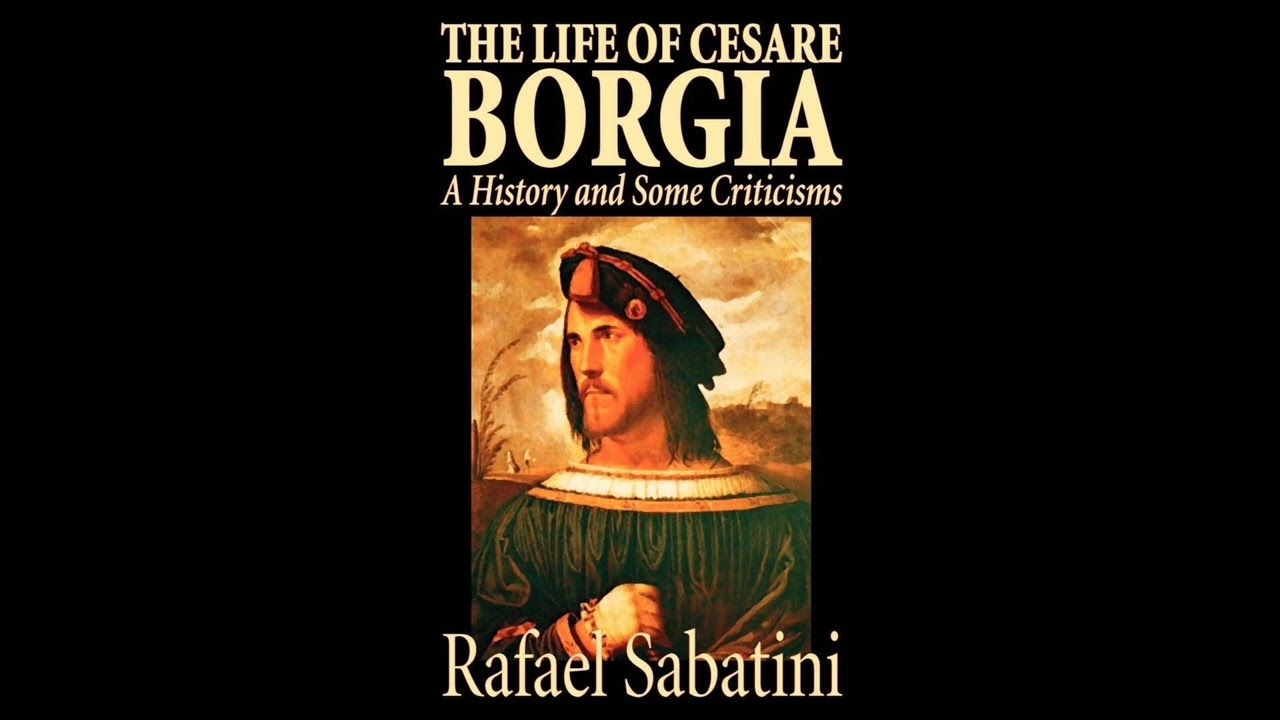
The Life of Cesare Borgia
The name Borgia still echoes with a certain dread, a whisper of ambition, ruthlessness, and scandal from the heart of the Italian Renaissance. Rafael Sabatini, a masterful teller of historical tales, takes on one of the most polarizing figures of this tumultuous era in his compelling biography, The Life of Cesare Borgia. This is not simply a dry recounting of facts; it is an investigation into the character and motivations of a man often painted as history's ultimate villain, prompting us to reconsider what we think we know about power, morality, and the forging of nations. For anyone fascinated by the cutthroat politics of the 15th and 16th centuries, by figures who dared to challenge the status quo, or by the enduring question of how far one can go in pursuit of a vision, this meticulously researched account offers a profound and challenging perspective that still resonates in our world of complex political leaders and moral ambiguities. Sabatini plunges listeners into the vibrant yet treacherous landscape of late 15th and early 16th century Italy, a patchwork of competing city-states, powerful noble families, and a papacy entangled in secular power struggles. At the center of this maelstrom stands Cesare Borgia, son of Rodrigo Borgia, who ascended to the papacy as Alexander VI. Initially groomed for an ecclesiastical career, Cesare soon shed his cardinal's robes to become a condottiero—a mercenary captain—and a formidable military and political leader. His primary objective, strongly supported by his papal father, was to consolidate the fragmented territories of central Italy, particularly the Romagna, into a unified, stable domain, free from the constant feuds of local lords. The story follows Cesare's meteoric rise, detailing his calculated military campaigns, his diplomatic maneuvers, and his often brutal methods to achieve his goals. Listeners witness him forging alliances, employing innovative military strategies, and ruthlessly eliminating rivals who stood in the way of his nascent state. From the strategic conquests in Romagna to his efforts to pacify rebellious cities, Cesare’s relentless drive for order and power is laid bare. Sabatini carefully sketches the political web surrounding him, introducing figures like the powerful Orsini and Colonna families, as well as the various French and Spanish forces whose shifting loyalties constantly threatened Cesare's precarious position. The narrative skillfully builds the tension of a man struggling to carve out a state from chaos, constantly battling both external enemies and internal betrayals, all while navigating the volatile currents of international politics and the ever-present threat of his family’s numerous adversaries. Rafael Sabatini himself was an author deeply immersed in the world of historical fiction, born in Jesi, Italy, in 1875, to Anglo-Italian parents. This unique heritage granted him fluency in multiple languages and a lifelong appreciation for the dramatic sweep of European history. He spent much of his life in England, where he became a prolific writer, known for his meticulous research and his ability to weave compelling narratives from historical fact. Before his passing in 1950, Sabatini produced a considerable body of work, including some of the most enduring historical adventure novels of the early 20th century. Among his most celebrated works are Scaramouche, a tale of the French Revolution, and The Sea-Hawk and Captain Blood, both swashbuckling sagas of piracy and adventure that have captivated generations of readers and have been adapted multiple times for film. Sabatini's distinctive literary style blended careful historical accuracy with a romantic flair, often presenting heroes and villains in shades of grey, challenging conventional perceptions. He distinguished himself by not merely recounting history but by bringing its figures to vivid life, inviting readers to question received wisdom and engage directly with the moral complexities of the past. His place in the literary canon rests on his skillful storytelling, his commitment to historical detail, and his ability to make distant eras feel immediate and relevant. One of the central themes that Sabatini brings to life in The Life of Cesare Borgia is the complex relationship between power and morality. Cesare, as portrayed here, is not simply a monster, but a pragmatist driven by a vision for a unified, stable Italy—a stark contrast to the warring factions of his time. Sabatini shows Cesare's ruthless actions, such as his decisive subjugation of rebellious lords in Romagna or his calculated eliminations of rivals like the Vitelli and Orsini at Senigallia, not as wanton cruelty but as necessary steps in consolidating power and establishing a lasting peace in his territories. This forces the listener to confront the difficult question of whether the ends can, at times, justify the means in statecraft, a debate famously articulated by Niccolò Machiavelli, who observed Cesare firsthand and drew inspiration from his methods. Another significant theme is the nature of historical revisionism and the challenge to established narratives. Sabatini consciously sets out to re-evaluate Cesare Borgia, a figure long demonized by history, especially in the wake of his family's downfall. He systematically dissects the contemporary accusations and later embellishments that contributed to Borgia's infamy, often demonstrating how political enemies and biased chroniclers exaggerated his vices while overlooking his administrative capabilities and strategic brilliance. For instance, Sabatini meticulously examines the common allegations of incest and fratricide against Cesare, presenting evidence and arguments that cast doubt on these sensational claims and suggesting they were often propaganda designed to discredit the Borgias. This approach encourages a critical examination of how history is written and how reputations are forged and destroyed. When Sabatini published The Life of Cesare Borgia in 1912, the world was on the cusp of profound change, though not yet fully aware of the cataclysm of World War I that loomed just two years later. Culturally, there was a significant appetite for historical narratives, especially those that offered adventure and challenged conventional thinking. The Edwardian era, following the long Victorian period, saw a loosening of some social strictures and a growing interest in more direct, less didactic forms of storytelling. Literary tastes were shifting, moving away from purely romanticized versions of history toward narratives that, while still dramatic, offered a deeper engagement with political realities and the psychological motivations of historical figures. Sabatini's work emerged in a climate where historical scholarship was becoming more rigorous, yet popular fiction still embraced the dramatic. His biography of Cesare Borgia resonated because it combined these elements: meticulous research, a willingness to confront historical myths, and a compelling, dramatic narrative style. It satisfied a public hunger for stories that were both educational and entertaining, allowing readers to step into the past and grapple with its complexities without being overwhelmed by academic dryness. His ability to fuse serious historical inquiry with an engaging storytelling voice ensured the book’s popular appeal, providing a fresh perspective on a figure many thought they already understood. Listening to The Life of Cesare Borgia as an audiobook offers a unique and immersive experience, particularly given the sheer length of several hours that allows for deep engagement with the period. A skilled narrator can bring Sabatini’s articulate, detailed prose to life, capturing the gravitas of political pronouncements, the tension of military maneuvers, and the nuanced portrayals of character that define this work. The measured pacing can underscore the strategic thought behind Cesare's actions, allowing listeners to absorb the intricacies of Renaissance Italian politics without feeling rushed. A good performance will emphasize the often-formal dialogue and the author's meticulous descriptions, creating a vivid sonic landscape of papal courts, battlefield councils, and hushed conspiracies. The spoken word adds a layer of immediacy to Sabatini’s re-evaluation of history, transforming what might otherwise be a dense historical study into a dramatic, persuasive retelling that fully honors the grand, often violent, spirit of the era.
Enjoyed The Life of Cesare Borgia? A few ways to support us
Audible & Amazon links are affiliate; we may earn a small commission at no extra cost.
About this production
Human narration by a volunteer reader from LibriVox.org, the public-domain audiobook project. LibriVox volunteers record literary works whose copyright has expired in the United States, releasing the resulting recordings into the public domain.
The Life of Cesare Borgia by Rafael Sabatini. The underlying text is in the U.S. public domain. We do not republish any modern copyrighted edition, translation, or commentary.
The 4K cinematic visuals accompanying this audiobook are generated by an AI image model from prompts derived from the source text. No copyrighted photos, paintings, or stock footage are used. AI generation is disclosed on every video on our YouTube channel as required by YouTube's altered/synthetic content policy.
English subtitles are transcribed from the LibriVox recording with OpenAI Whisper. Translations into the 11 other supported languages are produced by Meta's NLLB-200 neural translation model. No human translator's copyrighted translation is used.
Questions about sourcing or rights? See our DMCA & Sourcing policy or contact us.
Enjoyed this audiobook?
If you'd like to own a copy of The Life of Cesare Borgia or hear a professionally produced edition, the links below help support free audiobook production at no extra cost to you.
As an Amazon Associate we earn from qualifying purchases. Audible / print links are affiliate.