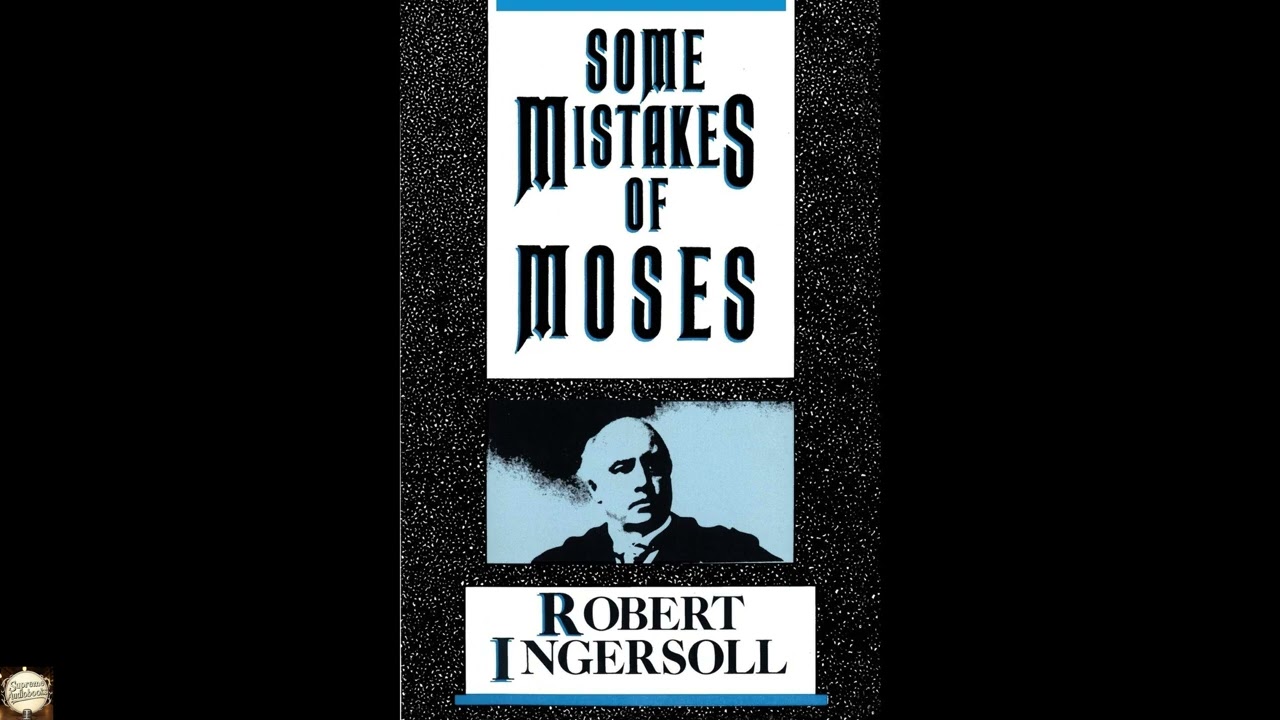
Some Mistakes of Moses
For over a century, Robert G. Ingersoll’s Some Mistakes of Moses has stood as a towering monument to intellectual honesty and the uncompromising application of reason to sacred texts. This foundational text of American freethought doesn't merely question; it rigorously dissects, using logic, humor, and burgeoning scientific understanding to challenge the literal interpretations of the Pentateuch. Why should a listener care about a nineteenth-century critique of ancient scripture today? Because its spirit of inquiry—its insistence on examining claims, however venerable, through the lens of evidence and ethics—remains profoundly relevant. In an age where discussions of faith, science, and morality continue to shape public discourse, Ingersoll offers a masterclass in critical thinking, inviting us to weigh tradition against the demands of compassion, knowledge, and an evolving human conscience. Ingersoll takes his audience on a meticulous, chapter-by-chapter examination of the first five books of the Old Testament, commonly attributed to Moses. The setting for this intellectual drama is the text itself, which Ingersoll holds up to a bright, unsparing light, scrutinizing its historical claims, its scientific pronouncements, and its ethical directives. The central conflict of the narrative pits the ancient, dogmatic worldview—represented by the literal biblical account—against the emerging rationalism and scientific discoveries of the modern era. Ingersoll, as the primary voice, acts as the sharp-witted attorney, presenting his case with a lawyer’s precision and a debater’s rhetorical flair. The arc of Ingersoll’s argument moves systematically through the biblical narrative, beginning with the Genesis account of creation. He questions the feasibility of a six-day creation in light of geological and astronomical evidence, then moves to the story of the Flood, assessing its global scale against known geographical and biological realities. His critique extends to the Exodus, where he scrutinizes the practicality of the miracles and the logistics of the desert wanderings. He devotes significant attention to the Mosaic laws and the ethical implications of actions attributed to God—such as the commands concerning violence, slavery, and the treatment of women. Rather than offering a devotional reading, Ingersoll presents an sustained argument, inviting listeners to consider whether the text, when interpreted literally, aligns with common sense, scientific observation, or a compassionate understanding of humanity. He never reveals a singular "twist," but instead builds a cumulative case against what he perceives as the errors and injustices embedded within traditional interpretations. Robert G. Ingersoll, often called "The Great Agnostic," was born in Dresden, New York, in 1833, the son of a Congregationalist minister known for his fiery abolitionist sermons. This upbringing in a household deeply engaged with moral and religious questions, coupled with a fiercely independent intellect, shaped Ingersoll into one of the most eloquent and persuasive voices of American freethought. Despite limited formal education, he became a successful lawyer, gaining admission to the bar in Illinois. His legal career eventually led him into politics, serving as Attorney General for Illinois, and later, he became a powerful orator on the national lecture circuit. Ingersoll's true calling, however, was public speaking and intellectual advocacy. His lectures drew massive crowds across the country, making him a household name in the late nineteenth century. Beyond Some Mistakes of Moses, his notable works include The Gods and Other Lectures, Vindication of Thomas Paine, and Why I Am An Agnostic, all of which cemented his reputation as a champion of reason, science, and secular humanism. He passed away in 1899, having left an indelible mark on American intellectual life, standing as a formidable figure who courageously challenged religious dogma and championed the right to independent thought in a deeply religious society. He remains a key figure in the history of rationalism and skepticism. At its core, Some Mistakes of Moses enacts a compelling dialogue between rationalism and religious dogma. Ingersoll meticulously weighs the Genesis account of creation against the emerging geological understanding of his era, demonstrating the glaring inconsistencies between a six-day earth and the vast epochs revealed by scientific observation. He asks, with an attorney’s precision, how such accounts can stand when pitted against empirical evidence. This method serves as a concrete example of his broader argument for prioritizing scientific inquiry over literal biblical interpretation. Secondly, the text functions as a powerful moral critique of scripture. Ingersoll does not shy away from questioning the ethical foundations of many biblical narratives and laws. For instance, he openly challenges the morality of passages that describe divine commands for violence against other peoples, or the stipulations regarding slavery, arguing that such directives are incompatible with a benevolent deity or a humane society. This bold questioning also champions intellectual freedom and skepticism. Ingersoll's very act of publishing and lecturing on this subject—in an era when religious orthodoxy held immense social sway—serves as an example of his commitment to the right to question all authority, including the most sacred. His arguments, often infused with wit and rhetorical flourish, encourage the listener to adopt an investigative stance, rather than passively accepting received wisdom. Finally, an underlying humanism permeates his arguments. He consistently appeals to human reason, compassion, and justice as benchmarks against which to measure the divine law. When discussing laws perceived as cruel or arbitrary, he implicitly argues for a human-centered morality that prioritizes kindness and fairness, even over what is presented as divine decree. Some Mistakes of Moses emerged from a period of profound intellectual ferment in post-Civil War America. The late nineteenth century witnessed rapid advancements in science, perhaps most notably Charles Darwin’s publication of On the Origin of Species in 1859, which fundamentally challenged traditional creation narratives. This era was marked by an intense cultural clash between scientific discovery and established religious beliefs. Ingersoll’s lectures and writings became immensely popular because they articulated the burgeoning skepticism and the questions many people harbored privately. His arguments provided a voice for those grappling with the implications of geology, astronomy, and biology on their faith. Politically, America was consolidating after the war, and while religious influence remained strong, there was an increasing space for public discourse on secular topics and scientific advancements. Ingersoll’s emergence as a celebrated orator during this time directly reflects the societal need for figures who could eloquently navigate and debate these new intellectual battlegrounds. Listening to Some Mistakes of Moses as an audiobook offers a direct connection to the electrifying power of Ingersoll’s original presentations. Ingersoll was, first and foremost, an orator of legendary skill, and his precise, often dramatic prose was designed to be heard. A skilled narrator brings his methodical arguments, his sharp wit, and his passionate conviction to life, allowing the listener to experience his critiques as they were originally intended—as persuasive, spoken performance. The several hours of listening provide a substantial yet digestible opportunity to engage deeply with his systematic deconstruction of biblical literalism. Listeners will find themselves drawn in by the pacing, which builds its case with a lawyerly deliberateness, punctuated by moments of cutting irony and insightful commentary, making the intellectual atmosphere vivid and compelling.
Enjoyed Some Mistakes of Moses? A few ways to support us
Audible & Amazon links are affiliate; we may earn a small commission at no extra cost.
About this production
Human narration by a volunteer reader from LibriVox.org, the public-domain audiobook project. LibriVox volunteers record literary works whose copyright has expired in the United States, releasing the resulting recordings into the public domain.
Some Mistakes of Moses by Robert G. Ingersoll. The underlying text is in the U.S. public domain. We do not republish any modern copyrighted edition, translation, or commentary.
The 4K cinematic visuals accompanying this audiobook are generated by an AI image model from prompts derived from the source text. No copyrighted photos, paintings, or stock footage are used. AI generation is disclosed on every video on our YouTube channel as required by YouTube's altered/synthetic content policy.
English subtitles are transcribed from the LibriVox recording with OpenAI Whisper. Translations into the 11 other supported languages are produced by Meta's NLLB-200 neural translation model. No human translator's copyrighted translation is used.
Questions about sourcing or rights? See our DMCA & Sourcing policy or contact us.
Enjoyed this audiobook?
If you'd like to own a copy of Some Mistakes of Moses or hear a professionally produced edition, the links below help support free audiobook production at no extra cost to you.
As an Amazon Associate we earn from qualifying purchases. Audible / print links are affiliate.
More Audiobooks
About the Holy Bible: A Lecture
A Lie Never Justifiable: A Study in Ethics
American Lutheranism Vindicated; or, Examination of the Lutheran Symbols, on Certain- Full Audiobook
The Autobiography of Frank G. Allen, Minister of the Gospel: and Selections from His- Full Audiobook