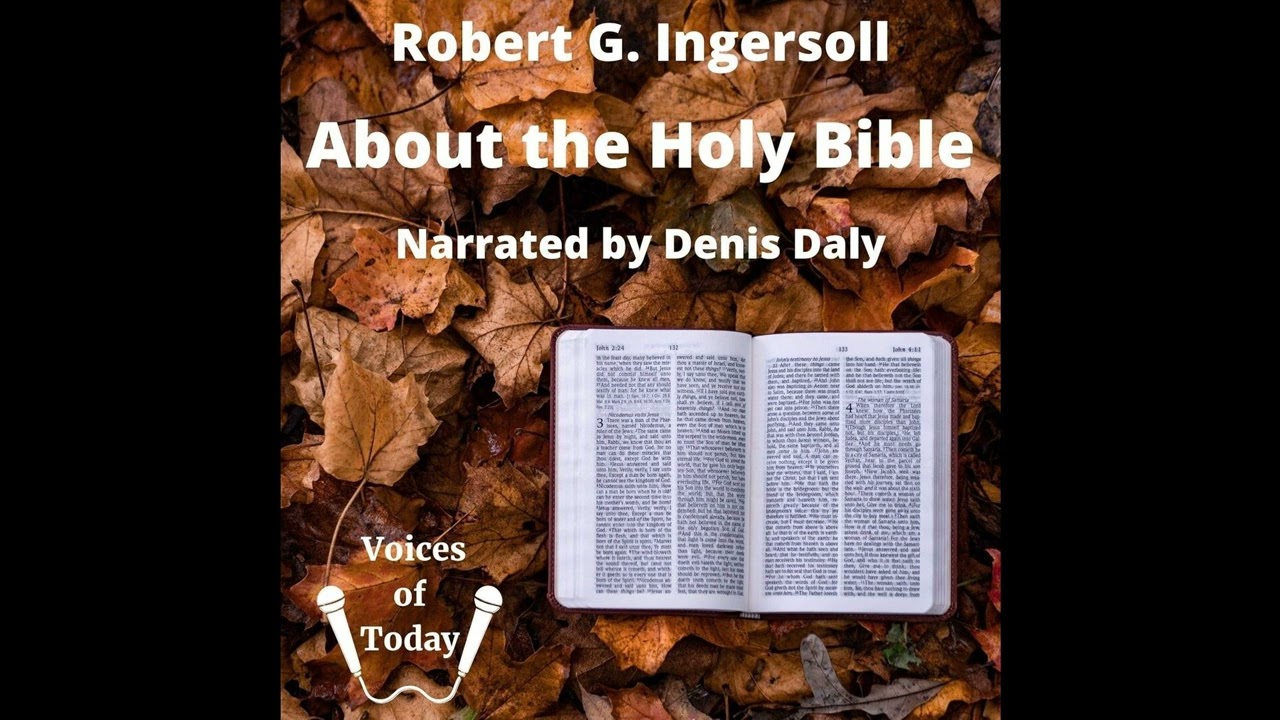
About the Holy Bible: A Lecture
Robert G. Ingersoll’s "About the Holy Bible: A Lecture" stands as a monumental address from a pivotal period in American intellectual history. This isn't a narrative in the traditional sense, but a powerful, meticulously constructed argument, delivered with the searing wit and profound humanism that defined its author. For anyone curious about the foundational texts of Western civilization, for those who question the intersection of faith and reason, or for listeners simply eager to hear a master orator dismantle long-held assumptions with both intellectual rigor and remarkable empathy, this spoken presentation remains as relevant and thought-provoking today as it was in the late nineteenth century. It’s a call to examine sacred texts not through the lens of unquestioning belief, but through the clear light of human reason and moral inquiry, inviting a personal engagement with complex ideas that continues to echo in contemporary discussions. As an intellectual drama, the lecture casts Robert Ingersoll himself as the central figure – a formidable, charismatic orator whose mission is to apply the tools of rational inquiry to the widely revered text of the Holy Bible. The stage is set within the cultural landscape of post-Civil War America, a time when traditional religious authority was immense, yet burgeoning scientific discovery and philosophical skepticism were beginning to challenge its dominance. Ingersoll's "plot" unfolds as a systematic, chapter-by-chapter, and often verse-by-verse examination of the Bible, beginning with the Old Testament. He walks his audience through the creation narratives, the stories of the Flood, the Exodus, and the various commandments, not as a believer seeking affirmation, but as a lawyer presenting his case before a jury, scrutinizing evidence, identifying contradictions, and questioning moral implications. The central conflict of this intellectual encounter is the clash between literal interpretations of the Bible, often presented as divinely inspired and infallible, and Ingersoll's unwavering commitment to logic, scientific understanding, and a human-centered morality. He points out what he perceives as inconsistencies in the historical accounts, scientific inaccuracies when measured against contemporary understanding, and ethical problems within the narratives and divine decrees. Ingersoll extends his critique beyond the Old Testament, bringing his analytical lens to bear on aspects of the New Testament as well, addressing issues of miracles, divine justice, and the character of God as presented in the scriptures. The arc of his argument builds relentlessly, guiding the listener through a comprehensive re-evaluation of the text, encouraging them to consider its contents with a fresh perspective, free from inherited dogma. Robert Green Ingersoll, born in Dresden, New York, in 1833, rose to prominence as "The Great Agnostic" of the nineteenth century. His early life saw him admitted to the bar and establishing a successful law practice in Illinois. The American Civil War interrupted his legal career, during which he served as a Union cavalry officer, commanding the 11th Illinois Volunteer Cavalry. His military service and subsequent foray into politics—serving as Attorney General of Illinois—provided him with a public platform, but it was his extraordinary oratorical skill and his unflinching embrace of freethought that cemented his place in history. He became arguably the most famous and influential public intellectual advocating for secularism and rationalism in America, touring extensively and delivering thousands of lectures to packed auditoriums across the country. Ingersoll's lectures, many of which were later published, challenged conventional religious beliefs with an eloquence and wit rarely matched. Works like "Mistakes of Moses," "Why I Am an Agnostic," and "The Gods" showcased his commitment to reason, science, and human progress. He was a passionate advocate for social justice, championing the rights of women, children, and African Americans at a time when such views were often unpopular. Despite significant opposition and ostracization from religious communities, Ingersoll never wavered from his principles, becoming a hero to those who valued intellectual freedom and a critic of dogmatic authority. His death in 1899 marked the end of an era, but his legacy as a champion of independent thought continues to resonate within the American intellectual canon. The lecture persuasively enacts several core themes, most notably the profound tension between reason and faith. Ingersoll systematically dissects biblical narratives, such as the creation story in Genesis or the detailed accounts of the Flood, by contrasting them with emerging scientific understanding and logical consistency. He doesn't merely dismiss these stories but meticulously highlights the perceived inconsistencies, anachronisms, and scientific impossibilities, arguing that such narratives cannot withstand rational scrutiny. Another central theme is humanism and morality. Ingersoll frequently critiques biblical passages that depict divine wrath, harsh punishments, or the subjugation of certain groups, arguing for a more compassionate, evidence-based ethical framework. He contrasts what he sees as the often-cruel morality expressed in parts of the Bible with an evolving human understanding of justice and kindness, advocating for an ethics rooted in human well-being rather than divine command. Further, the lecture powerfully exemplifies freedom of thought and skepticism. Ingersoll's entire approach serves as an invitation for his audience to question, to doubt, and to think independently rather than accept received wisdom without examination. He encourages a direct engagement with the text, unmediated by tradition or ecclesiastical authority, urging listeners to use their own intellects to evaluate its claims. Finally, the lecture is a masterclass in rhetoric and oratory. Ingersoll's command of language, his use of humor, satire, and carefully constructed arguments demonstrate the sheer power of the spoken word. His ability to build a compelling case, to move from textual analysis to broad philosophical implications, illustrates how persuasive argument, delivered with conviction and clarity, can challenge entrenched beliefs and inspire critical engagement. This lecture emerged during a particularly dynamic and often tumultuous period in American history. The late nineteenth century, often called the Gilded Age, was marked by rapid industrialization, vast economic disparities, and significant social upheaval. Scientifically, Charles Darwin's theories of evolution, though published decades earlier, continued to provoke fierce debate, directly challenging literal interpretations of creation. Philosophically, the rise of pragmatism and various forms of freethought were gaining traction, even as traditional Protestant evangelicalism remained a powerful cultural force. Ingersoll’s lectures provided a vital counterpoint to the prevailing religious orthodoxy, offering a secular perspective on morality, science, and the nature of belief. In this cultural milieu, questioning the Holy Bible publicly and systematically was a courageous, even radical act. Ingersoll spoke to a growing segment of the population that felt intellectually stifled by dogmatic religion, offering them a voice and a framework for their own doubts and questions. He was not merely an entertainer or an academic; he was a public intellectual shaping the discourse around science, religion, and ethics, helping to lay the groundwork for a more secular and pluralistic American society. His work spoke directly to the anxieties and aspirations of a nation grappling with modernity, seeking to reconcile ancient traditions with new knowledge and evolving moral sensibilities. Listening to "About the Holy Bible: A Lecture" as an audiobook allows the listener to experience Ingersoll's arguments in their most authentic form, as a direct address. Ingersoll was first and foremost an orator, and his words were crafted for the ear, designed to persuade and provoke from the stage. The several hours of runtime offer a sustained, immersive experience, inviting contemplation of each point as it unfolds. Pay close attention to the pacing of the narration, the inflection in the voice, and the subtle shifts in tone, as these elements are crucial to conveying Ingersoll's blend of intellectual authority, trenchant humor, and earnest humanitarianism. The spoken word allows his logical progressions, his rhetorical flourishes, and his passionate appeals to come alive, drawing the listener into the very moment of delivery, experiencing a powerful piece of American intellectual history firsthand.
Enjoyed About the Holy Bible: A Lecture? A few ways to support us
Audible & Amazon links are affiliate; we may earn a small commission at no extra cost.
About this production
Human narration by a volunteer reader from LibriVox.org, the public-domain audiobook project. LibriVox volunteers record literary works whose copyright has expired in the United States, releasing the resulting recordings into the public domain.
About the Holy Bible: A Lecture by Robert Ingersoll. The underlying text is in the U.S. public domain. We do not republish any modern copyrighted edition, translation, or commentary.
The 4K cinematic visuals accompanying this audiobook are generated by an AI image model from prompts derived from the source text. No copyrighted photos, paintings, or stock footage are used. AI generation is disclosed on every video on our YouTube channel as required by YouTube's altered/synthetic content policy.
English subtitles are transcribed from the LibriVox recording with OpenAI Whisper. Translations into the 11 other supported languages are produced by Meta's NLLB-200 neural translation model. No human translator's copyrighted translation is used.
Questions about sourcing or rights? See our DMCA & Sourcing policy or contact us.
Enjoyed this audiobook?
If you'd like to own a copy of About the Holy Bible: A Lecture or hear a professionally produced edition, the links below help support free audiobook production at no extra cost to you.
As an Amazon Associate we earn from qualifying purchases. Audible / print links are affiliate.