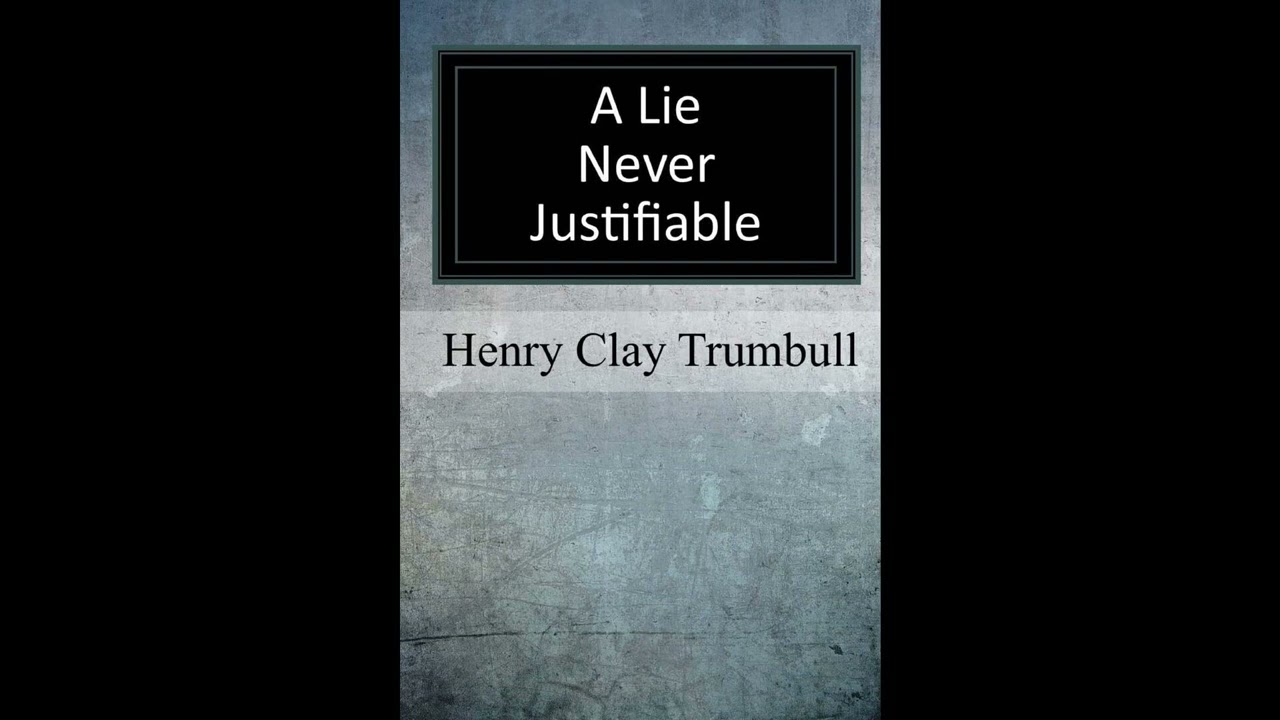
A Lie Never Justifiable: A Study in Ethics
Is there ever a circumstance, truly, when an untruth can be justified? This is the profound, unsettling question at the heart of Henry Clay Trumbull's A Lie Never Justifiable: A Study in Ethics. Far from a dusty academic treatise, this incisive work cuts directly to the core of human morality, challenging our comfortable rationalizations and forcing us to confront the true nature of honesty. In a world awash with misinformation, where the lines between fact and fiction blur, and where "alternative facts" often masquerade as truth, Trumbull's unwavering defense of an absolute ethical standard for truthfulness feels remarkably urgent and necessary. It invites a rigorous self-examination of our own daily ethical choices, prompting listeners to consider what foundational principles truly guide their words and actions in an increasingly complex modern age. Trumbull sets the stage by acknowledging the widespread human tendency to compromise on truth. We often encounter – and perhaps even participate in – situations where a lie seems like the easier, kinder, or even more expedient path. Perhaps it's a polite social untruth to avoid hurting feelings, a strategic misdirection to protect a secret, or a well-intentioned deception aimed at a perceived greater good. The intellectual landscape Trumbull navigates is rife with such scenarios, each presenting a moral dilemma where the intuitive response might be to bend the truth. His central conflict, then, is not external but deeply internal: the struggle between the appealing ease of situational ethics and the demanding rigidity of an uncompromising commitment to honesty. The book’s structure itself forms a compelling intellectual arc. Trumbull does not simply declare his position; he invites the listener into a methodical dismantling of every conceivable argument for justifying a lie. He methodically takes on common defenses: that a lie can save a life, preserve property, protect the innocent, or maintain social harmony. With each argument, he presents a counter-argument, often drawing on both philosophical reasoning and theological tenets. The listener is led through a rigorous thought process, moving from the initial premise that some lies might be permissible, through a series of logical steps, towards the conclusion that any deviation from truth carries significant, often unforeseen, moral and practical costs. The "story" here is the unfolding of a powerful ethical argument, challenging the listener to shed ingrained habits of thought and embrace a more demanding standard of integrity. Henry Clay Trumbull, born in Stonington, Connecticut, in 1833, was an influential American clergyman, author, and editor whose life spanned a period of immense social and intellectual change. After graduating from Yale and being ordained a Congregational minister, Trumbull served with distinction as a chaplain in the Union Army during the American Civil War. This personal experience on the front lines, witnessing both the profound sacrifices and moral compromises inherent in conflict, undoubtedly sharpened his ethical insights and strengthened his commitment to principles of integrity and truth. The exigencies of wartime—where deception could be a tactical tool and truth a casualty—would have provided a stark backdrop for his later ethical reflections. Following his military service, Trumbull dedicated many decades to religious education and publishing. He became the editor of The Sunday School Times, a prominent weekly publication, in 1875, a position he held until his death in 1903. Through this platform, and through a steady stream of books and articles, he became a leading voice in American Protestant thought, advocating for strong moral principles and the practical application of Christian ethics in daily life. His notable works include Kadesh-Barnea, a significant work of biblical scholarship, and numerous volumes on religious instruction and spiritual growth like Teaching and Teachers and Friendship the Master Passion. Trumbull’s prolific output cemented his place as a key figure in the late 19th-century religious and ethical discourse, shaping the moral compass of generations. One of the central themes that A Lie Never Justifiable enacts is the stark contrast between absolute truth and situational ethics. Trumbull adamantly argues that truth is not a flexible concept to be manipulated according to circumstances, but a bedrock principle. He might, for instance, examine the common scenario of a "white lie" told to a guest about their cooking; Trumbull would contend that even such a seemingly innocuous deception, while intended to be kind, subtly erodes the speaker's own commitment to honesty and the trust in the relationship. Another powerful theme is the inherently corrosive nature of deception. Trumbull shows how even a single untruth can necessitate a cascade of further lies to maintain the initial falsehood, leading to a tangled web that ultimately damages character and relationships. He might illustrate this by tracing how a small professional prevarication can escalate into a significant cover-up, demonstrating the spiraling consequences of departing from truth. The book also deeply underscores the divine mandate for honesty, grounding its ethical framework in Trumbull's religious convictions. For him, truth is not merely a human convention but a reflection of divine order, aligning human integrity with a higher moral authority. This perspective allows him to powerfully argue that God's immutable nature necessitates an unwavering human commitment to truth, rejecting any relativist interpretations. Furthermore, Trumbull brings to the fore the profound practical and social consequences of untruthfulness. He goes beyond the individual act, projecting how a society that tolerates "justifiable" lies risks the breakdown of public trust, the distortion of reality, and the degradation of collective moral fabric. He shows how the cost of a compromised truth far outweighs any perceived short-term gain. Trumbull’s work emerged from a specific cultural and intellectual milieu in late 19th-century America. This was a period of rapid industrialization, urbanization, and significant social upheaval following the Civil War, which spurred a renewed focus on individual character and societal morality. As traditional values were challenged by scientific advancements and evolving social structures, there was a palpable desire to define and reinforce clear ethical boundaries. Trumbull’s staunch moral absolutism stood as a powerful response to any burgeoning philosophical relativism, asserting a traditional, religiously informed moral order. His writings were part of a broader trend of didactic literature popular at the time, aimed at moral instruction and the cultivation of virtuous character in a rapidly changing world, reflecting the anxieties and aspirations of an era grappling with its ethical foundations. Listening to A Lie Never Justifiable: A Study in Ethics as an audiobook transforms a rigorous intellectual examination into an immersive experience. The precise, logical unfolding of Trumbull's arguments, moving from one ethical dilemma to the next, is significantly enhanced by a thoughtful narrator's voice. A skilled reader can guide you through the intricate reasoning, emphasizing the nuanced distinctions Trumbull draws and highlighting the compelling force of his convictions. The run length, measured in several hours, makes it an ideal companion for focused listening during commutes, long walks, or dedicated periods of contemplation. Listen for the narrator's pacing, which can underscore the gravity of Trumbull’s claims, allowing his systematic dismantling of justifications for lying to resonate with clarity and impact. The voice can bring out the passionate defense of truth, ensuring that what might otherwise be a dry topic becomes a potent, challenging intellectual engagement.
Enjoyed A Lie Never Justifiable: A Study in Ethics? A few ways to support us
Audible & Amazon links are affiliate; we may earn a small commission at no extra cost.
About this production
Human narration by a volunteer reader from LibriVox.org, the public-domain audiobook project. LibriVox volunteers record literary works whose copyright has expired in the United States, releasing the resulting recordings into the public domain.
A Lie Never Justifiable: A Study in Ethics by Henry Clay Trumbull. The underlying text is in the U.S. public domain. We do not republish any modern copyrighted edition, translation, or commentary.
The 4K cinematic visuals accompanying this audiobook are generated by an AI image model from prompts derived from the source text. No copyrighted photos, paintings, or stock footage are used. AI generation is disclosed on every video on our YouTube channel as required by YouTube's altered/synthetic content policy.
English subtitles are transcribed from the LibriVox recording with OpenAI Whisper. Translations into the 11 other supported languages are produced by Meta's NLLB-200 neural translation model. No human translator's copyrighted translation is used.
Questions about sourcing or rights? See our DMCA & Sourcing policy or contact us.
Enjoyed this audiobook?
If you'd like to own a copy of A Lie Never Justifiable: A Study in Ethics or hear a professionally produced edition, the links below help support free audiobook production at no extra cost to you.
As an Amazon Associate we earn from qualifying purchases. Audible / print links are affiliate.