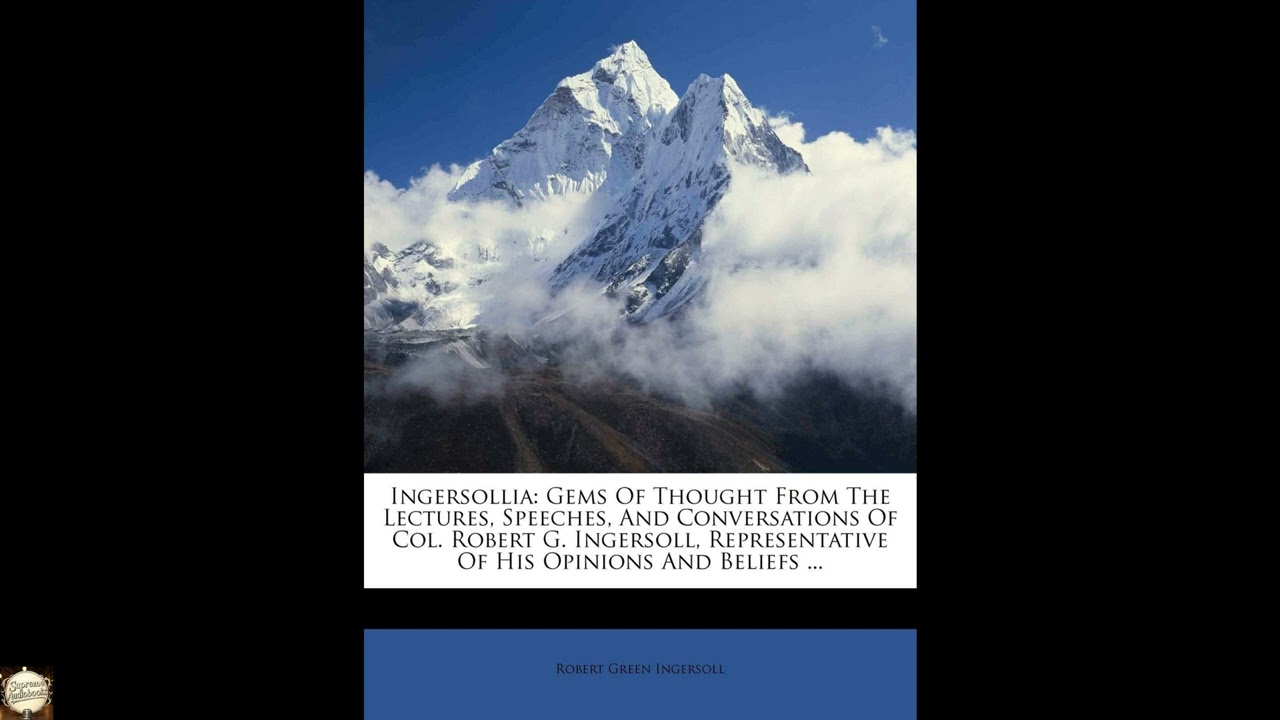
Ingersollia: Gems Of Thought From The Lectures, Speeches, And Conversations Of Col.
Among the intellectual giants of nineteenth-century America, Colonel Robert G. Ingersoll stands as a towering figure, celebrated and reviled in equal measure for his uncompromising advocacy of reason, humanism, and individual liberty. Ingersollia: Gems Of Thought From The Lectures, Speeches, And Conversations Of Col. offers an unparalleled window into the vibrant mind of this legendary orator, bringing together his most potent ideas and observations in a carefully curated collection. Far from being a mere historical curiosity, Ingersoll’s insights into faith, science, ethics, and the pursuit of happiness resonate profoundly in our contemporary world, where debates over the role of religion, the importance of critical thinking, and the foundations of a just society continue to shape our discourse. This assembly of his spoken brilliance invites listeners to engage with a thinker who dared to challenge the prevailing orthodoxies of his age, urging them toward a future built on compassion and intellectual honesty. This collection, rather than telling a linear story with fictional characters, presents a grand, sweeping intellectual panorama—a mosaic crafted from the distilled essence of Ingersoll's public life. Each "gem" functions as a self-contained exploration, yet collectively they reveal the coherent architecture of his philosophical framework. Listeners will find themselves transported to the bustling lecture halls and private discussions where Ingersoll held sway, his voice—even through the written word—leaping off the page with passionate conviction and sharp wit. The scope is breathtaking, moving from incisive critiques of biblical literalism and traditional religious doctrine to eloquent defenses of scientific progress and the inherent dignity of humanity. One might encounter a concise, devastating argument against the concept of eternal damnation, followed by a tender, poetic tribute to the beauty of earthly love and the wonder of the natural world. The central conflict animating these "gems" is the enduring struggle between dogma and doubt, between unexamined tradition and the relentless march of human inquiry. Ingersoll champions the human intellect as the ultimate arbiter of truth, urging his audiences to cast off the shackles of fear and superstition. He confronts the perceived threat of modern science head-on, positing it not as an enemy of morality but as its most reliable guide. The arc of this intellectual outpouring, therefore, is one of emancipation—the liberation of the mind from ancient prejudice, the elevation of human kindness above supernatural command, and the celebration of life lived fully and thoughtfully here and now. The listener is invited to witness this rhetorical battle, to feel the force of Ingersoll's arguments as he dismantles illogical premises and constructs, in their place, a vision of human flourishing grounded in empathy and reason. The intellect whose brilliance shines through these pages is that of Colonel Robert Green Ingersoll, born in 1833 in Dresden, New York, to a Congregationalist minister. From a young age, Ingersoll displayed a prodigious intellect and a burgeoning skepticism that would set him on a collision course with the religious establishment of his time. After a brief period as a schoolteacher, he read law and was admitted to the bar, quickly establishing a reputation as a formidable attorney. His service as a colonel in the Union Army during the American Civil War further forged his character, and upon returning to civilian life, he entered politics, serving as Attorney General of Illinois. However, it was his unparalleled oratorical skill that cemented his place in history, transforming him into a national sensation and earning him the moniker "The Great Agnostic." Ingersoll became the most famous—and infamous—public speaker of his era, traversing the country delivering lectures that captivated vast audiences. His speeches, which often ran for several hours, were meticulously crafted, blending profound philosophical arguments with sparkling wit, poetic flourish, and a disarming sincerity. He frequently spoke on topics that challenged the religious sensibilities of the day, delivering talks such as "The Mistakes of Moses," "Some Reasons Why I Am an Agnostic," and "Which Way?" His advocacy for agnosticism and his trenchant critiques of organized religion were deeply controversial, yet his personal integrity, his devotion to his family, and his unwavering commitment to civil liberties often won over even his harshest critics. He passed away in 1899, leaving behind a legacy of uncompromising intellectual honesty and a formidable body of work that continues to provoke and inspire. Two central themes pulse through Ingersollia. The first is the paramount importance of reason and scientific inquiry. Ingersoll consistently argues for the supremacy of human intellect and empirical observation over dogma and revelation. He critiques religious narratives not out of malice, but because he perceives them as hindering human progress and fostering fear. For instance, he systematically dissects biblical accounts, not to mock faith, but to demonstrate inconsistencies and urge listeners toward a fact-based understanding of the world. He champions figures like Charles Darwin and thinkers of the Enlightenment, seeing them as beacons leading humanity out of superstition and into an era of enlightenment, where truth is discovered through diligent investigation rather than accepted through blind faith. Another powerful theme is individual liberty and humanism. Ingersoll's entire philosophy pivots on the idea that each human being possesses inherent worth and the right to freedom of thought. He passionately advocates for the right to dissent, to question authority, and to live according to one's own conscience, provided it does no harm to others. His humanism is evident in his frequent calls for compassion, justice, and the amelioration of human suffering. He posits that morality does not descend from divine decree but arises from the inherent human capacity for empathy and the desire to create a better world for all. He consistently emphasizes the beauty and potential of life on Earth, suggesting that true fulfillment comes from human connection, creativity, and the pursuit of knowledge, rather than the promise of an afterlife. Ingersollia emerged from a uniquely fertile period in American history: the decades following the Civil War, known as the Gilded Age. This era was characterized by dramatic social, economic, and intellectual upheaval. Rapid industrialization transformed the country, while scientific advancements, most notably Darwin's theory of evolution, challenged long-held religious beliefs. "Higher criticism" of the Bible, imported from Germany, further eroded traditional interpretations of scripture, leading to widespread theological debate and anxiety. Against this backdrop, public lectures and debates were not merely entertainment; they were vital platforms for the dissemination of ideas, shaping public opinion and intellectual discourse. It was in this environment that Ingersoll’s voice became so compelling and necessary. As America grappled with modernity, questioning old traditions and searching for new foundations, Ingersoll provided a bold, articulate alternative to conventional religious narratives. He offered a secular humanism that celebrated progress, championed individual freedom, and sought to build a moral society on earthly, rather than heavenly, foundations. His eloquence and intellectual fearlessness made him a galvanizing force, both for those who found solace in his views and for those who vehemently opposed them, thereby cementing his indelible mark on American cultural and intellectual history. To truly appreciate the power of Colonel Ingersoll's arguments, listening to Ingersollia as an audiobook is the ideal format. Ingersoll was, first and foremost, an orator—his words were crafted to be spoken, to resonate in the air, to stir the emotions and intellect of a live audience. A skilled narrator breathes new life into these "gems," allowing the listener to experience the rhythm, the cadence, and the rhetorical force that made Ingersoll such a captivating figure. The approximately several hours of content allow for an immersive experience, whether consumed in a single, focused session or savored over multiple listens, revealing the nuanced layers of his wit, passion, and profound conviction. The subtle inflections of voice can highlight his irony, underscore his tenderness, or amplify the thunder of his indignation, drawing listeners directly into the intellectual arena where Ingersoll once held court.
Enjoyed Ingersollia: Gems Of Thought From The Lectures, Speeches, And Conversations Of Col.? A few ways to support us
Audible & Amazon links are affiliate; we may earn a small commission at no extra cost.
About this production
Human narration by a volunteer reader from LibriVox.org, the public-domain audiobook project. LibriVox volunteers record literary works whose copyright has expired in the United States, releasing the resulting recordings into the public domain.
Ingersollia: Gems Of Thought From The Lectures, Speeches, And Conversations Of Col. by Robert Green Ingersoll. The underlying text is in the U.S. public domain. We do not republish any modern copyrighted edition, translation, or commentary.
The 4K cinematic visuals accompanying this audiobook are generated by an AI image model from prompts derived from the source text. No copyrighted photos, paintings, or stock footage are used. AI generation is disclosed on every video on our YouTube channel as required by YouTube's altered/synthetic content policy.
English subtitles are transcribed from the LibriVox recording with OpenAI Whisper. Translations into the 11 other supported languages are produced by Meta's NLLB-200 neural translation model. No human translator's copyrighted translation is used.
Questions about sourcing or rights? See our DMCA & Sourcing policy or contact us.
Enjoyed this audiobook?
If you'd like to own a copy of Ingersollia: Gems Of Thought From The Lectures, Speeches, And Conversations Of Col. or hear a professionally produced edition, the links below help support free audiobook production at no extra cost to you.
As an Amazon Associate we earn from qualifying purchases. Audible / print links are affiliate.