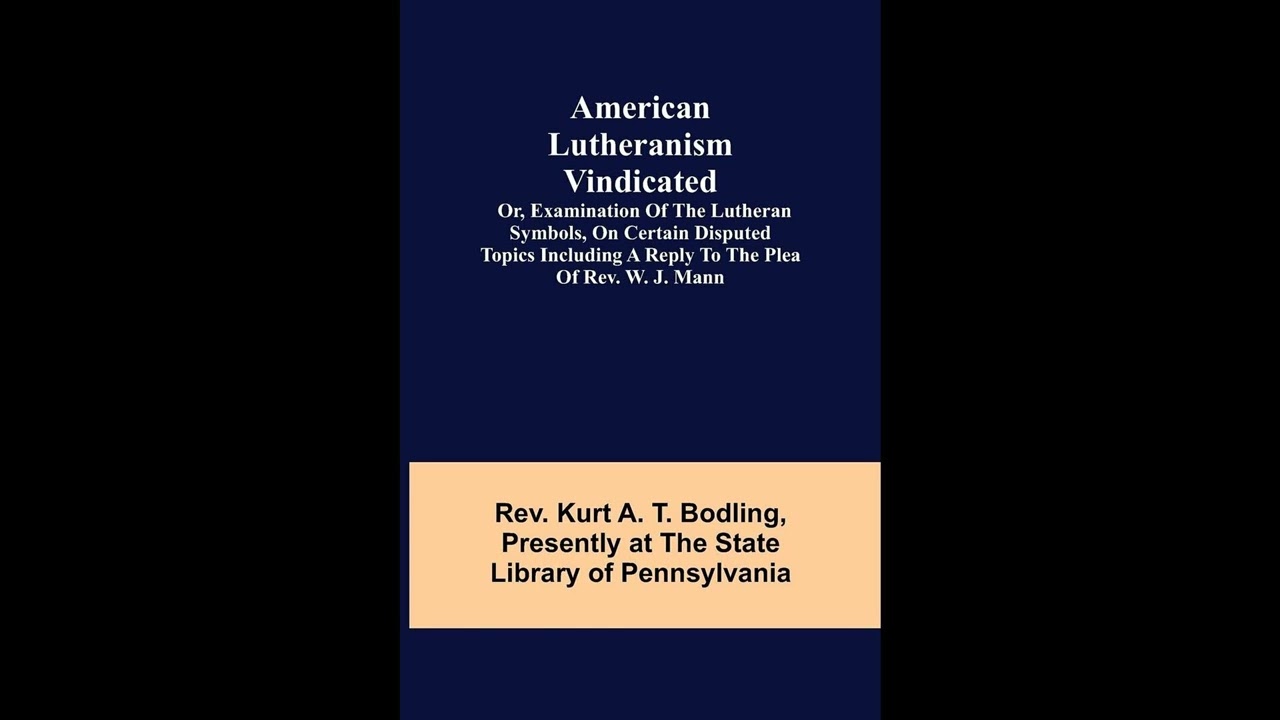
American Lutheranism Vindicated; or, Examination of the Lutheran Symbols, on Certain- Full Audiobook
Certain texts transcend the immediate moment of their creation, not merely as historical artifacts, but as living voices speaking to enduring questions. Such a work is American Lutheranism Vindicated; or, Examination of the Lutheran Symbols, on Certain-, a foundational statement that plunges listeners into the intellectual heart of a significant American religious tradition. This audiobook is more than a dusty theological tome; it stands as a testament to the passionate debates that shaped religious identity in the United States, offering an unparalleled view into how a faith community articulates, defends, and understands itself in the crucible of a new nation. For anyone seeking to grasp the foundational arguments behind American Lutheranism, or indeed, the broader dynamics of denominational self-definition, this extended analysis offers both clarity and compelling historical resonance, illuminating the enduring quest for theological coherence amidst a changing world. The text unfolds not as a narrative of individuals, but as a meticulously constructed argument, presenting a sustained intellectual campaign to clarify and defend the theological bedrock of American Lutheranism. The "setting" for this work is the dynamic intellectual and spiritual landscape where diverse Protestant traditions grappled for identity and influence. The central "characters" are, in essence, the Lutheran Symbols themselves—the authoritative confessional documents collected in the Book of Concord, such as the Augsburg Confession, the Apology of the Augsburg Confession, the Smalcald Articles, Luther's Small and Large Catechisms, and the Formula of Concord. The anonymous author, acting as an erudite advocate, introduces these symbols not merely as historical documents but as living expressions of a coherent theological system, setting the stage for their systematic defense. The central conflict animating this extended examination arises from perceived misunderstandings, misrepresentations, or challenges to American Lutheran identity and doctrine. The author takes on the task of rectifying these perceptions, engaging with both internal disputes within Lutheranism and external criticisms from other Protestant bodies or intellectual currents of the day. The argumentative arc proceeds through a comprehensive, section-by-section analysis of key doctrinal points—from the nature of God and Christology to justification by faith, the sacraments, and the role of the Law and Gospel. Each symbol is presented, its historical context briefly outlined, and its specific theological affirmations rigorously examined against potential misinterpretations. The goal throughout is a careful exposition, demonstrating the internal consistency and scriptural fidelity of the Lutheran position, fostering a deep appreciation for the confessional tradition without revealing the final cumulative affirmation that marks the text's conclusion. The author of American Lutheranism Vindicated remains unknown, a common occurrence for certain theological or polemical works published in periods when the message often outweighed individual attribution, or when a collective institutional voice was preferred. While we lack specific biographical details, the depth and breadth of theological knowledge displayed throughout the examination of the Lutheran Symbols point to an individual or group deeply versed in confessional Lutheran theology, church history, and the wider Protestant dogmatic landscape. This person or persons would have been highly educated, likely a theologian, pastor, or professor committed to the confessional renewal or consolidation of American Lutheranism. The very nature of the title, with its focus on "vindication," suggests a context where Lutheran identity was either under internal pressure to adapt or external scrutiny from other denominations or secular thought. Given the title's implications, this work likely emerged from a period of significant confessional ferment, perhaps in the 19th or early 20th century, when American Protestantism was consolidating and various denominations were defining their unique contributions and boundaries. The anonymous authorship allows the arguments to stand on their own merit, lending an air of institutional authority rather than individual opinion, a strategic choice that enhances the gravity of the "vindication." This approach aligns with the spirit of the Lutheran Symbols themselves, which were the product of collaborative theological effort and consensus rather than single authorship, representing the collective faith of a church body. The work thus stands as a significant historical artifact, representing a distinct phase in the formation of American religious identity, even without a named author. Among the several profound themes woven into the fabric of this comprehensive textual examination, theological defense stands out as paramount. The author’s painstaking work to clarify the Lutheran Symbols serves as a primer in apologetics—the art of articulating and defending one’s faith tradition. For instance, the detailed discussion on the doctrine of justification by faith alone, as found in the Augsburg Confession, does not merely state the position but anticipates and refutes counter-arguments from Roman Catholicism and various Reformed traditions, demonstrating how the text carefully delineates the nuanced Lutheran understanding. A related theme is the formation of religious identity. The book meticulously distinguishes "American Lutheranism" not just as a geographically situated variant, but as a robust confessional tradition capable of standing distinct in a religiously diverse nation, showing how its theological commitments shape its communal self-understanding. Furthermore, the work offers a profound lesson in hermeneutics, the theory and practice of interpretation. The author consistently refers back to the original intent and historical context of the Symbols, arguing against interpretations that might dilute or distort their meaning. For example, when discussing the Sacrament of the Altar, the text carefully examines the language of the Formula of Concord to affirm the real presence of Christ, contrasting this with various symbolic or memorialist views. This meticulous textual engagement exemplifies a dedication to interpreting sacred and confessional texts with precision and historical awareness. Finally, the tension between tradition and adaptation emerges as an underlying theme. The "vindication" itself implies a need to uphold enduring theological truths in the face of contemporary challenges, showcasing how a historic faith seeks to maintain its integrity while engaging with new intellectual or cultural landscapes, making a case for the continued relevance of established doctrine. The context for American Lutheranism Vindicated would have been a vibrant, often contentious period in American religious history. The 19th century, particularly after waves of German and Scandinavian immigration, saw a significant expansion of Lutheranism in the United States, alongside the proliferation of other Protestant denominations. This growth necessitated a clear articulation of Lutheran identity, distinguishing it from pietistic movements, various forms of revivalism, and other confessional traditions. Debates over confessional subscription—the degree to which pastors and congregations were bound by the historic Lutheran Symbols—were common. This work likely emerged from a robust confessional movement that sought to reassert classical Lutheran orthodoxy against perceived theological liberalism, indifferentism, or pressures to assimilate into a broader American Protestant evangelicalism. It was a time when religious texts were not only sermons and devotional guides but also intellectual weapons in the ongoing battle for theological definition and denominational distinctiveness, making the emergence of a text dedicated to "vindication" both timely and strategically important for the burgeoning American Lutheran church. Listening to American Lutheranism Vindicated as an audiobook offers a singular opportunity to engage directly with its weighty arguments. The extended run length, encompassing several hours, allows for a sustained, immersive experience, inviting listeners to absorb the meticulous argumentation without the visual distraction of dense prose on a page. Listen for the clarity and precision in the narrator's voice, which becomes the conduit for the author's carefully constructed points, allowing complex theological concepts to unfold with greater intelligibility. The pacing is crucial here, as the narrator guides you through the methodical examination of each confessional article, building the overall case with a measured rhythm. Pay attention to how the voice brings out the subtle nuances in the theological language, the cadences of intellectual discourse, and the underlying conviction in the defense of core beliefs. This oral presentation transforms what could be a challenging read into an accessible, compelling intellectual encounter, allowing the historical significance and enduring theological relevance of the work to truly resonate.
Enjoyed American Lutheranism Vindicated; or, Examination of the Lutheran Symbols, on Certain- Full Audiobook? A few ways to support us
Audible & Amazon links are affiliate; we may earn a small commission at no extra cost.
About this production
Human narration by a volunteer reader from LibriVox.org, the public-domain audiobook project. LibriVox volunteers record literary works whose copyright has expired in the United States, releasing the resulting recordings into the public domain.
American Lutheranism Vindicated; or, Examination of the Lutheran Symbols, on Certain- Full Audiobook by Samuel Simon Schmucker. The underlying text is in the U.S. public domain. We do not republish any modern copyrighted edition, translation, or commentary.
The 4K cinematic visuals accompanying this audiobook are generated by an AI image model from prompts derived from the source text. No copyrighted photos, paintings, or stock footage are used. AI generation is disclosed on every video on our YouTube channel as required by YouTube's altered/synthetic content policy.
English subtitles are transcribed from the LibriVox recording with OpenAI Whisper. Translations into the 11 other supported languages are produced by Meta's NLLB-200 neural translation model. No human translator's copyrighted translation is used.
Questions about sourcing or rights? See our DMCA & Sourcing policy or contact us.
View 10 famous quotes from this book →
Enjoyed this audiobook?
If you'd like to own a copy of American Lutheranism Vindicated; or, Examination of the Lutheran Symbols, on Certain- Full Audiobook or hear a professionally produced edition, the links below help support free audiobook production at no extra cost to you.
As an Amazon Associate we earn from qualifying purchases. Audible / print links are affiliate.