Sixty years with Plymouth Church
Stephen Morrell Griswold’s Sixty years with Plymouth Church offers listeners far more than a mere institutional history; it is an intimate, firsthand account of a foundational American church and its community during a transformative period, stretching from the antebellum era through the Progressive Age. This audiobook serves as a personal memoir, a social chronicle, and a compelling window into the moral and cultural currents that shaped modern America. For anyone seeking to understand the intersection of faith, social reform, and community building in the wake of the Civil War, or simply to immerse themselves in the rich texture of life in old Brooklyn, Griswold provides an invaluable perspective, rendered with the warmth and detail of a long-standing observer. His observations illuminate how local institutions became vital centers for national discourse and change. The narrative unfolds across six decades within the hallowed walls and bustling streets surrounding Plymouth Church in Brooklyn, New York. Beginning in the mid-19th century, just as the nation braced for its greatest internal conflict, Griswold introduces a community galvanized by fervent faith and an unwavering commitment to social justice. The central "character," beyond Griswold himself, is the church as a living entity—a spiritual home, a political forum, and a social anchor for its congregants. Listeners witness the rise to prominence of its legendary pastor, Henry Ward Beecher, whose powerful sermons and controversial stances on abolition, women's suffrage, and temperance made the church a national touchstone. Griswold paints a picture of a congregation that was not merely passive attendees, but active participants in the moral struggles of their time, from aiding fugitive slaves through the Underground Railroad to championing progressive ideals. As the years pass, the account follows the ebb and flow of the church’s influence and the evolution of its mission. The "plot" here is the unfolding of American history through the lens of a Brooklyn institution. We see the dramatic shifts brought by the Civil War, the challenges of Reconstruction, and the rapid urbanization and industrialization of the Gilded Age. Griswold’s chronicle presents not a simple hagiography, but a nuanced portrayal of an institution grappling with internal controversies and external pressures, striving to maintain its moral compass amidst changing social mores. He details the daily life of the church—its Sunday services, prayer meetings, charitable endeavors, and the personal relationships that bound its members together—creating a vivid tableau of community life that feels both historically distant and surprisingly relatable. Stephen Morrell Griswold, born in Albany, New York, in 1834, lived a life deeply intertwined with the civic and religious fabric of Brooklyn. A lawyer by profession, he also held significant public office, serving as Postmaster of Brooklyn and as a member of the New York State Assembly. These roles placed him squarely in the midst of the burgeoning political and economic life of one of America's most dynamic cities. His connection to Plymouth Church was not merely as an observer but as a devoted, long-standing member, giving him an insider's view that few could match. Griswold died in 1913, making Sixty years with Plymouth Church a posthumous reflection or one published very late in his life, distilling a lifetime of memory and observation into a cohesive narrative. Griswold's perspective is therefore unique: that of an educated, civically engaged layman who witnessed and participated in the events he describes. He was not a theologian or a professional historian in the academic sense, but a man of affairs and faith, whose prose is marked by clarity, personal anecdote, and a deep appreciation for the people and principles that defined Plymouth Church. While he may not occupy a place in the traditional literary canon as a novelist or poet, his memoir stands as an indispensable primary source, offering unparalleled insights into the social history, religious culture, and political activism of the late 19th and early 20th centuries. It is a testament to the power of personal testimony in illuminating broader historical trends. One of the central themes that emerges from Griswold’s account is the profound connection between faith and social activism. Plymouth Church, under Beecher's fiery leadership, was not content with abstract piety; it was a hotbed of abolitionist fervor, actively sheltering fugitive slaves and campaigning vigorously against the institution of slavery. Griswold describes scenes of passionate sermons that stirred congregants to action, and concrete examples of the church's role in the Underground Railroad, illustrating how religious conviction translated directly into daring social change. Another prominent theme is the enduring power of community and institutional memory. Griswold shows how a church functions as a sustained social organism, adapting to new challenges while preserving core values and traditions. He portrays the long-serving members, the evolving roles of various committees, and the shared rituals that forged a collective identity over generations, creating a sense of continuity even amidst rapid societal upheaval. The book also demonstrates the shifting landscape of American society through the lens of a local institution. As Brooklyn transformed from a growing town into a bustling urban center, Plymouth Church adapted its ministries and outreach, reflecting the challenges of industrialization, immigration, and the Gilded Age's stark social inequalities. Griswold details the church’s efforts in charitable work, its role in public education, and its engagement with emerging social issues, illustrating how a religious body could remain relevant and impactful in a rapidly modernizing nation. Finally, the power of oratory and the pulpit stands as a significant element. Griswold’s vivid descriptions of Henry Ward Beecher’s sermons — their eloquence, their emotional impact, and their ability to sway public opinion — reveal the central role of powerful rhetoric in 19th-century American culture, both within the church and in the broader civic arena. The era in which Griswold compiled his memories and likely published this work, spanning the late 19th and early 20th centuries, was a crucible of change for America. Following the trauma of the Civil War, the nation plunged into Reconstruction, followed by the frenetic industrial expansion of the Gilded Age. This period saw immense economic growth alongside burgeoning social inequalities, fueling the rise of progressive movements aimed at reform. Culturally, America was wrestling with evolving moral codes, the impact of scientific advancement, and the challenge of integrating vast waves of immigrants. Plymouth Church, born of antebellum reform zeal, found itself a spiritual and social beacon in this tumultuous environment. Griswold’s book emerged as a reflection on a generation that had witnessed monumental shifts, offering a historical perspective on the enduring influence of faith-based activism and community building amidst the pressures of a new century. It speaks to a moment when Americans looked back at the moral courage of previous generations while grappling with new challenges to their ideals. Listening to Sixty years with Plymouth Church as an audiobook allows the listener to fully appreciate the personal and reflective quality of Griswold's prose. The narration brings a steady, measured pace to his historical observations and anecdotes, making the "several hours" run length feel like a natural conversation with an elder statesman. The careful modulation of voice can highlight the dignity and gravity of the historical events described, from the intensity of abolitionist rallies to the quiet solemnity of Sunday services. Listen for the subtle shifts in tone as Griswold recounts moments of triumph, controversy, and enduring faith. The spoken word imbues his descriptions of 19th-century Brooklyn, the dynamic personality of Henry Ward Beecher, and the collective spirit of the congregation with an immediate, immersive atmosphere, transporting listeners directly into the heart of a pivotal American institution during a crucial epoch.
Enjoyed Sixty years with Plymouth Church? A few ways to support us
Audible & Amazon links are affiliate; we may earn a small commission at no extra cost.
About this production
Human narration by a volunteer reader from LibriVox.org, the public-domain audiobook project. LibriVox volunteers record literary works whose copyright has expired in the United States, releasing the resulting recordings into the public domain.
Sixty years with Plymouth Church by Stephen Morrell Griswold. The underlying text is in the U.S. public domain. We do not republish any modern copyrighted edition, translation, or commentary.
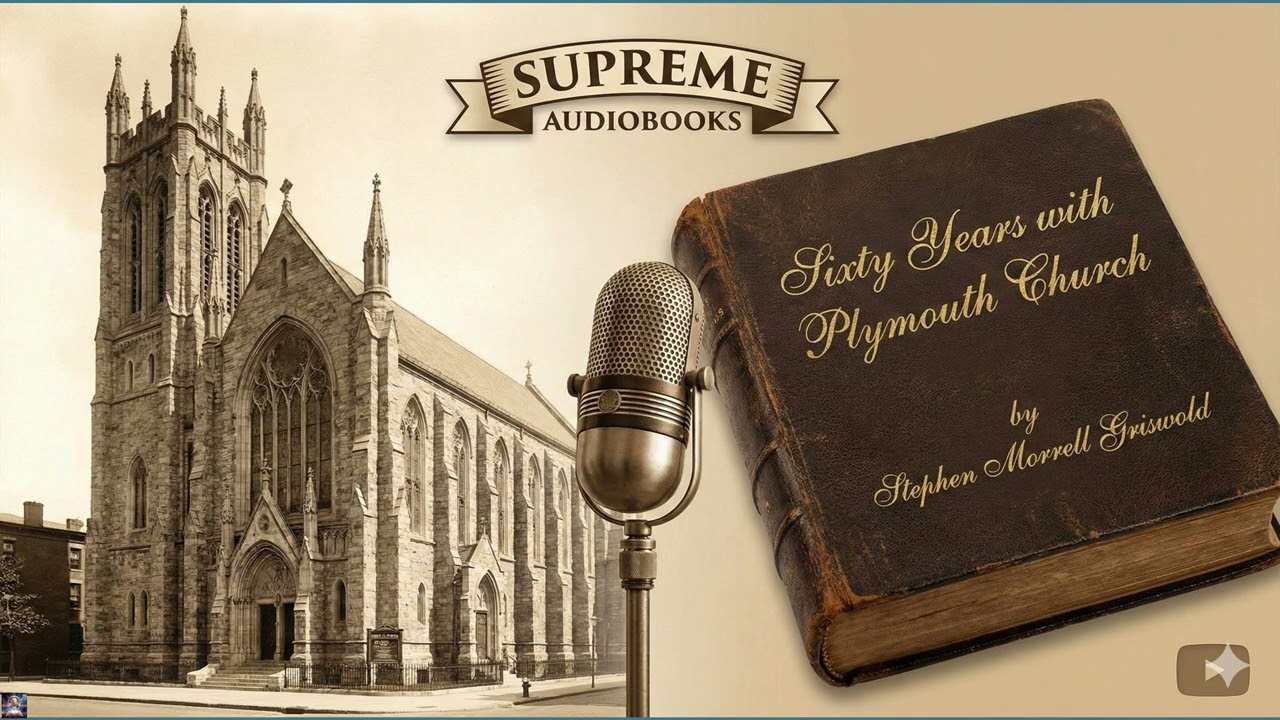
The 4K cinematic visuals accompanying this audiobook are generated by an AI image model from prompts derived from the source text. No copyrighted photos, paintings, or stock footage are used. AI generation is disclosed on every video on our YouTube channel as required by YouTube's altered/synthetic content policy.
English subtitles are transcribed from the LibriVox recording with OpenAI Whisper. Translations into the 11 other supported languages are produced by Meta's NLLB-200 neural translation model. No human translator's copyrighted translation is used.
Questions about sourcing or rights? See our DMCA & Sourcing policy or contact us.
Enjoyed this audiobook?
If you'd like to own a copy of Sixty years with Plymouth Church or hear a professionally produced edition, the links below help support free audiobook production at no extra cost to you.
As an Amazon Associate we earn from qualifying purchases. Audible / print links are affiliate.