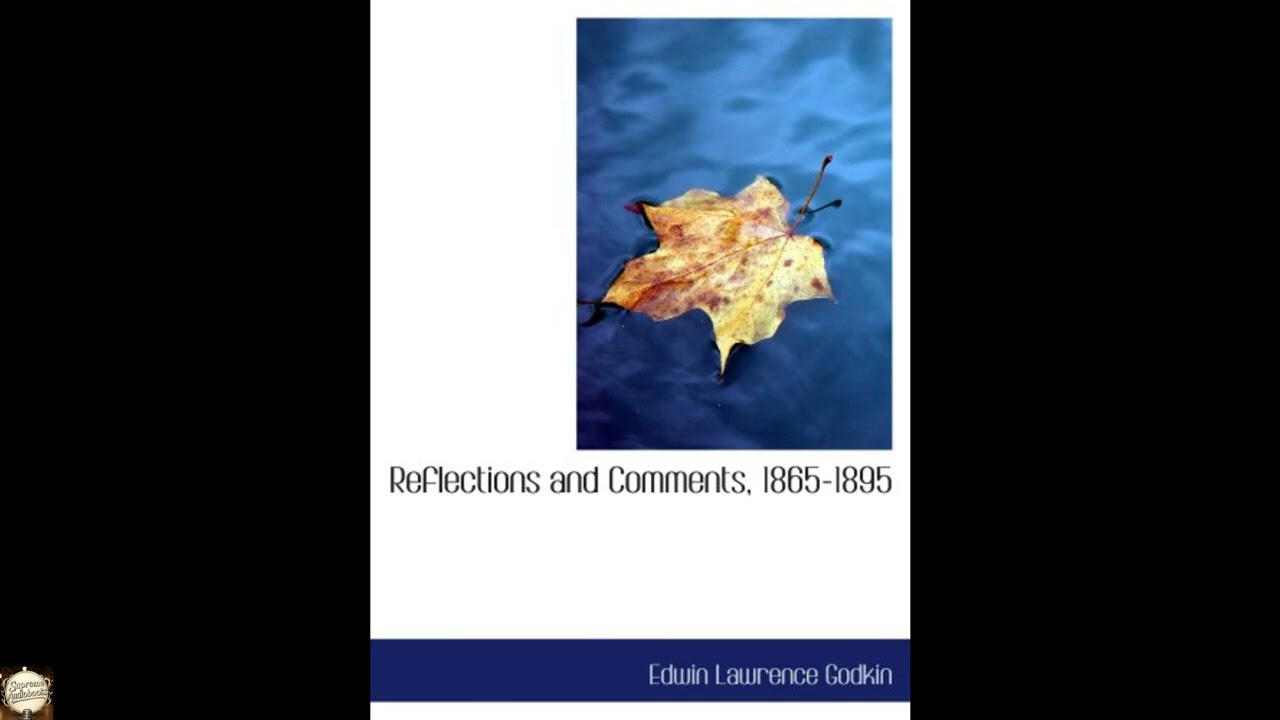
Reflections and Comments, 1865-1895
Edwin Lawrence Godkin’s Reflections and Comments, 1865-1895 offers listeners an unparalleled vantage point into the turbulent, transformative decades following the American Civil War. This collection of incisive essays and editorials—the distilled wisdom of one of America’s foremost public intellectuals—provides more than just a historical record; it is a masterclass in critical observation, a spirited defense of civic virtue, and a biting commentary on the challenges facing a nation striving to redefine itself. Through Godkin’s elegant and often acerbic prose, we witness the birth pangs of modern America, grapple with issues of reconstruction, industrialization, and political corruption that echo in surprising ways through our own era, and gain insight from a voice that championed integrity and reason in a clamorous age. It is a work that reminds us of the enduring power of thoughtful dissent and the essential role of an independent press. The intellectual landscape presented within Reflections and Comments unfolds like an ongoing conversation with the spirit of the age, charting the currents of American life from the close of the Civil War through the Gilded Age. The "story" here is not one of fictional characters, but of the American republic itself, seen through the keen eyes of a journalist deeply invested in its future. Beginning in 1865, Godkin’s early essays contend with the immediate aftermath of the war, questioning the moral and practical challenges of Reconstruction, and the monumental task of reuniting a fractured nation. He scrutinizes the promises and pitfalls of extending civil rights, the complexities of federal intervention, and the often-disheartening realities of political maneuvering during a period demanding statesmanship. As the collection progresses into the 1870s and 1880s, Godkin turns his attention to the rapid industrialization of the country and the accompanying societal shifts. Here, the central conflict becomes the struggle between democratic ideals and the encroaching forces of economic inequality, political patronage, and the sheer momentum of progress. He dissects the rise of political machines, the concentration of wealth, and the burgeoning calls for civil service reform, consistently arguing for rational, honest governance against the tide of self-interest and party loyalty. His commentary on the evolving American character—from rural simplicity to urban complexity—demonstrates his profound engagement with the very soul of the nation, always challenging his readers to hold their leaders and themselves to a higher standard of public conduct. Edwin Lawrence Godkin, born in Ireland in the mid-19th century, brought to American journalism a rigorous intellectual background forged at Queen's College, Belfast. His early career included stints as a war correspondent during the Crimean War and as an American correspondent for the London Daily News, experiences that honed his analytical skills and cultivated a broad international perspective. Emigrating to the United States in the mid-1850s, Godkin quickly established himself as a formidable voice in public discourse, ultimately founding The Nation in 1865. This influential weekly publication became his primary platform for shaping public opinion, setting a new standard for independent, intellectually robust journalism. Through The Nation, Godkin became a leading figure among the so-called "Mugwumps," a faction of Republicans who broke with their party over issues of political corruption and advocated for civil service reform. His sharp wit and unwavering commitment to what he perceived as moral rectitude made him a powerful, if sometimes controversial, figure. He contributed significantly to the intellectual currents of his time, influencing public policy and setting the tone for serious political commentary. Though not primarily a literary stylist in the sense of a novelist or poet, his prose was renowned for its clarity, precision, and persuasive force, earning him a lasting place in the canon of American public letters as a champion of independent thought and ethical governance. At the heart of Godkin’s reflections are several enduring themes that remain remarkably pertinent. One significant thread is his sustained critique of political corruption and the defense of civic virtue. He repeatedly skewers the patronage system, the abuses of power by party bosses, and the general moral laxity he observed in government. For instance, his essays often dissect specific legislative proposals or political appointments, not merely to report on them, but to expose their underlying motivations and warn against the erosion of public trust, always advocating for a merit-based, ethical civil service. He believed fervently that a healthy democracy depended on the integrity of its institutions and the moral character of its citizens. Another prominent theme is the role of an independent press in a democracy. Godkin saw journalism as a crucial watchdog, a force for accountability against the powerful. His own editorship of The Nation exemplified this belief, providing a forum for thoughtful debate and unvarnished criticism, distinct from the more partisan newspapers of the era. Listeners will hear him argue for a journalism that prioritizes truth and public interest over sensationalism or party loyalty, a call that resonates profoundly with contemporary debates about media bias and journalistic ethics. His writings also touch on the complexities of social and economic change, observing the growing pains of industrial America, the rise of powerful corporations, and the strains these changes placed on the traditional fabric of society, all while maintaining a consistent faith in reasoned discourse as the path forward. Godkin’s Reflections and Comments emerged from a period of profound upheaval in American history. The decades following the Civil War witnessed not only the monumental effort of Reconstruction and reunification, but also the rapid expansion of industry, a massive influx of immigrants, and the accelerating growth of cities. This was the Gilded Age, characterized by immense wealth for some, stark poverty for others, and a political landscape rife with corruption, from Tammany Hall to the Credit Mobilier scandal. Culturally, America was grappling with its identity as a continental power, navigating the tensions between agrarian ideals and urban realities, and debating the proper role of government in a burgeoning capitalist society. Godkin’s work was a direct response to this environment, born of a conviction that critical, independent commentary was essential to guide the nation through its challenges, to expose injustice, and to advocate for the principles of sound governance and an educated citizenry. He offered a clear, articulate voice amidst the clamor, seeking to impose order and reason on a chaotic and rapidly changing world. Listening to Reflections and Comments, 1865-1895 as an audiobook allows Godkin’s distinctive voice and analytical precision to truly come alive. The narrator’s thoughtful pacing and measured tone invite listeners to absorb the nuances of his arguments, allowing the listener to engage with his often-complex critiques at their own speed. Over several hours, this allows ample time to become immersed in the intellectual world of the late nineteenth century, understanding how Godkin constructed his points, often with a dry wit that shines through in spoken word. The extended format is ideal for appreciating the gradual unfolding of his perspectives across three momentous decades, providing a steady companion for commutes, thoughtful walks, or periods of focused reflection. It brings an era of profound transformation—and an indispensable commentator on that era—directly to the listener, enabling a direct and engaging encounter with history and political thought.
Enjoyed Reflections and Comments, 1865-1895? A few ways to support us
Audible & Amazon links are affiliate; we may earn a small commission at no extra cost.
About this production
Human narration by a volunteer reader from LibriVox.org, the public-domain audiobook project. LibriVox volunteers record literary works whose copyright has expired in the United States, releasing the resulting recordings into the public domain.
Reflections and Comments, 1865-1895 by Edwin Lawrence Godkin. The underlying text is in the U.S. public domain. We do not republish any modern copyrighted edition, translation, or commentary.
The 4K cinematic visuals accompanying this audiobook are generated by an AI image model from prompts derived from the source text. No copyrighted photos, paintings, or stock footage are used. AI generation is disclosed on every video on our YouTube channel as required by YouTube's altered/synthetic content policy.
English subtitles are transcribed from the LibriVox recording with OpenAI Whisper. Translations into the 11 other supported languages are produced by Meta's NLLB-200 neural translation model. No human translator's copyrighted translation is used.
Questions about sourcing or rights? See our DMCA & Sourcing policy or contact us.
Enjoyed this audiobook?
If you'd like to own a copy of Reflections and Comments, 1865-1895 or hear a professionally produced edition, the links below help support free audiobook production at no extra cost to you.
As an Amazon Associate we earn from qualifying purchases. Audible / print links are affiliate.