Succession in the Presidency of the Church
The continuity of leadership forms the cornerstone of any enduring institution, but for a church founded upon direct revelation, succession takes on profound, sacred significance. How does a spiritual body, tracing its origins to a divinely appointed prophet, ensure an unbroken chain of authority? B. H. Roberts’ Succession in the Presidency of the Church offers a meticulously argued account of this very question within one of America’s most distinctive religious traditions. This is not merely a historical record; it is a foundational theological treatise, laying bare the scriptural precedents, ecclesiastical protocols, and divine principles governing spiritual power transfer. For anyone pondering leadership dynamics or institutional perpetuity, Roberts’ work provides an illuminating, authoritative perspective, addressing anxieties of continuity and legitimacy in a unique religious context. Roberts constructs his argument with legal precision. The narrative begins with the premise of a living prophet, Joseph Smith, and the intellectual "conflict" of succession upon his death. Roberts examines the aftermath of Smith's martyrdom in 1844, a period of uncertainty and competing claims. He details the critical assembly in Nauvoo where the prophetic mantle was perceived to transfer to Brigham Young. This pivotal moment established the blueprint for subsequent transitions and the principles Roberts seeks to codify throughout his exposition. From this foundational episode, Roberts traces the succession of subsequent church presidents—Brigham Young, John Taylor, Wilford Woodruff, Lorenzo Snow, and Joseph F. Smith—demonstrating how the established principles were reaffirmed and solidified. He dissects the Quorum of the Twelve Apostles’ role, particularly its senior member, and the theological underpinnings designating this quorum as the rightful inheritor. The book clarifies the concept of "apostolic interregnum" and the process by which a new First Presidency is organized, not by popular vote, but through divinely revealed order and unanimous consent. Roberts defends this unique system, asserting its divine origin and efficacy in maintaining the church’s direction, illustrating how each succession strengthened the precedent. B. H. Roberts, born in 1857 in Lanarkshire, Scotland, stands as one of early Latter-day Saint thought’s most intellectually robust voices. Orphaned and impoverished, he immigrated to Utah Territory at age eleven. Largely self-educated, Roberts devoured books, honing a formidable intellect and command of language, becoming a teacher, newspaper editor, and sought-after speaker. His early life experiences forged a resilient scholar dedicated to his faith. Roberts' career was deeply linked with the development and defense of his church. He served multiple missions, including two terms as president of the Southern States Mission, experiences that sharpened his apologetic skills. He was a delegate to the Utah Constitutional Convention in 1895 and later elected to the U.S. House of Representatives, though he was controversially denied his seat due to allegations of polygamy, a practice the church had officially discontinued. Beyond public service, Roberts is best remembered for his monumental contributions as a historian and theologian. His most ambitious undertaking, A Comprehensive History of the Church of Jesus Christ of Latter-day Saints, Century I, remains an indispensable resource. Other significant works include Defense of the Faith and the Saints. Roberts was an interpreter, grappling with challenging historical and doctrinal questions with remarkable candor. He wrote as the church transitioned from isolation to integration, defining its identity and place in the world. He passed away in 1933, leaving a significant legacy of scholarship. Roberts' exposition in Succession in the Presidency of the Church distills several overarching themes. Foremost is Divine Mandate and Revelation. His central assertion is that succession is not a human invention, but a direct extension of God’s revealed will, put in place by prophetic design. He illustrates this by detailing Joseph Smith's declarations regarding the keys of the kingdom and the Twelve Apostles' role, showing how these pronouncements laid the groundwork for future transitions. Roberts emphasizes accounts of Smith conferring priesthood keys upon the Twelve, establishing a pre-ordained order for authority. Another prominent theme is Institutional Stability through Orderly Transition. Roberts meticulously documents how established principles prevent chaos and schism, ensuring consistent leadership and doctrinal foundation. He details the procedural gravity in organizing the First Presidency, underscoring the unanimity required from the Council of the Twelve Apostles. This ritualized, divinely sanctioned process is presented as a bulwark against internal strife. Finally, Roberts also addresses The Nature of Apostolic Authority, clarifying that the Twelve are not merely administrators, but "prophets, seers, and revelators" holding the same keys as the president, albeit with a different functional stewardship until a vacancy. This work emerged during a fascinating, often contentious period for the Church of Jesus Christ of Latter-day Saints and for America. Roberts wrote much of his material in the late nineteenth and early twentieth centuries. This was a time when the church, having settled in the American West, strove to shed perceptions of isolation and controversy, particularly concerning polygamy. The nation underwent rapid industrialization and social change; religious institutions often defined their unique doctrines against scientific advancement and secularizing trends. Roberts’ writings then served dual purposes: to provide an internal, systematic understanding of doctrine and history for members, and to offer robust defense of its principles to a skeptical external world. As the church integrated more into American society, works like Succession in the Presidency of the Church became essential tools for explaining its singular governance structure. It appeared as historical accounts became professionalized, yet Roberts brought a deeply faith-informed perspective to his methodology, aiming to establish the divine legitimacy of the church’s leadership for generations. Listening to Succession in the Presidency of the Church as an audiobook offers a unique opportunity to engage with Roberts’ substantial arguments reflectively. The 8-hour length makes it an ideal companion for attentive listening during commutes or focused study. A skilled narrator, bringing a clear, authoritative, and measured voice, guides the listener through Roberts’ detailed explanations and theological justifications. The unhurried pace allows for thoughtful consideration of complex principles, transforming what might be dense reading into an accessible intellectual experience. The spoken word underscores the gravitas of Roberts’ tone, emphasizing the spiritual conviction behind his scholarship.
Enjoyed Succession in the Presidency of the Church? A few ways to support us
Audible & Amazon links are affiliate; we may earn a small commission at no extra cost.
About this production
Human narration by a volunteer reader from LibriVox.org, the public-domain audiobook project. LibriVox volunteers record literary works whose copyright has expired in the United States, releasing the resulting recordings into the public domain.
Succession in the Presidency of the Church by B. H. Roberts. The underlying text is in the U.S. public domain. We do not republish any modern copyrighted edition, translation, or commentary.
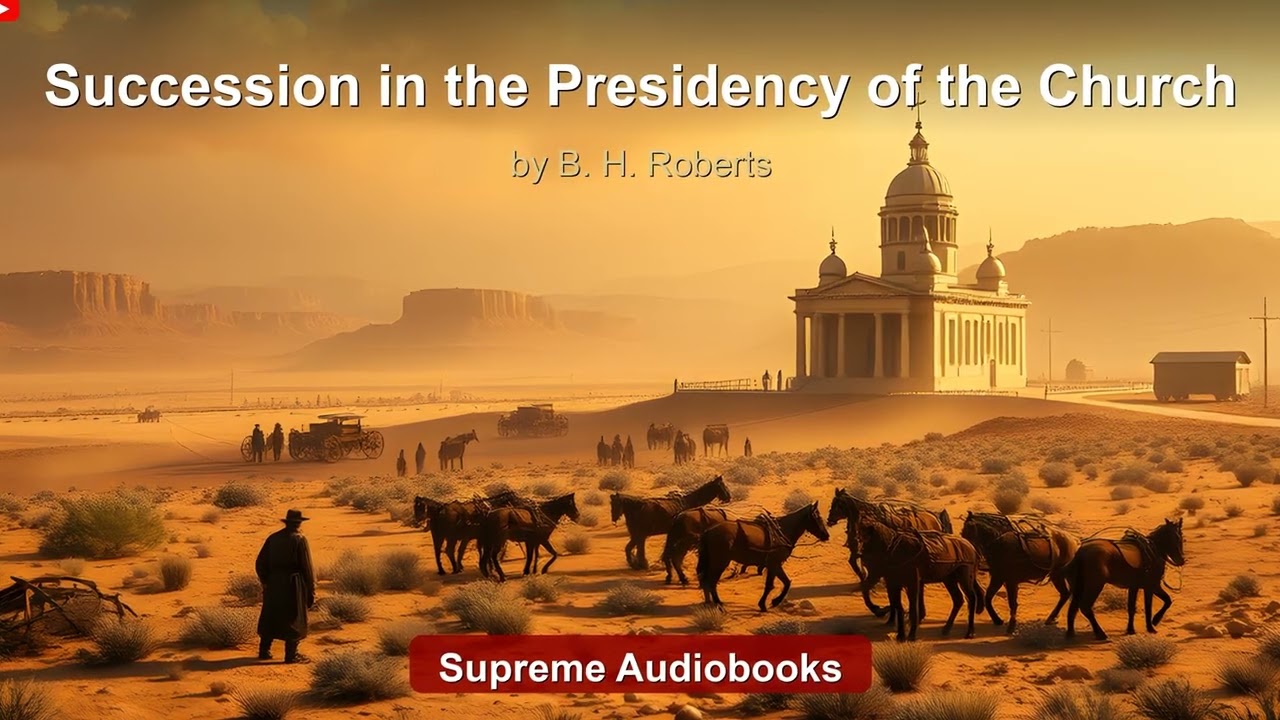
The 4K cinematic visuals accompanying this audiobook are generated by an AI image model from prompts derived from the source text. No copyrighted photos, paintings, or stock footage are used. AI generation is disclosed on every video on our YouTube channel as required by YouTube's altered/synthetic content policy.
English subtitles are transcribed from the LibriVox recording with OpenAI Whisper. Translations into the 11 other supported languages are produced by Meta's NLLB-200 neural translation model. No human translator's copyrighted translation is used.
Questions about sourcing or rights? See our DMCA & Sourcing policy or contact us.
Enjoyed this audiobook?
If you'd like to own a copy of Succession in the Presidency of the Church or hear a professionally produced edition, the links below help support free audiobook production at no extra cost to you.
As an Amazon Associate we earn from qualifying purchases. Audible / print links are affiliate.