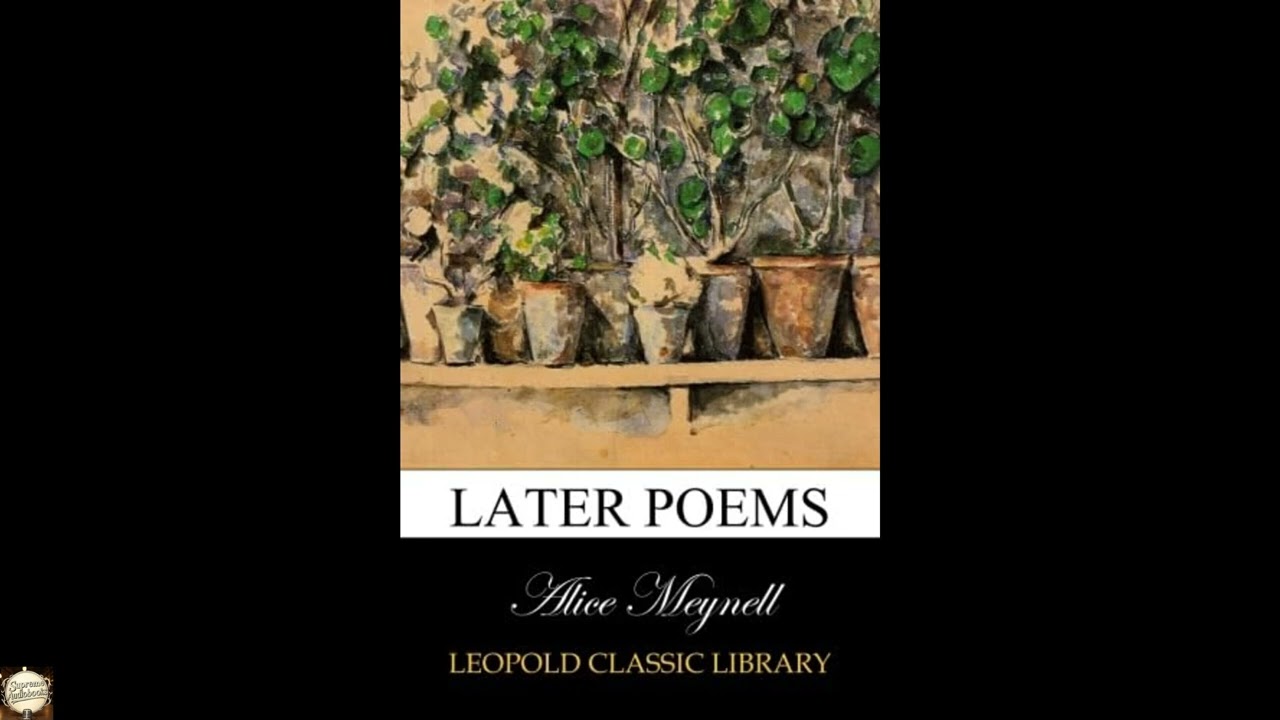
Later Poems
Alice Meynell's "Later Poems" offers an invitation to a world of quiet contemplation, profound observation, and luminous sensibility. In an age often defined by clamor, these verses stand as a testament to the enduring power of precision, spiritual grace, and deep engagement with the natural world. This collection from a remarkable poet presents a cohesive vision, a sustained conversation with beauty and faith that resonates as powerfully today as it did when first penned. It is a work that rewards stillness, promising refuge and renewal for those willing to pause and listen to its measured music. "Later Poems" doesn't unfold with a traditional narrative, but presents a progression through emotional and intellectual landscapes, much like walking through a meticulously curated garden where each bloom reveals a new facet. The setting is primarily the mind's eye, often anchored in observations of the English countryside—a field, a distant hill, a cloud formation—or within the intimate spaces of home and family. The central "character" is arguably the poet herself, or a sensitive, observant persona, engaging with moments of intense feeling and thought. Listeners will find themselves immersed in a series of meditations, where the natural world often mirrors inner states, and domestic scenes acquire a sacramental glow. The collection moves from immediate apprehension of beauty—the fleeting light, the silence of a winter morning—to deeper considerations of spiritual endurance and human affection. There is a perceptible arc from outward gaze, cataloging small wonders, to an inward turning, wrestling with questions of belief, loss, and the nature of time. Each poem acts as a vignette, a perfectly framed moment, yet together they build a cumulative impression of a life lived with extraordinary attentiveness. This quiet unfolding forms the unique "story" of Meynell's later verse, promising discovery without ever forcing a conclusion. Alice Meynell, born Alice Christiana Gertrude Thompson in 1847, lived a life marked by intellectual curiosity and deep spiritual conviction. Her early years traveling through Europe broadened her perspective and instilled a love for art and literature. Her conversion to Catholicism in 1868 profoundly shaped her worldview and her verse. In 1875, she married Wilfrid Meynell, a journalist and editor; together they became central figures in London's literary and Catholic intellectual circles. Their home became a salon where writers like Coventry Patmore, George Meredith, and Francis Thompson found camaraderie. The Meynells famously championed the destitute poet Francis Thompson, nurturing his talent. Meynell's first volume of poetry, "Preludes," published in 1875, garnered significant critical acclaim, drawing praise from figures such as John Ruskin. Her literary output extended beyond poetry to include substantial essays, collected in volumes like "The Rhythm of Life," which displayed her keen observational skills and elegant prose style. She maintained a rigorous commitment to precision and concision in her writing, qualities that set her apart. An active critic, editor, and mentor, she wielded considerable influence in fostering new talent. By her death in 1922, Alice Meynell had firmly established her place in English letters. Her work bridged late Victorian aestheticism—admired by Oscar Wilde and W.B. Yeats—with the emerging sensibilities of early modernism. Virginia Woolf and G.K. Chesterton lauded her clear-eyed honesty and the quiet strength of her voice. She stands as a poet who, despite a relatively small output of verse, achieved remarkable density of thought and feeling, contributing a unique and enduring strain of contemplative poetry to the English canon. The poems within this collection resonate with several recurring themes, woven together with a delicate yet firm hand. One prominent thread is the spiritual life and the search for grace. Meynell's Catholicism infuses her verse not with overt dogma, but with a pervasive sense of the sacred in the mundane. Her poems suggest that the profoundest truths are revealed not through grand epiphanies, but through patient attention to small details – a child's gaze, the stark beauty of a winter landscape – which subtly reveal a sense of divine love or the austere path of faith. Another significant theme is the contemplation of nature and its transience. Meynell possessed an acute eye for the natural world, whether describing "the tall, dry grass" or the subtle shift of light across a field. Her observations are precise, yet imbued with profound emotional depth. This natural beauty is often presented alongside an awareness of its fleeting quality, suggesting both sorrow and quiet acceptance of change. The collection also touches on motherhood and domesticity, elevating these experiences beyond mere routine. She portrays the bond between parent and child, the quiet warmth of home, not as limiting, but as a source of profound wisdom. "Later Poems" emerged during a transitional period in English literature, spanning the late Victorian and early Edwardian eras. The world Meynell inhabited was one grappling with the aftershocks of Darwinian science and rapid industrialization. Against this backdrop, a weariness with didactic Victorian poetry grew. A new emphasis on aesthetic beauty, personal introspection, and a return to spiritual concerns gained traction, sometimes labeled the Decadent movement or Fin de Siècle. Meynell’s restrained, intellectually rigorous, and spiritually inflected verse offered a distinct voice. While she shared with contemporaries a meticulous craftsmanship, her work often tempered extravagant aestheticism with a quiet moral seriousness and deeply felt spirituality. Her emergence also coincided with a period when women writers were increasingly gaining recognition. Meynell, through her precise language and profound subject matter, expanded the scope of what was considered appropriate for a female poetic voice. Listening to "Later Poems" as an audiobook offers a unique gateway into Alice Meynell’s craft. Poetry is an oral art, and hearing these verses read aloud brings forth their musicality, rhythm, and subtle cadences in a way silent reading cannot always achieve. The narrator's voice becomes a guide, highlighting emotional weight or allowing a metaphor's full resonance. With "several hours" of content, this collection provides ample opportunity for sustained listening during quiet reflection or a morning walk. Pay attention to the narrator's pacing, which should mirror Meynell’s measured approach, allowing each carefully chosen word and image to settle. This clear, reverent presentation amplifies the quiet power and profound beauty of these enduring verses, transforming a solitary reading into a shared, contemplative encounter.
Enjoyed Later Poems? A few ways to support us
Audible & Amazon links are affiliate; we may earn a small commission at no extra cost.
About this production
Human narration by a volunteer reader from LibriVox.org, the public-domain audiobook project. LibriVox volunteers record literary works whose copyright has expired in the United States, releasing the resulting recordings into the public domain.
Later Poems by Alice Meynell. The underlying text is in the U.S. public domain. We do not republish any modern copyrighted edition, translation, or commentary.
The 4K cinematic visuals accompanying this audiobook are generated by an AI image model from prompts derived from the source text. No copyrighted photos, paintings, or stock footage are used. AI generation is disclosed on every video on our YouTube channel as required by YouTube's altered/synthetic content policy.
English subtitles are transcribed from the LibriVox recording with OpenAI Whisper. Translations into the 11 other supported languages are produced by Meta's NLLB-200 neural translation model. No human translator's copyrighted translation is used.
Questions about sourcing or rights? See our DMCA & Sourcing policy or contact us.
Enjoyed this audiobook?
If you'd like to own a copy of Later Poems or hear a professionally produced edition, the links below help support free audiobook production at no extra cost to you.
As an Amazon Associate we earn from qualifying purchases. Audible / print links are affiliate.