Short Cruises
Step aboard a bygone era, where the salty tang of the Thames estuary mingles with the hearty laughter and occasional exasperation of ordinary folk caught in life's comedic currents. W. W. Jacobs' "Short Cruises" invites listeners into a world of small ships, riverside pubs, and the surprisingly dramatic everyday lives of sailors, dockworkers, and their families. This collection of short stories, infused with Jacobs' distinctive brand of gentle humor and keen observation, offers a delightful escape from modern complexities, proving that human foibles and the search for a quiet life—or a cunning advantage—are truly perennial. Here, the grand adventures are often found in the most unassuming corners, and the gravest perils might just be a meddling relative or a misunderstanding that spirals hilariously out of control. The stories in "Short Cruises" typically unfold along the docks and waterways of England, from bustling London wharves to the quieter reaches of the coast. Our main characters are a parade of everyday individuals: seasoned ship captains with a knack for tall tales, resourceful deckhands trying to dodge work or win a lady's affection, shrewd pub landlords keeping an eye on their regulars, and formidable wives who keep their seafaring husbands firmly ashore. Each narrative presents a miniature drama, often stemming from a simple premise: a petty rivalry, a secret romance, an attempt to outwit an authority figure, or a scheme to avoid a chore. We might meet a sailor pretending to be rich to impress a girl, only for his true circumstances to nearly scupper his plans, or witness the elaborate ruse a man devises to escape a bothersome relative, only to find his efforts lead to even greater entanglements. The arc of these stories is typically one of comedic escalation. A minor deception grows into a significant headache, a well-intentioned plan backfires spectacularly, or a quiet domestic squabble morphs into a public spectacle. The tension is rarely serious, instead revolving around the characters' increasingly desperate attempts to maintain appearances, avoid consequences, or untangle the webs they've woven for themselves. While each tale stands alone, together they paint a consistent picture of a specific social stratum and geographic locale, bound by shared humor and the understated resilience of people living close to the sea. You won't find cliffhangers or existential dread here, but rather the satisfying resolution of a cleverly constructed pickle, often leaving a smile in its wake. The creator of this wonderfully particular world was William Wymark Jacobs, born in London in 1863. His life began not far from the very scenes he would later immortalize in fiction; his father managed the South Devon Wharf at Wapping. This upbringing granted Jacobs an intimate, firsthand understanding of the Thames, its vessels, and the colorful characters who populated its banks. He worked initially as a clerk in the Post Office Savings Bank, a steady but perhaps creatively stifling profession, until his literary successes allowed him to devote himself full-time to writing. Jacobs published his first volume of short stories, "Many Cargoes," in 1896, and quickly became known for his distinctive voice. Jacobs’ career spanned the late Victorian and early Edwardian periods, and he continued writing well into the 20th century, passing away in 1943. While "Short Cruises" showcases his humorous side, he also demonstrated a chilling mastery of the supernatural, most famously with his enduring horror story, "The Monkey's Paw"—a stark contrast to his more frequent comedic output. Other notable collections include "Sailors' Knots" and "Sea Urchins." Jacobs was a true craftsman of the short story, revered for his precise plotting, sharp dialogue, and ability to evoke character and setting with remarkable economy. He found his niche detailing the lives of lower-middle-class and working-class people, particularly those connected to maritime life, distinguishing himself with a gentle wit that never quite veered into satire or cruelty. Jacobs' "Short Cruises" enacts several enduring human themes with subtle precision. One prominent theme is human folly and the unpredictability of best-laid plans. We see this again and again as characters attempt to manipulate situations, often with disastrously amusing results. For instance, a sailor might concoct an elaborate lie to avoid an unpleasant task or impress a lady, only to find his deceit unravels in public, leaving him more embarrassed than if he had simply been honest. Another recurring theme is the comedy of social aspiration and pretense. Many characters are striving, in their own modest ways, for a higher standing or a particular image, and the humor often arises from the clash between their grand ambitions and their very ordinary realities, frequently highlighted by their attempts to maintain dignity amidst indignity. Furthermore, the stories often highlight the quirks and comforts of community life and the inherent humor in close quarters, whether on a small coaster or within a close-knit riverside village. The constant interaction—and occasional friction—among neighbors, crewmates, and family members provides a wellspring of comedic situations. A man might try to hide a secret from his wife, only for the entire neighborhood to seem privy to his every move, underscoring how difficult true privacy can be in such environments. Finally, Jacobs subtly touches upon the longing for escape versus the pull of domesticity. His male characters, particularly the sailors, often dream of freedom on the open sea, yet are consistently drawn back to—or restrained by—the responsibilities and relationships ashore, finding their "cruises" are often shorter and more locally entangled than they imagined. "Short Cruises" emerged during a fascinating period of British history, roughly from the turn of the 20th century to the outbreak of the First World War. This was the Edwardian era, a time of relative peace and prosperity following the long Victorian reign. Culturally, there was a growing appetite for lighter, more escapist literature, often published in popular magazines which cultivated the short story as a highly regarded art form. Britain was still a preeminent naval power, and the sea played a massive role in its economy, trade, and national identity, making stories about maritime life broadly appealing. Politically, the British Empire was at its zenith, though subtle social shifts were also underway. The rise of a more visible working class and a greater focus on their lives in literature reflected a changing societal landscape. Jacobs' stories, with their realistic depictions of dock life and ordinary people, offered a humorous yet authentic window into a segment of society often overlooked by grander narratives. His writing provided a comforting counterpoint to the era's grander imperial narratives, grounding listeners in the everyday realities and enduring humor of life at home. Listening to "Short Cruises" as an audiobook offers a unique appreciation for Jacobs' masterful use of dialogue and his finely tuned comedic timing. The run length, measured in several enjoyable hours, makes it an ideal companion for a series of commutes, an afternoon of chores, or simply unwinding over several evenings. A skilled narrator can bring to life the distinct voices of Jacobs' characters: the gruff yet sentimental captain, the sharp-tongued wife, the wide-eyed greenhorn, and the wily pub regular. Pay attention to the subtle shifts in cadence and regional inflections that enhance the humor and underscore the social dynamics. The spoken word allows the atmospheric details – the creak of a ship's hull, the distant clang of a bell buoy, the murmur of conversation in a smoke-filled pub – to truly transport you to the bustling, comical world Jacobs created, making you feel as though you're right there, eavesdropping on a particularly amusing anecdote.
Enjoyed Short Cruises? A few ways to support us
Audible & Amazon links are affiliate; we may earn a small commission at no extra cost.
About this production
Human narration by a volunteer reader from LibriVox.org, the public-domain audiobook project. LibriVox volunteers record literary works whose copyright has expired in the United States, releasing the resulting recordings into the public domain.
Short Cruises by W W Jacobs. The underlying text is in the U.S. public domain. We do not republish any modern copyrighted edition, translation, or commentary.
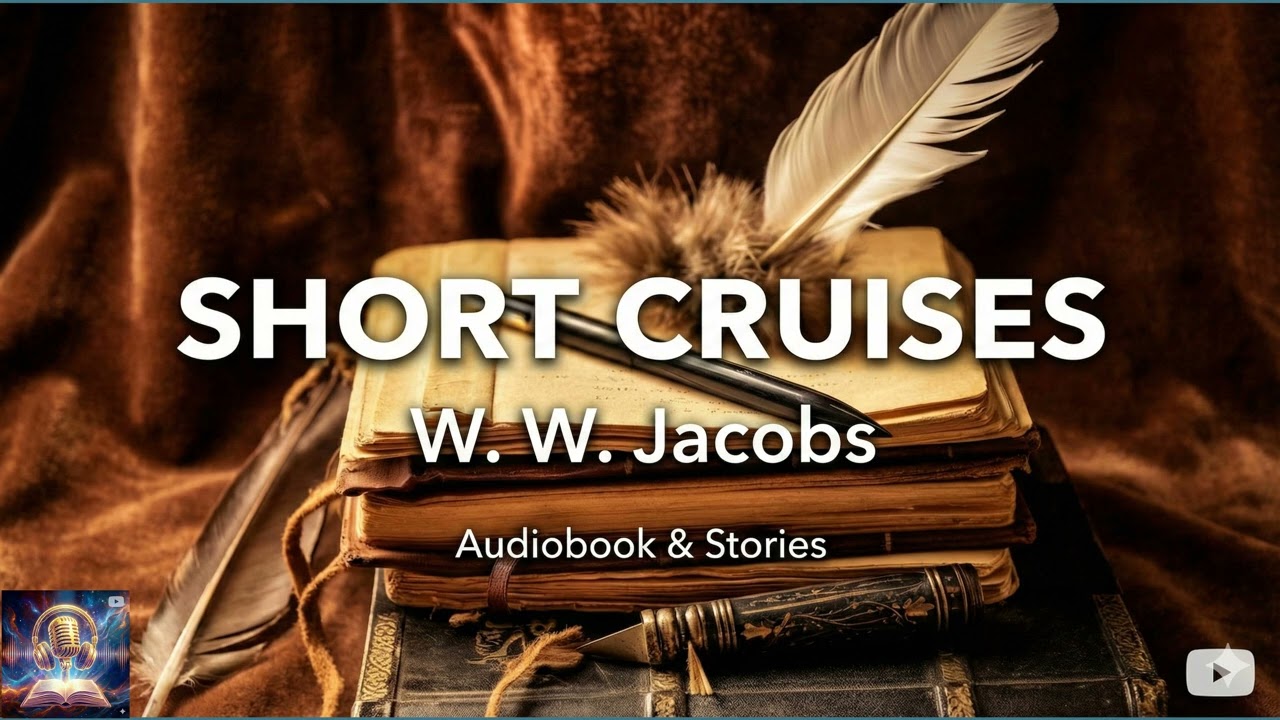
The 4K cinematic visuals accompanying this audiobook are generated by an AI image model from prompts derived from the source text. No copyrighted photos, paintings, or stock footage are used. AI generation is disclosed on every video on our YouTube channel as required by YouTube's altered/synthetic content policy.
English subtitles are transcribed from the LibriVox recording with OpenAI Whisper. Translations into the 11 other supported languages are produced by Meta's NLLB-200 neural translation model. No human translator's copyrighted translation is used.
Questions about sourcing or rights? See our DMCA & Sourcing policy or contact us.
Enjoyed this audiobook?
If you'd like to own a copy of Short Cruises or hear a professionally produced edition, the links below help support free audiobook production at no extra cost to you.
As an Amazon Associate we earn from qualifying purchases. Audible / print links are affiliate.