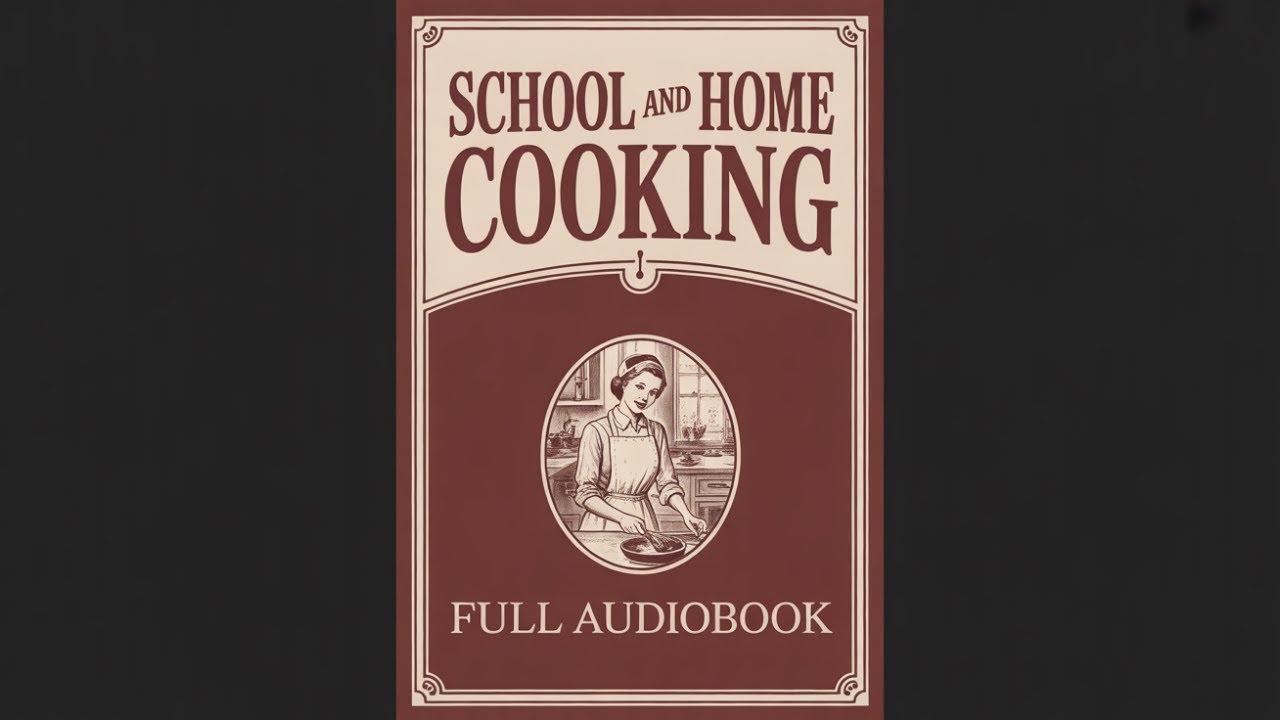
School and Home Cooking
Step into the bustling kitchens and classrooms of a bygone era with Carlotta C. Greer's "School and Home Cooking," a foundational text that offers far more than just recipes. Published in 1920, this isn't merely a cookbook; it is a meticulously crafted guide to the domestic sciences, a direct window into the principles that shaped home life, nutrition, and education for an entire generation of Americans. At its core, this volume presents a philosophy of efficiency, health, and skill in household management, making it an invaluable document for understanding the cultural and societal expectations placed upon women—and indeed, upon any individual responsible for the domestic sphere—a century ago. To listen today is to gain an intimate perspective on our culinary heritage, the scientific aspirations of its time, and the enduring quest for wholesome living. Greer’s work functions as a comprehensive curriculum, thoughtfully designed to transform the novice into a competent manager of the household kitchen. The setting for this educational endeavor is implicitly the early 20th-century American home and the burgeoning domestic science classrooms of the period, where the pursuit of scientific method was seen as key to modern living. The central "character" is the diligent student or homemaker, eager to master the arts of cookery and household economy, guided by Greer's clear, authoritative, and encouraging voice. The overarching challenge presented is the universal task of providing nutritious, appealing meals and maintaining a healthy domestic environment, all while navigating the then-evolving understanding of dietetics and hygiene. The book’s arc begins with fundamental principles, establishing a solid groundwork in kitchen arrangement, sanitation, and the basic chemistry of food preparation. Listeners are introduced to the properties of various foodstuffs, the importance of accurate measurements, and the proper use and care of kitchen equipment. From these essential building blocks, Greer progresses systematically through different food groups, detailing methods for preparing vegetables, fruits, meats, cereals, and dairy products. Chapters on bread-making, pastry, and desserts illustrate the precision required for successful baking, while later sections address the intricacies of meal planning, food preservation, and even the preparation of special diets for the sick. It is a methodical journey from foundational knowledge to comprehensive domestic competence, structured to build skill and confidence progressively without ever revealing the specific, detailed instructions of its more advanced applications or the precise methods of its later chapters. Carlotta C. Greer (1888-1970) stands as a significant figure in the history of home economics education in America. Born into an era that saw the professionalization of domestic arts, Greer dedicated her career to advancing the scientific study and practical application of household management. She held positions at several institutions, including the University of Kansas and Montana State College, where she taught and developed curricula that emphasized the scientific principles underlying cooking, nutrition, and home care. Her influence extended beyond the classroom through her authorship of several widely adopted textbooks. Beyond "School and Home Cooking," Greer contributed to the field with "Foods and Home Making," published in 1928, and "Your Home and You" in 1942. These works cemented her reputation as a leading authority, reflecting the progressive educational philosophy of her time. She was part of a movement that sought to elevate domestic labor from mere chore to a respected, science-based profession, integrating elements of chemistry, biology, and economics into the daily functioning of the home. Her writings exemplify the era's belief in efficiency, health, and the systematic approach to daily life, securing her a notable place within the canon of American educational literature regarding home management. "School and Home Cooking" illuminates several core themes. Foremost among these is the application of science and efficiency within the domestic sphere. Greer consistently emphasizes precise measurements, the chemical changes that occur during cooking, and the nutritional value of foods. For instance, her detailed explanations of protein coagulation or starch gelatinization transform mundane cooking tasks into exercises in practical chemistry, demonstrating how scientific understanding can lead to predictable and desirable culinary outcomes. Another key theme is education as a tool for empowerment and social well-being. The meticulous instructions and explanations in the book aim to equip individuals, primarily young women, with the knowledge and skills necessary to manage a healthy and orderly household. By teaching them not just how to cook, but why certain methods work, Greer fosters a sense of competence and agency, positioning domestic work as a respected profession rather than simply an unvalued duty. A third theme concerns public health and nutrition, reflecting the period's growing awareness of the link between diet and well-being. Greer dedicates significant portions of the text to balanced diets, food preservation techniques, and the preparation of healthful meals, especially for children and the infirm. Her advice on safe canning practices or the appropriate balance of macronutrients directly addresses contemporary public health concerns, seeking to improve national health through educated home management. Finally, the book offers a fascinating glimpse into the evolution of American culinary practices and dietary habits at the turn of the 20th century. The ingredients, cooking methods, and meal structures described provide a snapshot of what was considered modern, wholesome fare, revealing the culinary landscape just as industrialization began to transform food production and availability. The publication of "School and Home Cooking" in 1920 places it squarely in the post-World War I era, a time of significant cultural and social shifts in America. The Progressive Era's ideals—which championed scientific expertise, efficiency, and education as solutions to societal problems—were still deeply influential, particularly in the realm of home economics. This period saw the professionalization of domestic science, heavily promoted by figures like Ellen Swallow Richards, with land-grant colleges across the nation establishing departments dedicated to the field. Women, having recently secured the right to vote, were at the center of discussions about their evolving roles both inside and outside the home. Greer’s work emerged within this context, serving to standardize domestic practices and integrate scientific rigor into the daily routine of the American household, reflecting a national push for health, order, and modernity. It embodied the belief that a well-managed home, underpinned by scientific knowledge, was fundamental to a healthy and productive society. Listening to "School and Home Cooking" as an audiobook offers a uniquely immersive and instructive experience. The precise, formal language and the systematic instruction of Greer’s text truly come alive when narrated by a clear, measured voice. The several-hour runtime makes it an ideal companion for undertaking your own domestic tasks, whether you are cooking, cleaning, or simply enjoying a quiet moment, allowing the wisdom of a past era to gently inform your present. As you listen, pay attention to the specific vocabulary used to describe ingredients and techniques, the underlying tone of earnest instruction, and the philosophical underpinnings of an approach to food and home that prioritized scientific understanding and careful management. It’s like stepping into a turn-of-the-century classroom, with Carlotta C. Greer herself guiding you through the essential lessons of domestic science, providing a listening experience that is both educational and deeply reflective of historical American life.
Enjoyed School and Home Cooking? A few ways to support us
Audible & Amazon links are affiliate; we may earn a small commission at no extra cost.
About this production
Human narration by a volunteer reader from LibriVox.org, the public-domain audiobook project. LibriVox volunteers record literary works whose copyright has expired in the United States, releasing the resulting recordings into the public domain.
School and Home Cooking by Carlotta C. Greer. The underlying text is in the U.S. public domain. We do not republish any modern copyrighted edition, translation, or commentary.
The 4K cinematic visuals accompanying this audiobook are generated by an AI image model from prompts derived from the source text. No copyrighted photos, paintings, or stock footage are used. AI generation is disclosed on every video on our YouTube channel as required by YouTube's altered/synthetic content policy.
English subtitles are transcribed from the LibriVox recording with OpenAI Whisper. Translations into the 11 other supported languages are produced by Meta's NLLB-200 neural translation model. No human translator's copyrighted translation is used.
Questions about sourcing or rights? See our DMCA & Sourcing policy or contact us.
Enjoyed this audiobook?
If you'd like to own a copy of School and Home Cooking or hear a professionally produced edition, the links below help support free audiobook production at no extra cost to you.
As an Amazon Associate we earn from qualifying purchases. Audible / print links are affiliate.