Sappho: One Hundred Lyrics
"Sappho: One Hundred Lyrics" by Bliss Carman offers a rare chance to hear an ancient voice reborn through the sensibilities of a modern poet. For centuries, the name Sappho has conjured images of lyrical intensity, profound emotion, and an unparalleled mastery of verse. Though only fragments of her original Greek poetry survive, her reputation as the "Tenth Muse" has never faded. This collection is not a mere academic translation; it is Carman's loving, imaginative reconstruction of Sappho's lost work, a testament to the enduring power of her themes—love, beauty, nature, and longing—themes that resonate as powerfully today as they did on the sun-drenched island of Lesbos over two millennia ago. The listener steps into a world where human passion is laid bare, filtered through a poetic sensibility that bridges the gulf of ages. This lyrical collection presents a series of emotional vignettes, painting a vivid picture of the human heart in its most ardent and vulnerable states. The setting is primarily the ancient Aegean world, specifically the isle of Lesbos, where Sappho lived and taught amidst apple groves and by the shimmering sea. The lyric speaker, representing Sappho, grapples with intense currents of desire, friendship, and separation. Beloved women like Atthis and Anactoria populate this personal world, becoming both muses and objects of profound affection, their beauty and presence celebrated with breathtaking tenderness. The central conflict lies in the universal struggle to articulate and comprehend love's overwhelming force. Each lyric becomes a miniature drama of the soul, capturing the joyous intoxication of new affection, the bitter sting of jealousy, or the melancholic ache of parting. The speaker often invokes Aphrodite, pleading for her aid or questioning her influence, weaving mythology into personal experience. The lyrics move through seasons of the heart, from passionate heat to quiet reflection, creating an arc of shifting emotional states. A portrait emerges of a woman deeply attuned to both the natural world—the blush of a rose, the brilliance of stars—and the intense inner world of feeling, finding ultimate meaning in the connections forged between souls. Bliss Carman, author of this collection, was a prominent Canadian poet born in Fredericton, New Brunswick, in 1861. Educated at the University of New Brunswick, Edinburgh, and Harvard, Carman became a significant voice among the "Confederation Poets," including Archibald Lampman and Charles G. D. Roberts. These poets forged a distinct Canadian literary identity, often inspired by the nation's natural landscapes. Carman's prolific output, marked by lyrical sensitivity and a deep connection to nature, established him as a master of atmospheric verse with works like Low Tide on Grand Pré (1894). He also collaborated with Richard Hovey on the popular Songs from Vagabondia series. Though Canadian, Carman spent much of his adult life in the United States, cultivating his poetic vision until his passing in 1929. His interest in Sappho was a lifelong scholarly and artistic pursuit, culminating in Sappho: One Hundred Lyrics, first published in 1903. This ambitious project saw Carman take surviving fragments of Sappho's ancient Greek poetry and, through a blend of translation, imaginative reconstruction, and original invention, create a cohesive and expansive body of work. It was his attempt to resurrect, for a new English-speaking audience, the voice of a poet whose influence resonated through centuries despite the physical loss of her verses. Carman's version became one of the most widely read interpretations of Sappho's poetry in the early 20th century. Several compelling themes weave through Carman's Sappho: One Hundred Lyrics. First is intense, uninhibited love and desire, often directed toward other women. The lyrics speak openly of longing and physical affection, describing a beloved's sweet laughter or enchanting dancing. This profound passion Carman renders with delicate beauty. Alongside this, the interconnectedness of human emotion and the natural world is a constant motif. A beloved's arrival might be likened to spring's freshness, or sorrow might settle as heavily as twilight dew. Imagery of stars, moon, and flowers frequently mirrors inner states, such as the famous comparison of a maiden to a "sweet apple" on the highest branch. Another significant theme is the poignancy of loss and the relentless passage of time. Many lyrics reflect on youth's fleeting beauty, the pain of absence, or the certainty of death, often paired with a desire for enduring fame through poetry. The speaker grapples with the isolation of watching others find happiness while she experiences solitude. Carman’s reconstruction highlights the Greek concept of kleos – eternal glory through art – as a way to transcend mortality. This collection holds considerable literary significance, representing a specific, highly influential attempt to complete the fragmentary ancient record. Carman did not just translate; he channeled a spirit, offering a poetic interpretation that shaped how generations understood Sappho, making her voice accessible and culturally relevant. Bliss Carman’s Sappho: One Hundred Lyrics was published in 1903, at the turn of the 20th century. This was a period of significant cultural transition, moving from Victorian strictures toward burgeoning Modernist sensibilities. A widespread fascination with classical antiquity, fueled by new archaeological discoveries and renewed scholarly interest, permeated the era. Carman’s extensive collection of Sapphic verse reflected this trend, while navigating contemporary attitudes toward themes of sexuality and gender. The early 1900s saw romanticism still influencing poetry, and Carman’s lyrical approach presented Sappho’s emotional directness in a way that resonated. Ongoing study of papyrus fragments containing Sappho's actual words created a public appetite for her poetry, and Carman's reimagining helped popularize her beyond academic circles. To experience Sappho: One Hundred Lyrics as an audiobook is to receive these verses as they were perhaps always meant to be—spoken, heard, and felt. The inherent musicality of poetry, often lost on the silent page, comes vibrantly to life through skilled narration. Over several hours, a listener can sink into the rhythmic ebb and flow of Carman’s verse, allowing the narrator's voice to illuminate subtle nuances of emotion and the distinct atmospheric qualities of each lyric. Listen for the pacing that allows individual images, like "the silver moon," or intense feelings, such as "my heart in my breast is a-flutter," to resonate deeply. The careful modulation of tone and emphasis brings out the yearning, the joy, and the melancholic beauty that define this unique reconstruction, making the ancient echoes of Sappho's voice sing anew.
Enjoyed Sappho: One Hundred Lyrics? A few ways to support us
Audible & Amazon links are affiliate; we may earn a small commission at no extra cost.
About this production
Human narration by a volunteer reader from LibriVox.org, the public-domain audiobook project. LibriVox volunteers record literary works whose copyright has expired in the United States, releasing the resulting recordings into the public domain.
Sappho: One Hundred Lyrics by Bliss Carman. The underlying text is in the U.S. public domain. We do not republish any modern copyrighted edition, translation, or commentary.
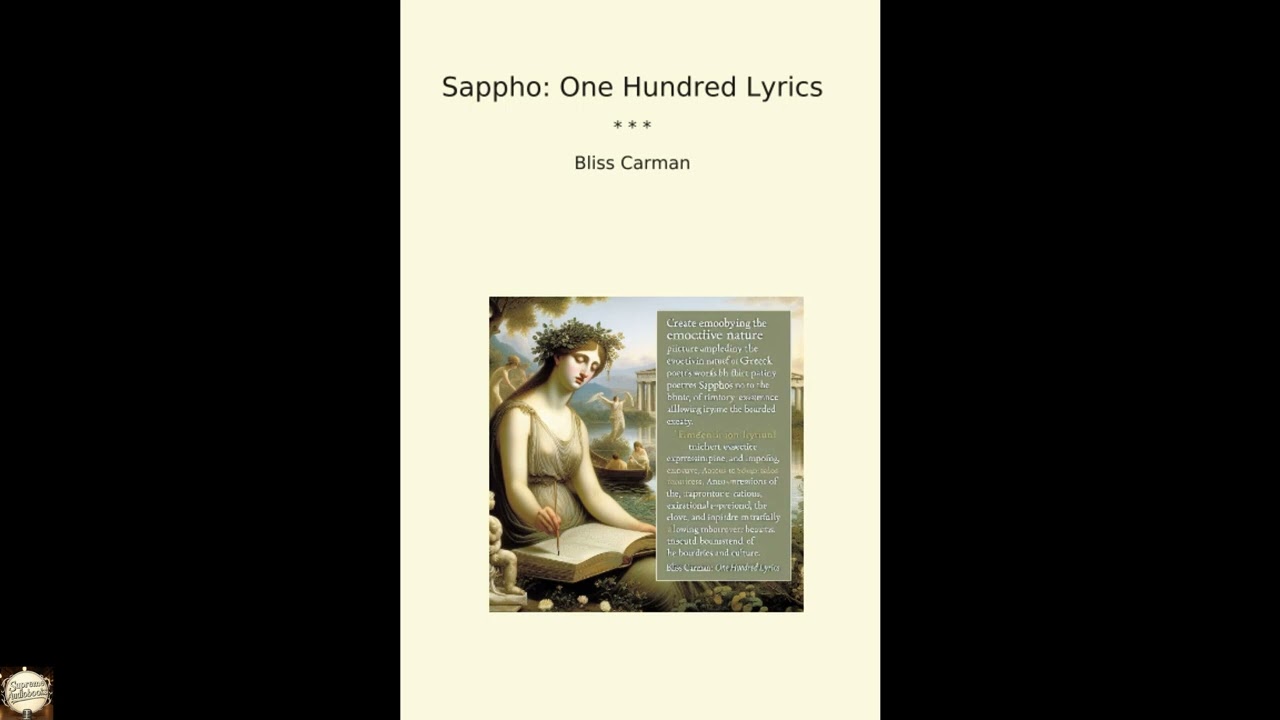
The 4K cinematic visuals accompanying this audiobook are generated by an AI image model from prompts derived from the source text. No copyrighted photos, paintings, or stock footage are used. AI generation is disclosed on every video on our YouTube channel as required by YouTube's altered/synthetic content policy.
English subtitles are transcribed from the LibriVox recording with OpenAI Whisper. Translations into the 11 other supported languages are produced by Meta's NLLB-200 neural translation model. No human translator's copyrighted translation is used.
Questions about sourcing or rights? See our DMCA & Sourcing policy or contact us.
Enjoyed this audiobook?
If you'd like to own a copy of Sappho: One Hundred Lyrics or hear a professionally produced edition, the links below help support free audiobook production at no extra cost to you.
As an Amazon Associate we earn from qualifying purchases. Audible / print links are affiliate.