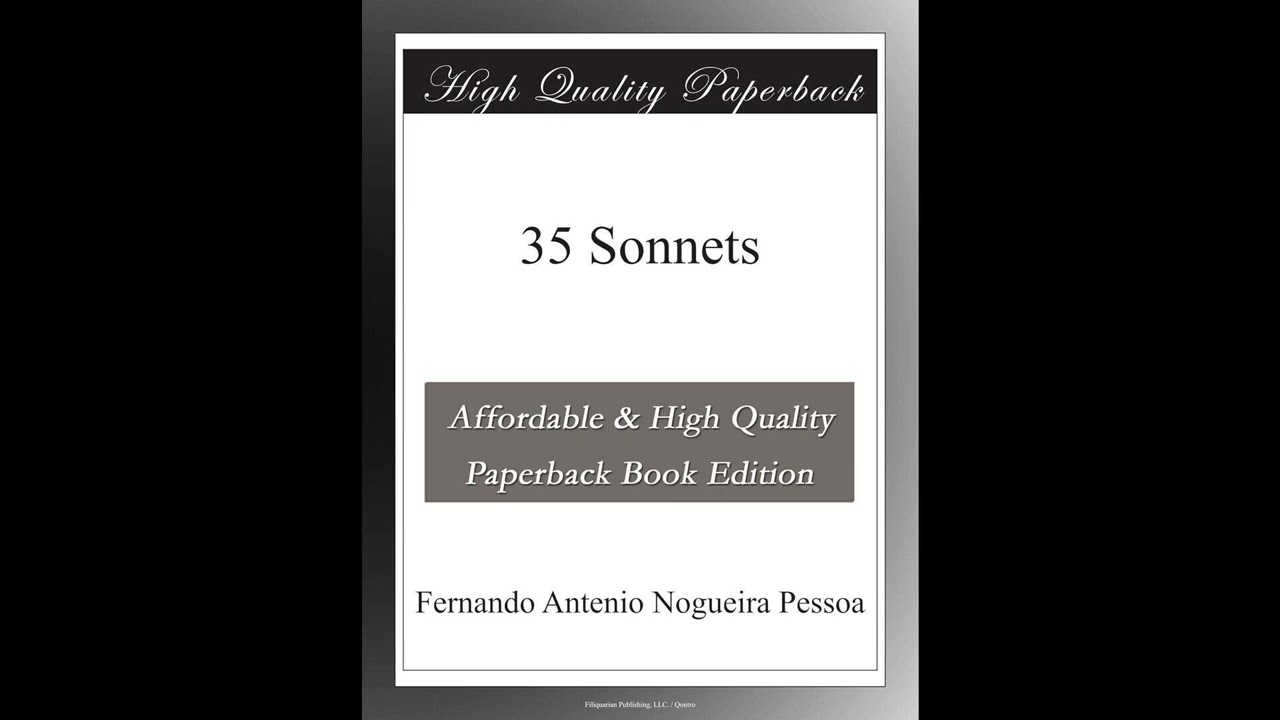
35 Sonnets
Fernando Pessoa's 35 Sonnets invites listeners into the profound, often bewildering, inner world of one of the twentieth century's most original poets. Far from a mere historical curiosity, these carefully crafted poems, penned in English by a Portuguese literary titan, offer a direct conduit to universal questions about identity, reality, and the nature of artistic expression. Each sonnet acts as a miniature stage where the mind wrestles with its own perceptions, doubts, and aspirations, providing not just verse but a concentrated dose of philosophical introspection. For anyone who has ever felt a sense of fragmented self, or sought meaning in the fleeting beauty of words, this collection presents a deeply resonant and surprisingly accessible experience, revealing the startling lucidity of a mind often described as an entire literature in itself. The sonnets themselves do not weave a conventional narrative with characters and a linear plot. Instead, they present a succession of intensely focused meditative states, each a self-contained contemplation, yet collectively building a compelling portrait of a consciousness grappling with existence. The "setting" is primarily the internal landscape of the speaker's mind—a space where thoughts, emotions, and abstract concepts are the tangible elements. The central "character," if one can be identified, is the poetic "I," which shifts and refracts, sometimes presenting as a detached observer, other times as a passionate seeker, and frequently as a figure wrestling with the very act of perception. The central conflict revolves around the fundamental human struggle to comprehend reality, to pin down the elusive nature of the self, and to articulate profound truths within the severe constraints of poetic form. Through these thirty-five pieces, the listener follows a subtle arc of introspection. The initial sonnets might introduce themes of doubt or the elusive quality of truth, perhaps questioning the solidity of the external world or the certainty of memory. As the collection progresses, the focus may sharpen, moving towards more direct confrontations with loneliness, the passage of time, or the bittersweet awareness of human limitations. There are moments of soaring intellectual clarity followed by descents into a profound sense of melancholy, echoing the Portuguese concept of saudade. Each sonnet offers a fresh attempt to articulate an often-paradoxical insight, building a cumulative sense of an individual mind forever poised on the edge of understanding, constantly reshaping its vision of truth. The listener is invited to witness not a story with an ending, but a continuing intellectual and emotional drama, played out in exquisite lyrical miniature. Fernando Antenio Nogueira Pessoa, born in Lisbon, Portugal, in 1888, lived a life marked by early loss and a profound intellectual curiosity. After his father's death and his mother's subsequent remarriage, he moved with his family to Durban, South Africa, where his stepfather served as the Portuguese consul. This crucial period, lasting from age seven to seventeen, immersed Pessoa in an English-speaking environment, leading to his fluency in the language and his early exposure to English literature, a factor deeply relevant to 35 Sonnets. He returned to Lisbon in 1905, where he spent the remainder of his life, supporting himself as a commercial correspondent while dedicating his evenings and weekends to an astonishing volume of poetry, prose, and criticism. Though he published relatively little during his lifetime, he generated an entire cosmos of literary output, much of it under the names of his famous "heteronyms"—distinct poetic personalities like Alberto Caeiro, Ricardo Reis, and Álvaro de Campos, each with their own biography, philosophy, and writing style. Pessoa’s private literary endeavor remained largely hidden from the public until after his death in 1935, when a trunk full of his unpublished manuscripts was discovered. This posthumous revelation cemented his place as one of the most significant figures in 20th-century literature, not just in Portugal but globally. His work, which spans Symbolism, Futurism, and a unique form of Modernism, challenged conventional notions of authorship and identity. While his heteronyms often receive the most critical attention for their distinct voices, his "orthonymic" work—poetry published under his own name, including many of these English sonnets—offers direct insight into his singular poetic concerns. His sustained engagement with the sonnet form demonstrates his deep respect for poetic tradition even as he pushed its thematic boundaries, placing him within a lineage that includes Shakespeare and Milton, but with a distinctly contemporary sensibility. Among the key themes that pervade 35 Sonnets, the most prominent is arguably the fragmentation of identity and the elusive nature of the self. Many of these poems question the coherence of the "I," suggesting that consciousness is a shifting, often contradictory collection of roles and perceptions rather than a unified entity. One sonnet might describe the feeling of being an audience to one's own thoughts, as if the self is not the actor but merely a spectator to its internal drama, observing its own joys and sorrows with a strange detachment. Another recurring theme is the interplay between reality and illusion. Pessoa frequently blurs the lines between what is perceived and what is truly "real," often implying that our understanding of the world is largely a construct of the mind. A sonnet might present a vivid natural scene—a garden, a sunset—only to pivot, in its sestet, to a meditation on how that beauty is entirely dependent on the observer's subjective experience, perhaps even suggesting that the external world only exists as an idea. A third central preoccupation is the power and limitations of language itself as a tool for apprehending truth. The sonnet form, with its strict rhyme scheme and meter, becomes a vehicle for this struggle, demonstrating how the very act of crafting language can both reveal and obscure meaning. A poem might lament the inadequacy of words to capture an emotion fully, or conversely, celebrate how the precise arrangement of syllables can momentarily create a perfect, if temporary, insight. Finally, a pervasive sense of existential loneliness and melancholy frequently surfaces. While not overtly tragic, many sonnets possess a deep contemplative sadness, a sense of isolation even amidst the most profound intellectual engagement. One sonnet might paint a picture of quiet solitude, where the only company is one's own thoughts, leading to a poignant reflection on the human condition—a state of being fundamentally alone with one's consciousness, even when surrounded by others. The early 20th century, the period during which Pessoa was actively writing and conceiving many of these sonnets, was a time of immense cultural and political upheaval in Europe. Portugal itself was undergoing significant changes, transitioning from a monarchy to the First Republic, a period marked by political instability and social ferment. Across the continent, the shadow of World War I loomed, eventually breaking out and fundamentally altering the global landscape. This era saw the flourishing of Modernism in literature and art, characterized by a rejection of traditional forms, an experimentation with new modes of expression, and a profound questioning of established beliefs and social structures. Poets like T.S. Eliot and Ezra Pound were forging new paths in English poetry, embracing fragmentation and complex allusions. Pessoa, though geographically somewhat isolated in Lisbon, was acutely aware of these international currents. His decision to write poetry in English, a language he mastered during his formative years in South Africa, was not merely an academic exercise but a conscious engagement with a broader literary tradition. These sonnets, steeped in a form perfected by English poets, allowed him to channel universal philosophical quandaries and emotional states into a structure that both honored tradition and provided a disciplined framework for his often-radical ideas. They emerged at a time when the very concept of a unified self was being challenged by psychology and philosophy, and when artists sought new ways to express the fractured realities of a rapidly changing world. Pessoa’s sonnets, with their intense introspection and formal rigor, represent a quiet but powerful response to this era of intellectual and societal flux, a personal quest for meaning in an increasingly complex universe. Listening to 35 Sonnets as an audiobook offers a unique and deeply personal way to connect with Pessoa's vision. The human voice brings the rhythm and cadence of each sonnet to life, allowing the listener to absorb the intricate interplay of meter and meaning in a way that silent reading might not immediately convey. Pay attention to the narrator's pacing, the subtle pauses, and the inflection used to highlight specific words or philosophical turns. These choices can deepen the understanding of Pessoa's nuanced arguments and emotional undertones. The run length provides ample opportunity for sustained engagement, allowing one to sit with the thoughts presented, perhaps revisiting individual sonnets to ponder their depths. Hearing the verse read aloud can also make the classical form feel immediate and accessible, transforming what might appear as formal constraints on the page into a natural flow of thought and feeling, revealing the profound intimacy of a poet speaking directly to the mind's ear.
Enjoyed 35 Sonnets? A few ways to support us
Audible & Amazon links are affiliate; we may earn a small commission at no extra cost.
About this production
Human narration by a volunteer reader from LibriVox.org, the public-domain audiobook project. LibriVox volunteers record literary works whose copyright has expired in the United States, releasing the resulting recordings into the public domain.
35 Sonnets by Fernando Antenio Nogueira Pessoa. The underlying text is in the U.S. public domain. We do not republish any modern copyrighted edition, translation, or commentary.
The 4K cinematic visuals accompanying this audiobook are generated by an AI image model from prompts derived from the source text. No copyrighted photos, paintings, or stock footage are used. AI generation is disclosed on every video on our YouTube channel as required by YouTube's altered/synthetic content policy.
English subtitles are transcribed from the LibriVox recording with OpenAI Whisper. Translations into the 11 other supported languages are produced by Meta's NLLB-200 neural translation model. No human translator's copyrighted translation is used.
Questions about sourcing or rights? See our DMCA & Sourcing policy or contact us.
View 10 famous quotes from this book →
Enjoyed this audiobook?
If you'd like to own a copy of 35 Sonnets or hear a professionally produced edition, the links below help support free audiobook production at no extra cost to you.
As an Amazon Associate we earn from qualifying purchases. Audible / print links are affiliate.