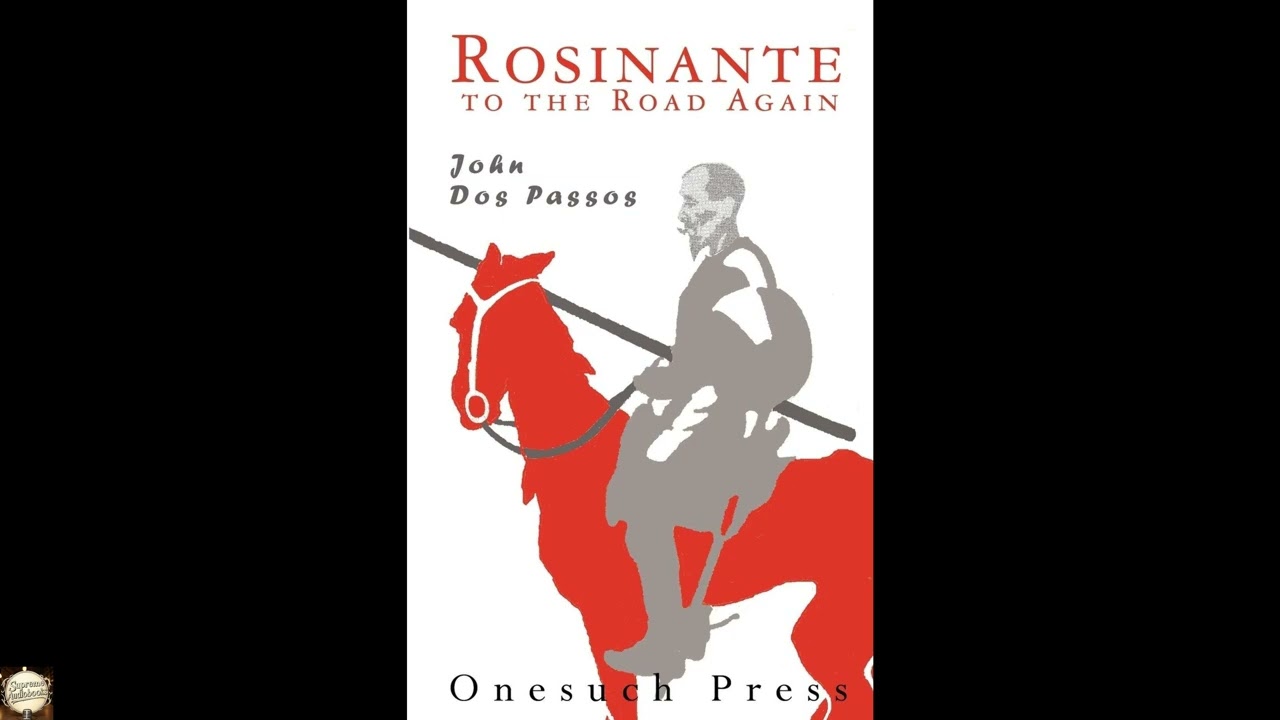
Rosinante to the Road Again
The world felt shattered after the Great War, and for a generation of young Americans, the old certainties had crumbled, replaced by a profound sense of loss and questioning. John Dos Passos’s Rosinante to the Road Again captures this very sentiment, serving as an eloquent, often wistful, record of that disillusionment and the urgent need to find new meaning in a landscape irrevocably altered. It presents a vital snapshot of a pivotal historical moment, exploring the inner lives of individuals grappling with a world they no longer recognized, and it offers an intimate look at the formation of one of America's most significant literary voices, showing us how the spirit of a searching age could animate a novel that continues to resonate with anyone seeking answers in uncertain times. The narrative follows Martin Howe, an American writer adrift in the aftermath of the First World War. He travels through Spain with his companion, a medical student named Lyaeus, whose name itself hints at a classical, perhaps Bacchic, freedom of spirit. Their journey is less about reaching a specific destination and more about the experience of the road itself, a rambling and introspective exploration of a country still steeped in tradition, yet facing its own modern challenges. As they wander from bustling cities to dusty villages, they engage in long, thoughtful conversations, observing the Spanish people and their way of life with a keen, often critical, eye. These encounters form the backbone of the story, as Howe and Lyaeus grapple with the trauma of war, the perceived failure of Western civilization's ideals, and the desperate longing for a more authentic, fulfilling existence. Their travels become a spiritual quest, an attempt to find some enduring truth or beauty in a world that feels broken. They meet a varied cast of characters – peasants, intellectuals, bullfighters, artists – each offering a different perspective on life, love, and the pursuit of happiness. Howe, with his writer’s sensibility, absorbs these observations, filtering them through his own growing cynicism and idealism. The central tension lies in their struggle to reconcile the brutal realities they have witnessed with their yearning for poetry and purpose, as they seek to understand Spain not merely as a foreign land, but as a mirror reflecting their own generation's anxieties and hopes. The book avoids a neat resolution, instead leaving its characters, and the listener, with an enduring sense of contemplation, of questions posed rather than definitively answered. John Dos Passos, born in Chicago in 1896, lived a life as dynamic and observational as his prose. He attended Harvard University, and like many young men of his generation, volunteered as an ambulance driver in France and Italy during the First World War. This direct, harrowing experience profoundly shaped his worldview and became a foundational influence on his early fiction, including Rosinante to the Road Again and his later war novel, Three Soldiers. Dos Passos was a quintessential member of the "Lost Generation," a term coined by Gertrude Stein for American expatriates and intellectuals who came of age during the war and felt disillusioned by its outcome. His prolific career saw him travel widely, engage deeply with political movements, and relentlessly experiment with literary form. Beyond his early works, Dos Passos is best known for his monumental U.S.A. trilogy, which comprises The 42nd Parallel, 1919, and The Big Money. These novels revolutionized the American novel with their innovative use of documentary techniques—including newsreels, capsule biographies of public figures, and a stream-of-consciousness "Camera Eye" section—to create a panoramic, kaleidoscopic portrait of early 20th-century America. He stood alongside contemporaries like Ernest Hemingway and F. Scott Fitzgerald as a major voice of American Modernism, chronicling the social and economic upheavals of his time. Dos Passos maintained a lifelong commitment to observing and documenting American life, ultimately settling in Virginia and continuing to write prolifically until his death in 1970. A powerful theme running through the book is the profound disillusionment that gripped a generation after the catastrophic First World War. Martin Howe and Lyaeus carry the invisible wounds of that conflict, and their travels through Spain become a means of processing a world that seems to have lost its moral compass. They observe the traditional rhythms of Spanish life, such as the stoic dignity of farmers or the passionate intensity of flamenco, often contrasting it with the perceived decay and hypocrisy of modern industrial society. For example, their cynical remarks about European politics stand in stark contrast to their appreciation for a simple meal shared with villagers, highlighting their search for genuine human connection amidst the wreckage of grand ideologies. Another central concern is the quest for authentic experience and the meaning of personal freedom. The protagonists deliberately avoid the well-trodden tourist paths, seeking out the "real" Spain in its less polished corners. They engage in spirited discussions about art, philosophy, and the nature of beauty, often debating whether true freedom lies in artistic creation, political engagement, or simply a life lived close to the land. We see this enacted in their preference for small, unassuming inns over grand hotels, and their intellectual sparring over the merits of various artists and writers, always circling back to the idea of finding a personal truth in a world full of artifice. The book also implicitly addresses the clash between tradition and nascent modernity, as the ancient customs of Spain are viewed through the lens of early 20th-century skepticism and artistic aspiration. Rosinante to the Road Again emerged in the early 1920s, a period of immense cultural and political ferment following the end of the First World War. In America, the "Roaring Twenties" were taking hold, marked by economic boom, social change, and a burgeoning sense of modernity. In Europe, countries were rebuilding, grappling with economic instability, and facing new political ideologies. The literary world, too, was undergoing a radical shift, moving away from Victorian sensibilities towards the experimental forms and psychological depths of Modernism. Writers like T.S. Eliot, James Joyce, and Virginia Woolf were redefining the novel and poetry. Dos Passos, having witnessed the horrors of war firsthand, was part of this wave of writers who felt compelled to articulate the confusion, anger, and longing of a generation that had seen its ideals shattered and was now searching for new ways to understand the human condition and society itself. The book, therefore, exists as an early and vivid expression of the "Lost Generation's" collective voice. Listening to Rosinante to the Road Again as an audiobook transforms its observational prose into an immersive experience. A skilled narrator can bring out the nuanced tones of Martin Howe’s introspection and the lively cadences of the philosophical dialogues between him and Lyaeus, making their intellectual exchanges feel immediate and engaging. The unhurried pace of the narrative, mirroring the characters' meandering travels across Spain, lends itself perfectly to audio, inviting listeners to slow down and absorb the vivid descriptions of landscapes, cityscapes, and the sounds of Spanish life. One can easily picture the dusty roads and the sun-drenched plazas as the narrative unfolds, allowing the atmosphere of post-war Spain to truly envelop the listener. The extended run length makes it an ideal companion for long commutes, thoughtful evenings, or quiet afternoons, offering an expansive window into a unique moment in literary history and a searching exploration of human experience.
Enjoyed Rosinante to the Road Again? A few ways to support us
Audible & Amazon links are affiliate; we may earn a small commission at no extra cost.
About this production
Human narration by a volunteer reader from LibriVox.org, the public-domain audiobook project. LibriVox volunteers record literary works whose copyright has expired in the United States, releasing the resulting recordings into the public domain.
Rosinante to the Road Again by John Dos Passos. The underlying text is in the U.S. public domain. We do not republish any modern copyrighted edition, translation, or commentary.
The 4K cinematic visuals accompanying this audiobook are generated by an AI image model from prompts derived from the source text. No copyrighted photos, paintings, or stock footage are used. AI generation is disclosed on every video on our YouTube channel as required by YouTube's altered/synthetic content policy.
English subtitles are transcribed from the LibriVox recording with OpenAI Whisper. Translations into the 11 other supported languages are produced by Meta's NLLB-200 neural translation model. No human translator's copyrighted translation is used.
Questions about sourcing or rights? See our DMCA & Sourcing policy or contact us.
Enjoyed this audiobook?
If you'd like to own a copy of Rosinante to the Road Again or hear a professionally produced edition, the links below help support free audiobook production at no extra cost to you.
As an Amazon Associate we earn from qualifying purchases. Audible / print links are affiliate.