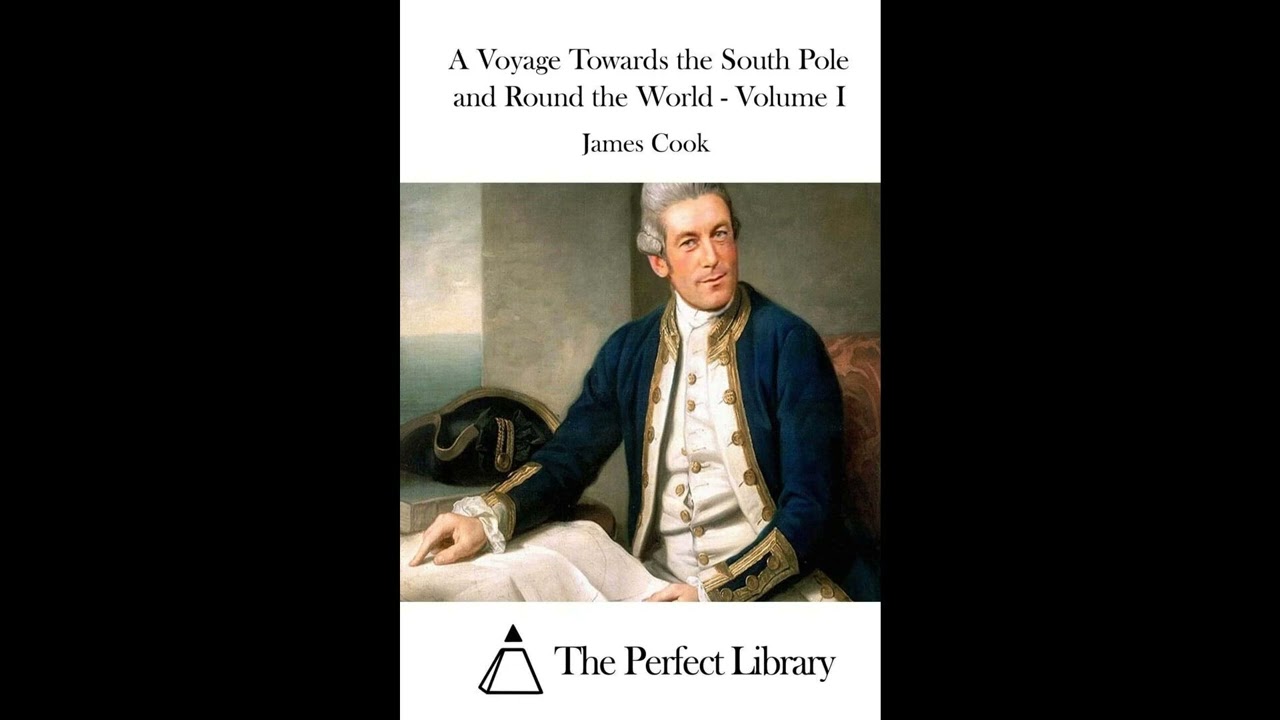
A Voyage Towards the South Pole and Round the World - Volume I
Imagine a time when the world was still laced with vast, uncharted regions, where maps blurred into speculative warnings, and the true dimensions of our planet remained a matter of fierce conjecture. "A Voyage Towards the South Pole and Round the World - Volume I" transports listeners to just such an epoch—a period defined by daring nautical endeavors, relentless scientific curiosity, and an unyielding drive to push past the very limits of human understanding. This foundational account, an authentic voice from the Age of Exploration, offers more than a simple record of physical passage; it stands as a testament to humanity's capacity for endurance, ingenuity, and a profound yearning to witness what lies beyond the horizon. It compels us to consider the courage required to confront the absolute unknown, a primal challenge that resonates with our own contemporary quests for knowledge and self-discovery. The narrative commences with the ship’s spirited departure from a bustling European port, the air thick with anticipation and the promise of discovery. Our anonymous narrator, likely a keen observer within the expedition’s scientific or navigational hierarchy, introduces us to the vessel—a sturdy, purpose-built ship designed for the rigors of high seas—and the diverse crew, a microcosm of society bound by a shared, formidable task. As they leave the familiar coastlines behind, the initial stages of the voyage across the Atlantic bring forth the classic challenges of maritime travel: shifting winds, sudden squalls, and the necessity of meticulous maintenance. Days blur into weeks as the sun's angle perceptibly lowers, guiding them ever southward, the crew settling into the demanding rhythm of life at sea, constantly alert to the subtle changes in weather and water that dictate their survival. As the vessel enters the desolate reaches of the Southern Ocean, the true gravity of their mission begins to weigh upon both ship and crew. Here, the landscape transforms into one of breathtaking, yet fearsome, grandeur—vast expanses of turbulent grey water punctuated by towering icebergs and the ominous presence of pack ice. The relentless cold permeates every corner of the ship, and the constant vigilance against natural hazards—crushing ice, furious blizzards, and the ever-present threat of scurvy—becomes a daily struggle for existence. The narrator meticulously records geographical coordinates, meteorological data, and any sightings of unfamiliar marine life, painting a vivid picture of a world few human eyes had ever witnessed. Volume I concludes as the expedition presses deeper into these extreme latitudes, having overcome numerous obstacles but with the ultimate goal of circumnavigation still unfolding before them, leaving the listener poised on the precipice of further revelation. The authorship of this remarkable account, presented as "Unknown," places it within a long and esteemed tradition of maritime and scientific reportage that often prioritized the collective achievement of an expedition over individual renown. During the centuries of intense global exploration, from the Renaissance through the Age of Enlightenment, it was not uncommon for official voyage journals, logs, and personal observations to be compiled, edited, or even slightly embellished for public consumption, sometimes without a single credited author, or attributed to a generalized "Company of Adventurers" or "Officer of the Fleet." Such publications served multiple crucial functions, disseminating vital geographical and scientific data, asserting national claims, and satisfying an eager public appetite for thrilling tales of discovery. This work stands as a direct descendant of that powerful lineage, representing a period when the very concept of authorship was more fluid, sometimes secondary to the information being conveyed. It echoes the spirit of voyagers who, regardless of personal recognition, meticulously documented the world as they found it. These textual artifacts are invaluable for understanding the intellectual currents of their time, providing not just gripping adventure but also raw data—observations of flora, fauna, indigenous peoples, and celestial mechanics—that contributed significantly to the burgeoning fields of natural history, cartography, and early anthropology. It reminds us that some of history's most impactful narratives stem from a collective human endeavor rather than a singular artistic genius. At its core, the account vividly enacts several enduring themes. Foremost is the profound confrontation between humanity and the untamed natural world. Time and again, the narrative places the small, vulnerable vessel and its crew against the overwhelming power of the elements. For instance, the descriptions of the ship struggling through an immense field of ice, where every creak of the timbers and every crunch against the floes signifies potential destruction, underscore the sheer fragility of human endeavor when faced with the indifferent might of the ocean and ice. Another prominent theme is the relentless pursuit of knowledge. The narrator consistently emphasizes the scientific objectives of the voyage, detailing the precise measurements of longitude and latitude, the recording of new species, and the careful charting of unseen coastlines. A concrete example appears in the meticulous descriptions of astronomical observations made under challenging conditions, demonstrating the era's dedication to empirical data and the systematic quest to fill in the blank spaces of the global map, driven by the rational spirit of the Enlightenment. The isolation and sheer psychological weight of sustained effort also emerge as significant motifs, showing the toll that immense distances and weeks without sight of land take on the human spirit. Historically, this kind of voyage report emerged during a pivotal moment: the late 18th and early 19th centuries, a period often referred to as the "Age of Reason" or the "Age of Enlightenment." This era was characterized by an explosion of scientific inquiry, a growing belief in the power of human reason, and a profound desire to classify and understand the entire natural world. Major European powers—particularly Great Britain and France—sponsored ambitious expeditions not merely for conquest or trade, but with explicit scientific mandates: to map, to classify, to collect, and to observe. The search for the fabled Terra Australis Incognita, a vast southern continent long hypothesized but unproven, fueled many such ventures, giving rise to legendary figures like Captain James Cook, whose voyages significantly pushed the boundaries of southern exploration, though the continent itself remained elusive for decades more. This specific work likely surfaced from a public hungry for these accounts, seeking to understand the farthest reaches of the globe and the triumphs of human ingenuity over formidable odds. The technical advancements in shipbuilding, navigation (such as improved chronometers for determining longitude), and cartography during this time made such extensive voyages feasible, even if still fraught with immense peril. These narratives served as both educational tools and thrilling adventure stories, shaping the public's perception of the world and inspiring subsequent generations of scientists, sailors, and dreamers to push the frontiers even further. To experience "A Voyage Towards the South Pole and Round the World - Volume I" as an audiobook is to gain an immediate, visceral connection to this past era of grand discovery. A skilled narrator can bring to life the measured, precise language of the account, transforming what might otherwise be dense factual descriptions into a gripping, immersive experience. The rhythmic cadence of the prose, reflecting the slow, grinding progress of a sailing vessel, finds a natural complement in careful vocal delivery. Listeners can almost feel the spray of the waves, hear the creak of the ship's timbers, and sense the overwhelming silence of the desolate southern regions. The sustained length of the reading allows for deep immersion, enabling the atmosphere of isolation, the tension of approaching storms, and the awe of unprecedented sightings to truly settle and resonate, providing a unique window into the minds and experiences of those who bravely ventured into the world's last great unknowns.
Enjoyed A Voyage Towards the South Pole and Round the World - Volume I? A few ways to support us
Audible & Amazon links are affiliate; we may earn a small commission at no extra cost.
About this production
Human narration by a volunteer reader from LibriVox.org, the public-domain audiobook project. LibriVox volunteers record literary works whose copyright has expired in the United States, releasing the resulting recordings into the public domain.
A Voyage Towards the South Pole and Round the World - Volume I by Volume I. The underlying text is in the U.S. public domain. We do not republish any modern copyrighted edition, translation, or commentary.
The 4K cinematic visuals accompanying this audiobook are generated by an AI image model from prompts derived from the source text. No copyrighted photos, paintings, or stock footage are used. AI generation is disclosed on every video on our YouTube channel as required by YouTube's altered/synthetic content policy.
English subtitles are transcribed from the LibriVox recording with OpenAI Whisper. Translations into the 11 other supported languages are produced by Meta's NLLB-200 neural translation model. No human translator's copyrighted translation is used.
Questions about sourcing or rights? See our DMCA & Sourcing policy or contact us.
Enjoyed this audiobook?
If you'd like to own a copy of A Voyage Towards the South Pole and Round the World - Volume I or hear a professionally produced edition, the links below help support free audiobook production at no extra cost to you.
As an Amazon Associate we earn from qualifying purchases. Audible / print links are affiliate.