Rose and Roof-Tree — Poems
Step into a quiet parlor of the American Gilded Age, where flickering gaslight illuminates the pages of a deeply personal collection of verse. George Parsons Lathrop's Rose and Roof-Tree presents an intimate and reflective gathering of poems that once captivated readers with their grace, sentiment, and keen observation of life’s quieter moments. Far from being mere historical curiosities, these poems speak to enduring human experiences – the solace of home, the complexities of love, the ephemeral beauty of nature, and the quiet search for meaning in a rapidly changing world. For anyone seeking a moment of contemplative beauty, a window into a bygone era's sensibilities, or simply the resonant pleasure of well-crafted verse, this collection offers a tranquil and rewarding sojourn. Within Rose and Roof-Tree, Lathrop lays out a poetic landscape that moves from the familiar comforts of domestic life to broader meditations on the natural world and the passage of time. The collection's title itself hints at its core themes: "Rose" perhaps symbolizing beauty, love, and his renowned wife, Rose Hawthorne, while "Roof-Tree" evokes home, family, and the foundational elements of one's existence. Listeners will encounter verses that paint vivid pictures of hearth and home, celebrating the quiet joys and sometimes unspoken sorrows that reside within the walls of a cherished dwelling. These are not grand epics but rather delicate vignettes—short, lyrical pieces that capture a fleeting thought, a remembered glance, or the gentle interplay between a married couple as they navigate their shared life. The collection progresses through various moods and settings, occasionally venturing beyond the immediate domestic sphere to consider the majesty of landscapes, the changing seasons, or the introspective thoughts that arise during solitary moments. There are poems that reflect a deep appreciation for the American countryside, its forests, rivers, and the quiet dignity of its towns. A central thread through these poems is the constant human striving for connection and understanding—with loved ones, with the natural world, and with a sense of purpose. While no singular "plot" unfolds in the traditional sense, the listener experiences an arc of emotional and intellectual engagement, moving through moments of tender affection, quiet contemplation, and a gentle reckoning with the inevitable tides of life and loss. The collection stands as a testament to the idea that profound truth can often be found in the seemingly ordinary. George Parsons Lathrop was born in Honolulu, Hawaii Territory, in 1851, a location that offered an unconventional start for a future figure in American letters. His father was a U.S. consul, and young Lathrop spent parts of his youth abroad, including in Germany, where he received some of his education. This early exposure to different cultures likely broadened his perspective, even if his poetic subjects often remained rooted in American sensibilities. He returned to the United States to study law but soon turned his talents to writing, journalism, and literary criticism, establishing himself as a significant voice in the late 19th-century American literary scene. Lathrop's life took a particularly interesting turn when he married Rose Hawthorne, the daughter of the towering American novelist Nathaniel Hawthorne, in 1871. This union placed him directly at the heart of America's literary aristocracy and significantly influenced his career. He became a respected editor and critic, known for his incisive analyses and for editing posthumous editions of his famous father-in-law's works, playing a crucial role in shaping Hawthorne's legacy. Beyond his poetry, Lathrop published several novels, including An Echo of Passion and Gettysburg: A Battle Ode, and contributed widely to prominent magazines of the era. He and Rose later converted to Catholicism, a deeply personal decision that further shaped his philosophical outlook in his later years before his passing in New York City in 1898. One of the central themes woven throughout Rose and Roof-Tree is the profound importance of home and domesticity. Lathrop frequently employs imagery of the hearth, the garden, and the shared spaces of a house to convey a sense of comfort, belonging, and emotional stability. For instance, a poem might describe the quiet satisfaction found in a spouse's presence during an evening spent indoors, or the significance of a well-tended garden as a metaphor for a life cultivated with care. This theme isn't merely sentimental; it often presents home as a sanctuary against the larger, often tumultuous world outside, a place where genuine human connection can truly flourish. Another prominent theme is the interplay between nature and human emotion. Lathrop often uses natural imagery—the changing leaves, the flow of a river, the cycle of seasons—not just as decorative elements but as reflections of inner states or as catalysts for contemplation. A particular poem might describe a winter landscape, drawing parallels between its stark beauty and feelings of solitude, or a spring morning that inspires hope and renewal. Through these connections, Lathrop suggests that the natural world holds deep truths about human existence, offering both solace and profound lessons for those who observe it closely. The period in which Rose and Roof-Tree appeared, the late 19th century, was a time of immense change in America. The nation was still grappling with the aftermath of the Civil War, industrialization was rapidly transforming society, and urbanization was drawing people away from rural life. In the literary world, a tension existed between the lingering romanticism of earlier generations and the emerging tide of realism and naturalism. Lathrop's work, while embracing elements of realism in its specific observations, largely aligned with what was sometimes called the "genteel tradition"—a style characterized by decorum, moral uplift, and an appreciation for beauty and refinement. This collection emerged as a response to the era's anxieties, offering readers a space for reflection and an affirmation of enduring values like family, faith, and the simple beauties of life amidst an increasingly complex world. It reflected a cultural desire for stability and grace in a time of great upheaval. Listening to Rose and Roof-Tree as an audiobook transforms the experience of Lathrop's poetry from a solitary reading into a shared auditory event. The spoken word brings forth the inherent musicality and rhythm of the verse in a way that silent reading often cannot fully capture. The narrator’s voice becomes the conduit for Lathrop's carefully chosen words, highlighting the subtle cadences, the delicate rhymes, and the emotional resonance embedded within each line. As the poems unfold over several hours, listeners can appreciate the cumulative effect of Lathrop's sustained focus on domestic beauty and introspective thought. The pacing allows for contemplation, inviting one to absorb the imagery and sentiment, making the collection ideal for quiet evenings or peaceful mornings, perhaps while walking or simply resting. Pay attention to how the voice modulates to convey the warmth of a loving sentiment or the quiet dignity of a reflective moment, bringing Lathrop's world vividly to life.
Enjoyed Rose and Roof-Tree — Poems? A few ways to support us
Audible & Amazon links are affiliate; we may earn a small commission at no extra cost.
About this production
Human narration by a volunteer reader from LibriVox.org, the public-domain audiobook project. LibriVox volunteers record literary works whose copyright has expired in the United States, releasing the resulting recordings into the public domain.
Rose and Roof-Tree — Poems by George Parsons Lathrop. The underlying text is in the U.S. public domain. We do not republish any modern copyrighted edition, translation, or commentary.
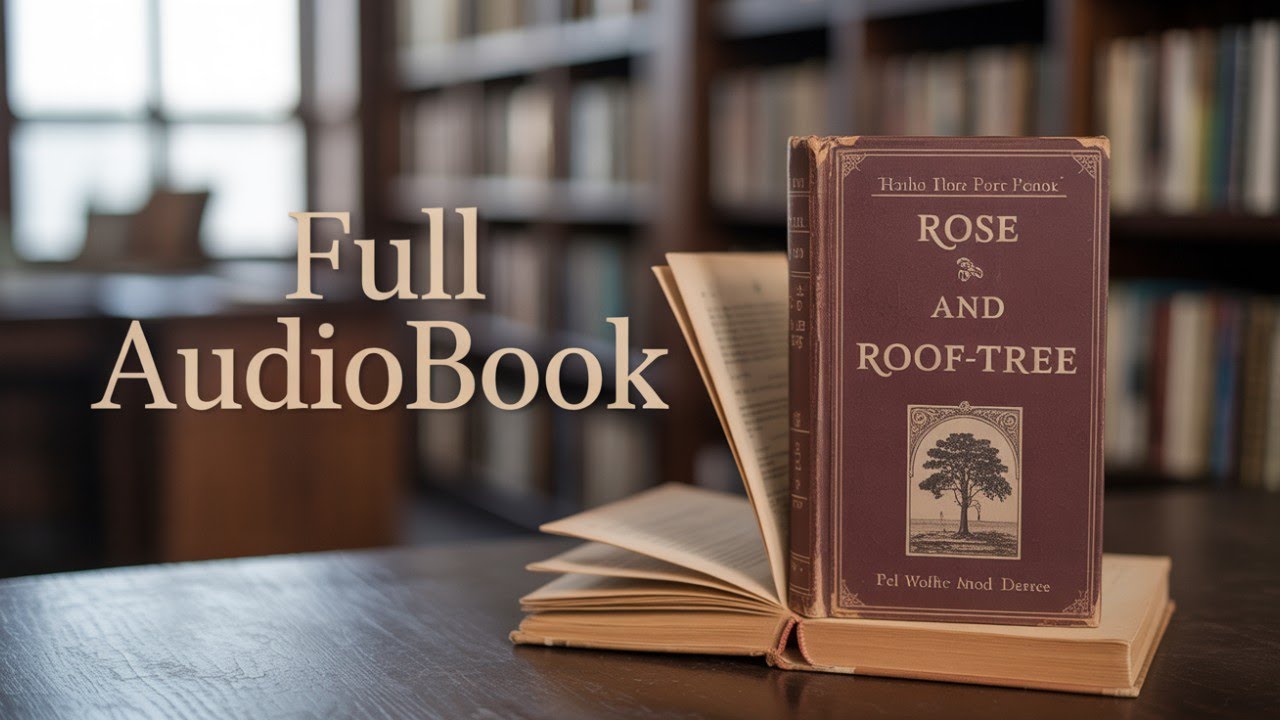
The 4K cinematic visuals accompanying this audiobook are generated by an AI image model from prompts derived from the source text. No copyrighted photos, paintings, or stock footage are used. AI generation is disclosed on every video on our YouTube channel as required by YouTube's altered/synthetic content policy.
English subtitles are transcribed from the LibriVox recording with OpenAI Whisper. Translations into the 11 other supported languages are produced by Meta's NLLB-200 neural translation model. No human translator's copyrighted translation is used.
Questions about sourcing or rights? See our DMCA & Sourcing policy or contact us.
Enjoyed this audiobook?
If you'd like to own a copy of Rose and Roof-Tree — Poems or hear a professionally produced edition, the links below help support free audiobook production at no extra cost to you.
As an Amazon Associate we earn from qualifying purchases. Audible / print links are affiliate.