Robin Hood
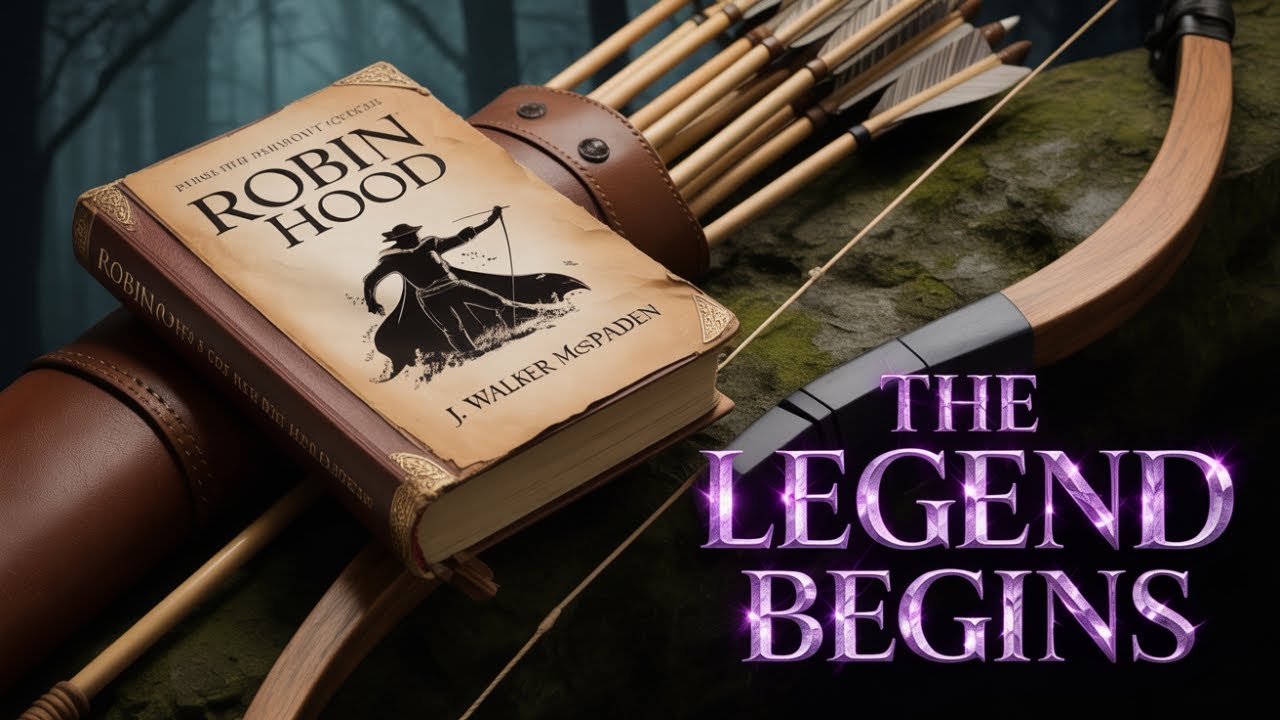
The legend of Robin Hood has echoed through centuries, a powerful whisper of rebellion against injustice that continues to resonate today. J. Walker McSpadden’s rendition of this enduring tale offers a spirited gateway into a world where a skilled archer, dispossessed and wronged, chooses not despair but defiance. He gathers a band of loyal companions to reclaim a semblance of fairness in a deeply unfair world. This is more than a story of adventure and derring-do; it speaks to a fundamental human longing for equity, for the weak to triumph over the strong, and for courage to light the way when shadows of oppression lengthen. It asks what true law means when those in power abuse their authority, inspiring hope that even a single person, with integrity and a keen bow, can challenge a corrupt system. We are transported to medieval England, a land groaning under the heavy hand of Prince John, regent in the absence of the crusading King Richard. With the rightful king abroad, the realm is plundered by avaricious nobles and grasping sheriffs, their coffers swelling while the common folk starve. Amidst this turmoil, an honorable yeoman named Robin finds himself unjustly outlawed, forced to flee into the verdant depths of Sherwood Forest. Here, beneath the ancient oaks, he sheds his former life and adopts an identity synonymous with spirited resistance. Robin Hood quickly draws to himself a diverse company of individuals, all wronged by the oppressive regime. Among them are the towering Little John, a formidable staff-wielder; the jovial Friar Tuck, a stout man of the cloth who loves ale and honest fighting; and the noble Maid Marian, whose wit and courage are sharp as any arrow, alongside Will Scarlet and Alan-a-Dale. This band of "Merry Men" dedicates itself to a unique form of justice, ambushing wealthy travelers—corrupt clergymen, greedy merchants, and the King’s tax collectors—to redistribute ill-gotten gains among the poor and downtrodden. Their exploits become a thorn in the side of the nefarious Sheriff of Nottingham, who tirelessly attempts to capture Robin and his gang, often falling victim to their cunning traps and superior woodcraft. The narrative follows their skirmishes, ingenious disguises, and steadfast commitment to upholding a moral code in a land where morality has been forgotten by those in power. J. Walker McSpadden (1874-1960), an American editor and author, played a significant role in making classic stories accessible to a broad, often younger, audience during the early twentieth century. McSpadden was not a scholar of ancient texts, but a gifted popularizer. He skillfully rendered foundational narratives into engaging, flowing prose. His version of Robin Hood, published in 1904, exemplifies this talent for adaptation, taking centuries-old oral traditions and various written accounts, shaping them into a coherent, family-friendly narrative that retained the original legend's spirit of adventure and justice. He was remarkably prolific, producing numerous retellings and encyclopedic works. Among his notable titles were Stories from Wagner, introducing operatic myths to English readers, and Stories from Chaucer, simplifying medieval tales. He also edited works about famous characters like Alice in Wonderland and Rip Van Winkle, solidifying his reputation as a preserver of literary heritage. His work, though not original in plot, holds a significant place for transmitting cultural narratives, ensuring stories like Robin Hood—potentially intimidating or obscure—remained vital components of shared literacy. At its heart, McSpadden’s Robin Hood champions social justice. The narrative consistently illustrates Robin’s commitment to righting wrongs, taking from oppressors and providing for the needy. A memorable instance involves Robin encountering starving peasants, their crops seized by the Sheriff’s men, and subsequently intercepting a convoy of the Sheriff's ill-gotten bounty, ensuring food and coin reach the needy. This direct action offers concrete examples of justice enacted where official channels have failed. Another prominent theme is defiance against tyranny. Robin and his Merry Men continually challenge the corrupt authority of Prince John and the Sheriff of Nottingham, demonstrating that legitimate power derives from moral governance, not brute force or inherited status. Their refusal to bend to unjust laws, and resourcefulness in outwitting oppressors, underscores the power of wit and unity against overwhelming odds. Loyalty and brotherhood among Robin’s men also shine brightly. From Little John’s unwavering support to Friar Tuck’s spirited participation, their collective camaraderie reinforces that strength lies in solidarity, forming a powerful example of community built on mutual respect and common cause. McSpadden’s Robin Hood emerged during the early years of the twentieth century, a period in both America and Britain marked by social change and a burgeoning interest in accessible literature for a broader audience. In the United States, the Progressive Era was taking hold, a time of widespread activism and reform, aimed at correcting injustices, curbing industrial capitalism’s excesses, and increasing public participation. Stories of a hero who stood for the common person against wealthy, corrupt figures resonated deeply with the spirit of the age, echoing calls for corporate regulation and greater economic equity. Literarily, this era saw a concerted effort to popularize classic tales, particularly for children and young adults, ensuring foundational myths remained part of cultural education. McSpadden was a leading figure in this movement, which sought to distill complex narratives into engaging, digestible forms. His version of Robin Hood likely stripped away some of the grittier or more ambiguous elements of older renditions, presenting a clear moral vision for didactic purposes, while still offering excitement. The enduring legend itself, having been retold for centuries, found a new voice in McSpadden’s early 20th-century interpretation, aligning its core message of justice with contemporary concerns. The legend of Robin Hood, with its roots in oral tradition and balladry, finds a natural home in the audiobook format. Listening recaptures the communal spirit of storytelling, as a skilled narrator brings Sherwood Forest's rustling leaves, the clang of quarterstaves, and the hearty laughter of the Merry Men to your imagination. The several hours of narration provide a perfect companion for long drives, focused work, or relaxing, letting the tale unfold at its own deliberate pace. A good narration will bring life to the distinct voices of Robin, the blustering Sheriff, the booming Friar Tuck, and the cunning Maid Marian, distinguishing characters through tone and cadence. Listen for the subtle shifts in atmosphere—the tension of a hidden ambush, the exhilaration of a successful trick, the warmth of camaraderie around a forest fire. McSpadden’s prose, designed for clear comprehension and engaging delivery, shines when spoken aloud, allowing dialogue’s wit and action’s swiftness to resonate. It is an invitation to experience this foundational adventure as it was always meant to be shared: through the human voice.
Enjoyed Robin Hood? A few ways to support us
Audible & Amazon links are affiliate; we may earn a small commission at no extra cost.
About this production
Human narration by a volunteer reader from LibriVox.org, the public-domain audiobook project. LibriVox volunteers record literary works whose copyright has expired in the United States, releasing the resulting recordings into the public domain.
Robin Hood by J Walker McSpadden. The underlying text is in the U.S. public domain. We do not republish any modern copyrighted edition, translation, or commentary.
The 4K cinematic visuals accompanying this audiobook are generated by an AI image model from prompts derived from the source text. No copyrighted photos, paintings, or stock footage are used. AI generation is disclosed on every video on our YouTube channel as required by YouTube's altered/synthetic content policy.
English subtitles are transcribed from the LibriVox recording with OpenAI Whisper. Translations into the 11 other supported languages are produced by Meta's NLLB-200 neural translation model. No human translator's copyrighted translation is used.
Questions about sourcing or rights? See our DMCA & Sourcing policy or contact us.
Enjoyed this audiobook?
If you'd like to own a copy of Robin Hood or hear a professionally produced edition, the links below help support free audiobook production at no extra cost to you.
As an Amazon Associate we earn from qualifying purchases. Audible / print links are affiliate.