Glen of the High North
In a world increasingly defined by the noise and speed of modern life, there is a profound resonance in stories that call us back to the elemental. Glen of the High North stands as one such foundational classic, a stark and beautiful narrative that plunges listeners into the unforgiving embrace of the wilderness, challenging perceptions of survival, community, and the human spirit itself. It is a testament to the enduring power of a compelling story, its raw depiction of humanity against elemental forces offering profound insights for anyone seeking connection, authenticity, and resilience in a complex world. This is not merely a tale of endurance; it is an examination of what it means to truly live when stripped of every modern comfort, a question as relevant today as it was when this powerful narrative first took shape. The story unfolds within the breathtaking yet brutal confines of a remote glen, nestled deep within the vast, indifferent expanse of the High North. Here, towering peaks pierce an often-leaden sky, and the seasons wield absolute power, dictating every aspect of existence. Our introduction comes through Elias Thorne, a man hardened by isolation and the relentless demands of a trapper's life. He is a figure of quiet strength, his face etched by wind and sun, his movements precise and economical, honed by years of reading the subtle language of the wild. Elias lives by a rigorous, self-imposed code, his solitude a shield against a past he rarely acknowledges, a past that still casts long shadows even in the perpetual twilight of the northern winters. His days are a relentless cycle of trapping, hunting, and contending with the ferocious beauty of his environment, where a single misstep can mean the difference between life and oblivion. The delicate balance of Elias's existence is irrevocably altered by the arrival of Liora, a young woman who appears in the glen as unexpectedly as a spring thaw. She is an outsider, perhaps a refugee from a distant, unseen world, bearing her own secrets and a quiet determination that belies her fragile appearance. Liora brings not only a different perspective but a palpable sense of hope and vulnerability, forcing Elias to confront the walls he has meticulously built around himself. Her presence introduces a new dynamic to the small, insular community that sparsely populates the glen—a group of equally hardened settlers, bound by necessity and a shared struggle against the land, yet often wary of anything new. As the harsh northern winter tightens its grip, bringing with it unprecedented challenges and threats, Elias, Liora, and the community must navigate not only the external dangers of their environment but also the complex, often fraught, terrain of human connection, prejudice, and trust, pushing them all towards an uncertain future where survival depends on forging unexpected alliances. While the author of Glen of the High North remains unknown, a commonality it shares with some of the most enduring and elemental stories across history, its presence in the literary canon is undeniable. Like ancient sagas or rediscovered folk tales, its power stems from its very anonymity, allowing the narrative itself to stand unencumbered by biographical detail, speaking directly to universal human experiences. Such works often emerge from a collective consciousness, refined through generations of retelling, or are unearthed from forgotten archives, testament to a story's inherent strength rather than its creator's fame. The absence of a named author invites us to consider the possibility that this account, so raw and authentic, might be more than a singular invention; it could be a reflection of countless individual struggles, distilled into a singular, compelling voice that transcends time and specific identity. This particular quality of being "authorless" imbues Glen of the High North with an almost mythic quality, positioning it as a work that feels less written and more simply discovered—a record of human truth rather than artistic creation. It aligns with a tradition where the story itself is the monument, its impact stemming from its unvarnished prose, its unflinching gaze at hardship, and its deeply felt characterizations. The work’s classic status is thus affirmed not by an author's reputation or literary movement, but by its sustained ability to resonate, to challenge, and to move generations of listeners with its powerful depiction of humanity stripped bare against the grand, indifferent theatre of nature. Its enduring appeal lies in this very purity, a narrative free from the trappings of ego, focused solely on the stark realities it portrays. At its core, Glen of the High North masterfully enacts several profound themes that grant it enduring significance. The most immediate is the theme of survival and resilience. Every scene is permeated with the stark reality of existence in a hostile land. We witness Elias’s almost instinctual ability to track game through blinding blizzards, understanding the delicate balance between hunter and hunted. Liora’s transformation, from a seemingly out-of-place arrival to a resourceful member of the community, exemplifies adaptation in the face of overwhelming odds—her quiet determination to learn the ways of the glen’s inhabitants, from foraging to mending tools, demonstrates a profound human capacity to endure. This theme is often crystallized in scenes depicting the relentless grip of winter, where the characters’ every decision, from stockpiling firewood to rationing dwindling supplies, becomes a desperate gamble against the encroaching cold and scarcity. Another crucial theme is the intricate relationship between humanity and nature. The glen itself acts as a potent character, beautiful in its indifference, terrifying in its power. The story frequently contrasts the small, fragile outposts of human life with the vast, untamed wilderness that surrounds them. One particularly evocative scene might describe a character lost in a whiteout, the vast silence of the snow-laden landscape emphasizing human insignificance, while another could depict the breathtaking spectacle of the aurora borealis, reminding them of nature’s awe-inspiring majesty. This dynamic is not one of simple opposition, but of profound interdependence; the characters survive not by conquering nature, but by understanding and accommodating its rhythms. The themes of isolation and community also emerge with powerful clarity. Elias's self-imposed solitude is a key element, a deliberate choice that initially seems to offer protection but ultimately becomes a barrier to true connection. The arrival of Liora, and the subsequent challenges faced by the small group of settlers, gradually chips away at this isolation. Moments of shared hardship, such as a communal effort to dig out a snow-buried cabin or the quiet sharing of a rare meal, highlight the fragile yet vital bonds that can form when individuals are pushed to their limits. This transition from wary independence to grudging, then genuine, mutual reliance underscores the inherent human need for connection, even in the most forbidding environments. Finally, the novel also examines identity and belonging. Liora’s quest for a place in the world, Elias’s struggle to reconcile his past with his present, and the question of what makes the glen truly "home" for its inhabitants, all contribute to this examination. It is a fundamental question of finding one’s place, both geographically and within the fabric of human relationships. This compelling narrative emerged from a period deeply interested in the raw, untamed aspects of life, a time when the edges of known civilization were still defined by vast wilderness. While we lack specific dates, the sensibilities of Glen of the High North align powerfully with the literary landscape of the late nineteenth and early twentieth centuries, an era marked by rapid industrialization, expanding empires, and a growing fascination with—and anxiety about—the "frontier." As urban centers swelled and technology advanced, there was a palpable cultural yearning for stories that returned to fundamental struggles, to the direct confrontation between human will and the elemental forces of nature. Culturally, this was a time when the myth of the "rugged individual" held sway, yet was also being complicated by the realities of collective survival and the increasing awareness of environmental limits. Politically, there was often an emphasis on expansion and the taming of wild lands, but works like Glen of the High North often presented a more nuanced, even reverent, view of nature's power. Within the literary world, movements such as Naturalism gained traction, focusing on how environment and heredity shaped human destiny, often with a stark, unsentimental gaze. This work, with its focus on survival, its acknowledgment of nature’s indifference, and its portrayal of characters shaped by their harsh surroundings, reflects these broader currents, offering a compelling artistic response to the questions of human place and purpose in a world rapidly transforming. It speaks to a shared societal moment where the wilderness was both a threat and a promise, a place of dread and profound spiritual clarity. Listening to Glen of the High North as an audiobook offers an immersive experience, allowing the listener to fully sink into the vast, silent world of the High North. The narrator’s voice becomes a vital guide, its cadence mirroring the slow, deliberate rhythms of life in the glen, punctuated by moments of intense action or quiet reflection. Listen for the subtle shifts in tone as the narrator embodies Elias’s stoic resolve, Liora’s nascent hope, or the weathered wisdom of the other settlers; these vocal interpretations breathe extraordinary life into the sparse, yet meaningful, dialogue. The run length of several hours makes this audiobook ideal for long, uninterrupted sessions, perfect for allowing the listener to truly inhabit the remote setting—whether curled by a fire, during a long drive, or on a solitary walk. The careful pacing allows the atmosphere to build organically, drawing you into the chill of the wind, the crunch of snow underfoot, and the profound, often startling, quiet of the wilderness, creating a powerful, almost tangible connection to this unforgettable story.
Enjoyed Glen of the High North? A few ways to support us
Audible & Amazon links are affiliate; we may earn a small commission at no extra cost.
About this production
Human narration by a volunteer reader from LibriVox.org, the public-domain audiobook project. LibriVox volunteers record literary works whose copyright has expired in the United States, releasing the resulting recordings into the public domain.
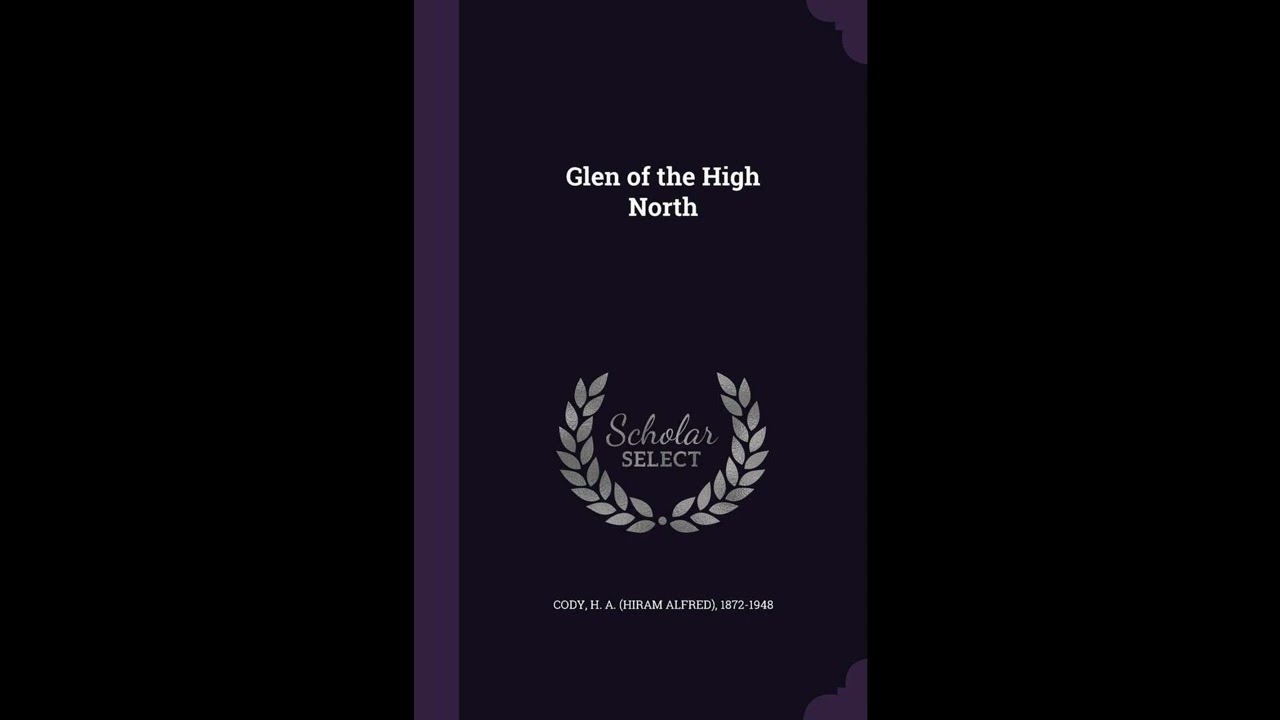
Glen of the High North by H A (Hiram Alfred) Cody. The underlying text is in the U.S. public domain. We do not republish any modern copyrighted edition, translation, or commentary.
The 4K cinematic visuals accompanying this audiobook are generated by an AI image model from prompts derived from the source text. No copyrighted photos, paintings, or stock footage are used. AI generation is disclosed on every video on our YouTube channel as required by YouTube's altered/synthetic content policy.
English subtitles are transcribed from the LibriVox recording with OpenAI Whisper. Translations into the 11 other supported languages are produced by Meta's NLLB-200 neural translation model. No human translator's copyrighted translation is used.
Questions about sourcing or rights? See our DMCA & Sourcing policy or contact us.
View 10 famous quotes from this book →
Enjoyed this audiobook?
If you'd like to own a copy of Glen of the High North or hear a professionally produced edition, the links below help support free audiobook production at no extra cost to you.
As an Amazon Associate we earn from qualifying purchases. Audible / print links are affiliate.