Rise of the New West, 1819-1829
The American story is often told through its movement westward, a restless expansion across a continent that shaped not only its geography but its very soul. In "Rise of the New West, 1819-1829," Frederick Jackson Turner doesn't just recount history; he uncovers the fundamental forces that forged American identity. This isn't merely a chronicle of dates and events; it is a profound examination of how the unique conditions of the frontier molded democratic ideals, fostered individualism, and set the course for a nation constantly redefining itself. For anyone seeking to understand the deep roots of American exceptionalism, the enduring debates over land and liberty, or simply the forces that built the nation we inhabit today, Turner’s analysis offers an essential lens. Turner sets his historical stage in the crucial decade following the War of 1812, a time when the young American republic, still finding its footing, began to cast its gaze decisively beyond the Appalachian Mountains. The setting is the vast expanse of the trans-Appalachian West—the fertile lands of the Ohio and Mississippi Valleys, the burgeoning territories of Missouri and Michigan, and the developing states like Indiana, Illinois, and Alabama. Here, the raw wilderness confronted ambitious settlers, land speculators, and a federal government grappling with how to integrate these new regions into the national fabric. The primary figures in this unfolding drama are not just individual leaders, but the collective mass of pioneers, farmers, trappers, and politicians who migrated, settled, and asserted their claims. The central dynamic Turner analyzes is the push and pull between the established East and the burgeoning West, a process marked by constant negotiation and sometimes outright conflict. Settlers, driven by economic opportunity and a hunger for land, faced the challenges of isolation, Native American resistance, and the demanding task of transforming wild landscapes into productive farms and communities. This westward surge created new political demands, forcing issues like internal improvements (roads, canals), land policy, and the balance of power between states into the national conversation. The story arc follows this complex interplay: from the initial waves of migration and the establishment of frontier outposts, through the development of nascent political systems and economic networks, to the crystallization of a distinct "Western" voice that would profoundly influence American politics and culture in the decades to follow. Frederick Jackson Turner, born in Portage, Wisconsin, in 1861, was destined to interpret the American frontier. Growing up in a state deeply connected to the legacy of westward expansion, he witnessed firsthand the closing chapters of the frontier era. He pursued his education at the University of Wisconsin and later earned his Ph.D. from Johns Hopkins University, where he was exposed to new methodologies in historical research. It was his groundbreaking 1893 essay, "The Significance of the Frontier in American History," delivered at the World's Columbian Exposition in Chicago, that catapulted him to national prominence and fundamentally reshaped the understanding of American history. Turner spent the bulk of his distinguished career teaching at the University of Wisconsin and later at Harvard, inspiring generations of students and scholars. His other significant works include "The United States, 1830-1850: The Nation and Its Sections," which continued his sectional analysis of American development. He was a leading figure among the Progressive historians, who sought to understand the social and economic forces driving historical change. Turner's "frontier thesis," as it became known, argued that the constant westward expansion and the encounter with the wilderness were the primary engines shaping American democracy, character, and institutions, imbuing the nation with its distinctive individualism and egalitarianism. Though his ideas would later face critique and revision, his place in the American historical canon remains unassailable for the enduring influence and provocative insights he brought to the study of the nation's past. "Rise of the New West" foregrounds several crucial themes that define the American experience. One prominent theme is the frontier as a crucible for democracy and individualism. Turner demonstrates how the raw conditions of frontier life, where established hierarchies were absent and success often depended on self-reliance, fostered a practical, democratic spirit. For instance, new settlers, far from the authority of older communities, had to organize themselves, establish their own local governance, and make decisions collectively, reinforcing principles of popular sovereignty and individual agency. Another key theme is the emergence of sectionalism and distinct regional identities. As the West grew, it developed its own unique political and economic interests, often clashing with those of the industrialized North and the agrarian South. Debates over land sales, the price of public lands, and the construction of roads and canals, such as the proposed National Road, became battlegrounds where Western representatives articulated demands specific to their region, highlighting the growing divergence in national priorities. Furthermore, the book powerfully illustrates the transformation of the wilderness, detailing how vast tracts of uncultivated land were rapidly converted into agricultural centers and organized communities. The relentless clearing of forests for farms, the establishment of gristmills and sawmills, and the creation of new market towns all exemplify this dramatic process of human imposition on the natural world, a process central to America’s self-conception. When Frederick Jackson Turner penned "Rise of the New West" in 1906, America was undergoing a period of profound introspection. The official declaration by the Census Bureau in 1890 that the frontier was "closed" had created a national crisis of identity. Industrialization had transformed urban centers, immigration surged, and the nation was increasingly asserting itself on the global stage following the Spanish-American War. Turner’s work emerged precisely at this juncture, offering a powerful explanatory framework for understanding how America had become what it was, just as the very conditions he described were fading into memory. His historical analysis provided a narrative of American exceptionalism rooted in its unique geographical and social conditions, a reassuring story for a nation grappling with the complexities of industrialization, urbanization, and the responsibilities of empire. Turner's insights into the formative power of westward expansion resonated deeply with a public searching for meaning in a rapidly changing world, helping them understand the origins of their democratic institutions, their national character, and the enduring spirit of individualism that he argued was the hallmark of the American people. Listening to "Rise of the New West, 1819-1829" as an audiobook offers a unique opportunity to absorb Turner's meticulous research and profound arguments. The clear, thoughtful narration allows the listener to engage with the text at a measured pace, perfectly suited for the intricate details of historical analysis. You can absorb the sweep of American expansion, the struggles of early settlers, and the nuanced political debates of a nascent nation without the visual demands of reading dense academic prose. The spoken word brings a different kind of life to Turner’s work, allowing his conceptual frameworks and vivid descriptions of frontier life to truly resonate. It transforms a foundational text of American history from a silent academic exercise into a compelling oral history that unfolds with all the gravity and significance it commands.
Enjoyed Rise of the New West, 1819-1829? A few ways to support us
Audible & Amazon links are affiliate; we may earn a small commission at no extra cost.
About this production
Human narration by a volunteer reader from LibriVox.org, the public-domain audiobook project. LibriVox volunteers record literary works whose copyright has expired in the United States, releasing the resulting recordings into the public domain.
Rise of the New West, 1819-1829 by Frederick Jackson Turner. The underlying text is in the U.S. public domain. We do not republish any modern copyrighted edition, translation, or commentary.
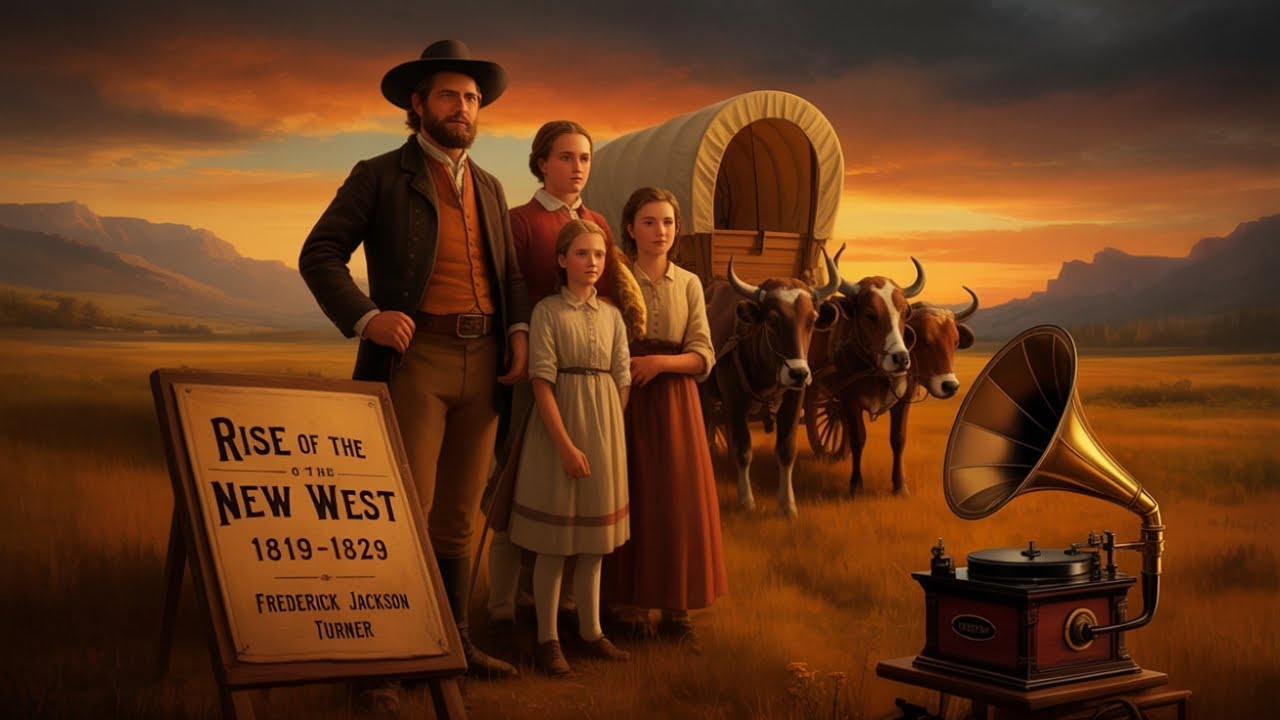
The 4K cinematic visuals accompanying this audiobook are generated by an AI image model from prompts derived from the source text. No copyrighted photos, paintings, or stock footage are used. AI generation is disclosed on every video on our YouTube channel as required by YouTube's altered/synthetic content policy.
English subtitles are transcribed from the LibriVox recording with OpenAI Whisper. Translations into the 11 other supported languages are produced by Meta's NLLB-200 neural translation model. No human translator's copyrighted translation is used.
Questions about sourcing or rights? See our DMCA & Sourcing policy or contact us.
Enjoyed this audiobook?
If you'd like to own a copy of Rise of the New West, 1819-1829 or hear a professionally produced edition, the links below help support free audiobook production at no extra cost to you.
As an Amazon Associate we earn from qualifying purchases. Audible / print links are affiliate.
More Audiobooks


The Lions of the Lord: A Tale of the Old West

Fred Fearnot's New Ranch and How He and Terry Managed It

Great Epochs in American History: Volume II: The Planting Of The First Colonies
Chief of scouts, as Pilot to Emigrant and Government trains, Across the Plains of th- Full Audiobook