Report of the Juvenile Delinquency Committee
Imagine a world grappling with the specter of a changing youth, a society struggling to understand the forces shaping its youngest generation. This is the urgent, compelling landscape at the heart of R. M. Algie’s "Report of the Juvenile Delinquency Committee." Far from a dry bureaucratic document, this powerful text stands as a landmark piece of social commentary and historical insight, offering a window into the anxieties, compassion, and intellectual vigor of an earlier era. It compels us to consider how deeply intertwined societal structure, economic conditions, and moral frameworks are with the development of children, making it startlingly relevant for anyone pondering contemporary challenges to youth welfare, justice, and community responsibility. The questions it poses, and the methods it employs to seek answers, resonate with an enduring human concern for the future reflected in its young. The report sets its stage within a society experiencing significant shifts, observing the burgeoning urban centers and the evolving family unit as crucial backdrops to a perceived rise in juvenile misconduct. While not a novel with named protagonists in the traditional sense, the central figures here are collectively "the juvenile delinquent" – presented not as a monolithic entity, but as a composite of societal pressures, individual vulnerabilities, and institutional failings. We meet them through the anonymized case studies, statistical analyses, and expert testimonies that populate the committee's exhaustive investigation. The committee itself, comprised of diligent legal minds, social workers, and educators, acts as the narrative’s guiding intelligence, systematically dissecting the problem. Their central conflict is the stark contrast between the traditional, often punitive, responses to youth crime and the emerging understanding that environmental factors, poverty, lack of educational opportunity, and family instability play significant roles. The report unfolds as a meticulously structured inquiry, moving from an initial identification of the problem—the escalating numbers of young offenders—to a profound examination of root causes. It charts an arc from initial observation and data collection through a period of critical analysis, where various theories on causality are weighed, debated, and supported by collected evidence. Ultimately, it culminates in a set of carefully considered recommendations aimed at societal reform and the establishment of more effective, rehabilitative systems. The "story" here is one of intellectual pursuit, a quest for understanding that seeks to move beyond mere judgment to a more compassionate and effective approach to a pressing social ill, leaving the listener to ponder the efficacy of its proposed solutions and the lasting impact of its findings. Ronald Macmillan Algie, the esteemed author steering this monumental work, was a figure of considerable intellectual and public stature. Born in 1887 in Antrim, Northern Ireland, Algie emigrated to New Zealand, where he would leave an indelible mark on both its legal and political landscapes. Educated in law, he developed a keen analytical mind and a profound commitment to public service, eventually becoming a respected Member of Parliament. Throughout his extensive career, which spanned many decades until his passing in 1976, Algie held various ministerial portfolios, including Minister of Education and Minister of Justice, demonstrating his deep engagement with the very issues addressed in this report. His work was characterized by a meticulous attention to detail, a rigorous adherence to legal principles, and a pragmatic yet compassionate approach to social problems. While "Report of the Juvenile Delinquency Committee" might be his most notable contribution in the realm of social reform documentation, his influence was also felt through numerous parliamentary debates, legal reforms, and public addresses that shaped New Zealand society during a pivotal period of its development. His background as a barrister and politician provided him with a unique perspective, allowing him to bridge the gap between abstract legal theory and the tangible realities of social policy. Algie’s extensive experience in both the legal system and public policy undoubtedly informed the structure and precision of the committee's findings. His leadership brought a necessary blend of academic rigor and practical understanding to the complex issue of juvenile delinquency. His involvement placed the report firmly within a tradition of enlightened governance, where intellectual capacity was harnessed for the betterment of society. This commitment to reasoned argument and evidence-based solutions is evident on every page of the report, elevating it beyond a mere administrative document to a significant contribution to social thought. It showcases Algie's capacity for synthesizing diverse information and advocating for impactful, humane policies, solidifying his place as a key intellectual voice of his time in the public sphere. This remarkable report enacts several profound themes. First, it grapples with the concept of social responsibility, arguing that juvenile delinquency is not merely an individual failing but a symptom of broader societal issues. The committee points to the dire effects of urban poverty, inadequate housing, and insufficient access to education, showing how these conditions funnel young people towards paths of disengagement and crime. For instance, the report might cite statistics linking higher rates of truancy to areas with limited school resources, or draw a direct line between unemployment in working-class neighborhoods and an increase in petty theft among adolescents. Second, the text confronts the shifting definition of justice and the emerging emphasis on rehabilitation over pure punishment. Rather than simply calling for harsher penalties, the committee advocates for reformative institutions, vocational training, and psychological support for young offenders. An illustrative example could be the detailed proposals for youth courts staffed by specialized judges and social workers, focusing on the welfare of the child rather than solely on retribution for the offense. Third, the report implicitly debates the enduring question of nature versus nurture, ultimately leaning heavily towards the latter. It meticulously details how environmental factors, family dynamics, and peer influence often outweigh innate predispositions in shaping a child's behavior. The committee presents compelling evidence, perhaps through interviews with probation officers or analyses of familial backgrounds, to demonstrate that children from stable, supportive homes, even those in challenging circumstances, are less likely to fall into patterns of delinquency than those lacking such support. Finally, it highlights the theme of institutional reform as a critical necessity. The report doesn't just diagnose problems; it proposes concrete, systemic changes to schools, welfare agencies, and the judicial system itself, arguing for greater coordination and a more holistic approach to youth development. An example might be the call for community-based youth centers, offering recreational activities and mentorship, as a proactive measure to prevent delinquency rather than simply reacting to it after the fact. The emergence of "Report of the Juvenile Delinquency Committee" aligns with a period of intense social introspection, particularly in the mid-twentieth century. Following the dislocations and anxieties of global conflicts, many societies experienced profound demographic shifts, rapid urbanization, and significant changes in family structures. This era witnessed a growing awareness of social science, psychology, and sociology, leading to a more nuanced understanding of human behavior and societal problems. Rather than viewing crime purely through a moral or legal lens, there was a developing intellectual movement to understand its underlying causes—economic, psychological, and environmental. Culturally, there was a rising concern for the welfare of children and the recognition that childhood itself was a distinct developmental stage requiring specialized care and intervention. This report, therefore, did not emerge in a vacuum, but as a critical response to these evolving intellectual currents and pressing societal concerns, reflecting a broader movement towards evidence-based policy-making and a more enlightened approach to social welfare. Listening to "Report of the Juvenile Delinquency Committee" as an audiobook offers a singular experience, transforming a foundational social document into an immediate and engaging narrative. The spoken word allows the listener to absorb the intricate arguments and compelling evidence with a focus that printed text often demands. The run length of several hours provides ample time to immerse oneself in the depth of the committee's investigation, allowing the listener to follow the systematic progression of thought without interruption. A skilled narrator will bring a suitable gravitas to the factual presentations, allowing the detailed statistical data and carefully crafted policy recommendations to resonate with clarity and purpose. Listeners can appreciate the thoughtful pacing as the committee moves from identifying problems to proposing solutions, with the narrator's voice conveying the earnestness and intellectual rigor of Algie and his colleagues. There is no dialogue in the traditional sense, but the report’s prose, often formal yet imbued with a sense of urgent social concern, becomes a compelling, articulate voice, allowing the weight of its historical arguments to truly land. It's an opportunity to experience a piece of history that continues to inform our present debates on youth, society, and justice.
Enjoyed Report of the Juvenile Delinquency Committee? A few ways to support us
Audible & Amazon links are affiliate; we may earn a small commission at no extra cost.
About this production
Human narration by a volunteer reader from LibriVox.org, the public-domain audiobook project. LibriVox volunteers record literary works whose copyright has expired in the United States, releasing the resulting recordings into the public domain.
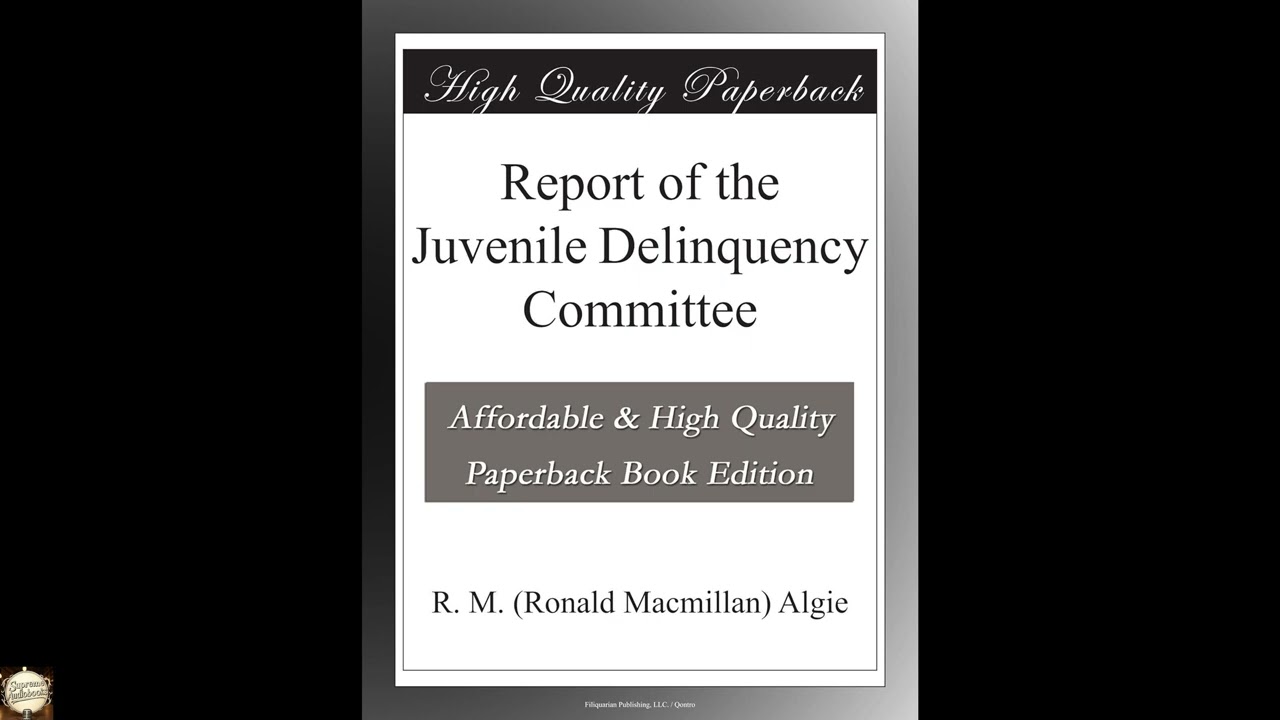
Report of the Juvenile Delinquency Committee by R. M. (Ronald Macmillan) Algie. The underlying text is in the U.S. public domain. We do not republish any modern copyrighted edition, translation, or commentary.
The 4K cinematic visuals accompanying this audiobook are generated by an AI image model from prompts derived from the source text. No copyrighted photos, paintings, or stock footage are used. AI generation is disclosed on every video on our YouTube channel as required by YouTube's altered/synthetic content policy.
English subtitles are transcribed from the LibriVox recording with OpenAI Whisper. Translations into the 11 other supported languages are produced by Meta's NLLB-200 neural translation model. No human translator's copyrighted translation is used.
Questions about sourcing or rights? See our DMCA & Sourcing policy or contact us.
Enjoyed this audiobook?
If you'd like to own a copy of Report of the Juvenile Delinquency Committee or hear a professionally produced edition, the links below help support free audiobook production at no extra cost to you.
As an Amazon Associate we earn from qualifying purchases. Audible / print links are affiliate.