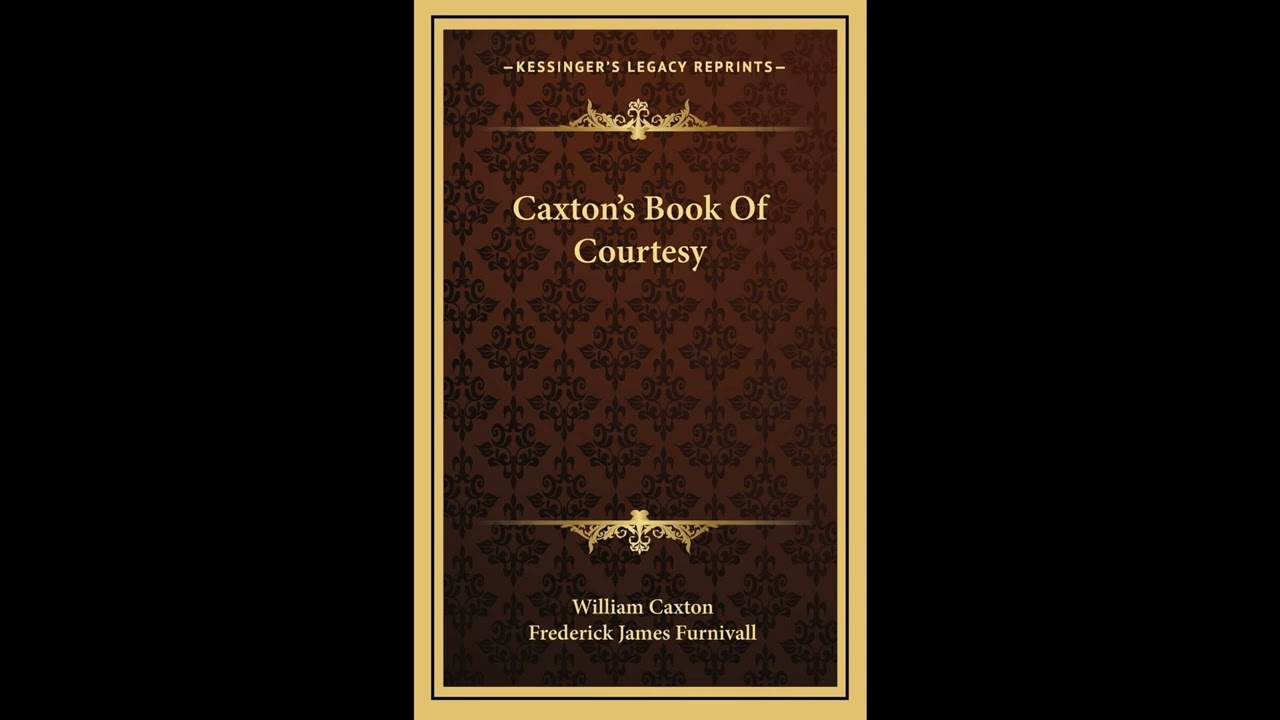
Caxton's Book Of Courtesy
In an age where social graces often seem to bend and shift with the latest trend, a voice from the very dawn of printed English offers a steadying hand. William Caxton's Book Of Courtesy stands as a unique monument to the persistent human desire for order, refinement, and respectful interaction. This isn't merely a historical curiosity; it is a foundational document reflecting the building blocks of polite society in late medieval England, a society navigating profound change yet yearning for guiding principles. Listening to its counsel today offers more than a glimpse into a bygone era; it provides a profound reflection on the enduring values of consideration, integrity, and self-presentation that continue to shape our world, offering a surprising mirror to our own contemporary struggles with etiquette and ethical conduct. While Caxton's Book Of Courtesy does not present a narrative in the conventional sense, it unfolds as a carefully structured instructional text, guiding its audience—primarily young men destined for public life—through the labyrinth of social expectation. The setting is implicitly the home, the court, and the public square of fifteenth-century England, places where a young person's future could be made or marred by their deportment. The 'main character,' if one can call it that, is the idealized young individual being taught, a blank slate upon whom the author, through the text, inscribes the necessary virtues and practical skills for navigating a complex social hierarchy. The central drive of the book is the transformation of the raw, unrefined individual into a person of dignity and repute, someone capable of honoring themselves and their station through judicious behavior and speech. The arc of this instructional 'story' begins with fundamental lessons in personal hygiene and table manners: how to wash hands, how to sit, how to eat without offense, and how to drink with temperance. From these basic physical actions, the guidance elevates to matters of speech and address, emphasizing respectful language, avoiding gossip, and speaking truth without bluntness. The text then progresses to broader social interactions—how to conduct oneself in the presence of superiors, how to interact graciously with peers, and how to maintain an honorable bearing in all public and private settings. It builds piece by piece a comprehensive model of the courteous life. The work’s 'conflict' lies in the constant, internal struggle between natural, unbridled impulse and the disciplined, learned behaviors required for social harmony. It implicitly understands that true courtesy is not innate but a cultivated art, demanding attention and a genuine desire for self-improvement. The instruction progresses from external performance to internal moral cultivation, suggesting that outward grace must stem from an inner core of virtue and respect for others, ultimately forging character that reflects well on the individual and their community. The progenitor of this counsel was William Caxton, the pivotal figure who introduced the printing press to England. Born in Kent around 1422, Caxton's early life was spent in the bustling world of international commerce. He apprenticed as a mercer, a trade that led him to Bruges in the Low Countries, a major center for European trade and intellectual exchange. His mercantile career provided him with a keen understanding of public demand and practical utility. During his decades abroad, Caxton also served in diplomatic capacities, exposing him to European courts and the broader continental literary scene, where he learned the art of printing around 1473-74. Returning to England in 1476, he established his press near Westminster Abbey, revolutionizing the dissemination of knowledge and literature. His output was prodigious, numbering over 100 books, many being his own translations from French and Latin into English. Caxton's publishing philosophy was pragmatic: provide texts morally uplifting and practically useful to an expanding literate public, including gentry, merchants, and emerging professional classes. He printed foundational texts like Chaucer's Canterbury Tales and Malory's Le Morte d'Arthur. Caxton was more than a printer; he was an editor, translator, and crucial arbiter of English prose at a time when the language itself was standardizing, leaving an indelible mark on both literature and language. At its heart, Caxton's Book Of Courtesy articulates several enduring themes. Firstly, the pervasive importance of social order and hierarchy. The text repeatedly guides its reader on how to behave appropriately depending on the rank of those around them, instructing on precise ways of addressing superiors, showing deference, and interacting graciously with equals and inferiors alike. This meticulous attention to social layering reveals a society highly attuned to status and the need for clear guidelines to maintain harmony within its structured framework. Another prominent theme is personal virtue and self-improvement, extending beyond mere outward show. Caxton’s book encourages an internal cultivation of character, admonishing against vanity and pride, instead championing humility and genuine kindness. It advises against boastfulness or speaking ill of others, urging a measured and truthful tongue. The emphasis on temperance in all things speaks to a holistic vision of a well-ordered life. This is further supported by the theme of effective communication and honorable presentation. The work trains the reader in the art of eloquent, appropriate speech, underscoring how words can build or destroy reputations, fostering understanding and respect. Caxton produced The Book Of Courtesy during the late fifteenth century, a pivotal era of transition for England. Emerging from the tumultuous Wars of the Roses, the rise of the Tudor dynasty brought a desire for renewed social order. Culturally, the nation was at the cusp of the Renaissance, with a shift towards humanism. This period also saw the rise of a new, affluent merchant class, distinct from the traditional aristocracy, who keenly sought guidance in appropriate behavior to cement their social standing. The literary world, revolutionized by the printing press, democratized knowledge. Courtesy books like Caxton's met a real demand from this burgeoning literate population—merchants, lesser gentry, and aspirational individuals—who required practical instruction for navigating a society rapidly redefining its codes of conduct and presentation. Caxton, a former merchant himself, understood this need perfectly, and his Book Of Courtesy served as a printed blueprint for navigating a society quickly evolving its social expectations. Hearing Caxton's Book Of Courtesy as an audiobook offers a direct, engaging connection to its original intent: oral instruction. A skilled narrator’s voice, lending authority and clarity, allows the listener to absorb Caxton’s wisdom as if it were being read aloud in a fifteenth-century hall. Over its several hours run length, the deliberate pacing permits thoughtful reflection on each piece of counsel, from basic etiquette to deeper moral injunctions. Listen for the subtle shifts in tone as the instruction moves from practical tips to ethical principles. The narrator’s delivery enhances the sense of historical authenticity, inviting you to reflect on both the quaintness and the enduring wisdom contained within these pages, making the past feel present.
Enjoyed Caxton's Book Of Courtesy? A few ways to support us
Audible & Amazon links are affiliate; we may earn a small commission at no extra cost.
About this production
Human narration by a volunteer reader from LibriVox.org, the public-domain audiobook project. LibriVox volunteers record literary works whose copyright has expired in the United States, releasing the resulting recordings into the public domain.
Caxton's Book Of Courtesy by William Caxton. The underlying text is in the U.S. public domain. We do not republish any modern copyrighted edition, translation, or commentary.
The 4K cinematic visuals accompanying this audiobook are generated by an AI image model from prompts derived from the source text. No copyrighted photos, paintings, or stock footage are used. AI generation is disclosed on every video on our YouTube channel as required by YouTube's altered/synthetic content policy.
English subtitles are transcribed from the LibriVox recording with OpenAI Whisper. Translations into the 11 other supported languages are produced by Meta's NLLB-200 neural translation model. No human translator's copyrighted translation is used.
Questions about sourcing or rights? See our DMCA & Sourcing policy or contact us.
Enjoyed this audiobook?
If you'd like to own a copy of Caxton's Book Of Courtesy or hear a professionally produced edition, the links below help support free audiobook production at no extra cost to you.
As an Amazon Associate we earn from qualifying purchases. Audible / print links are affiliate.