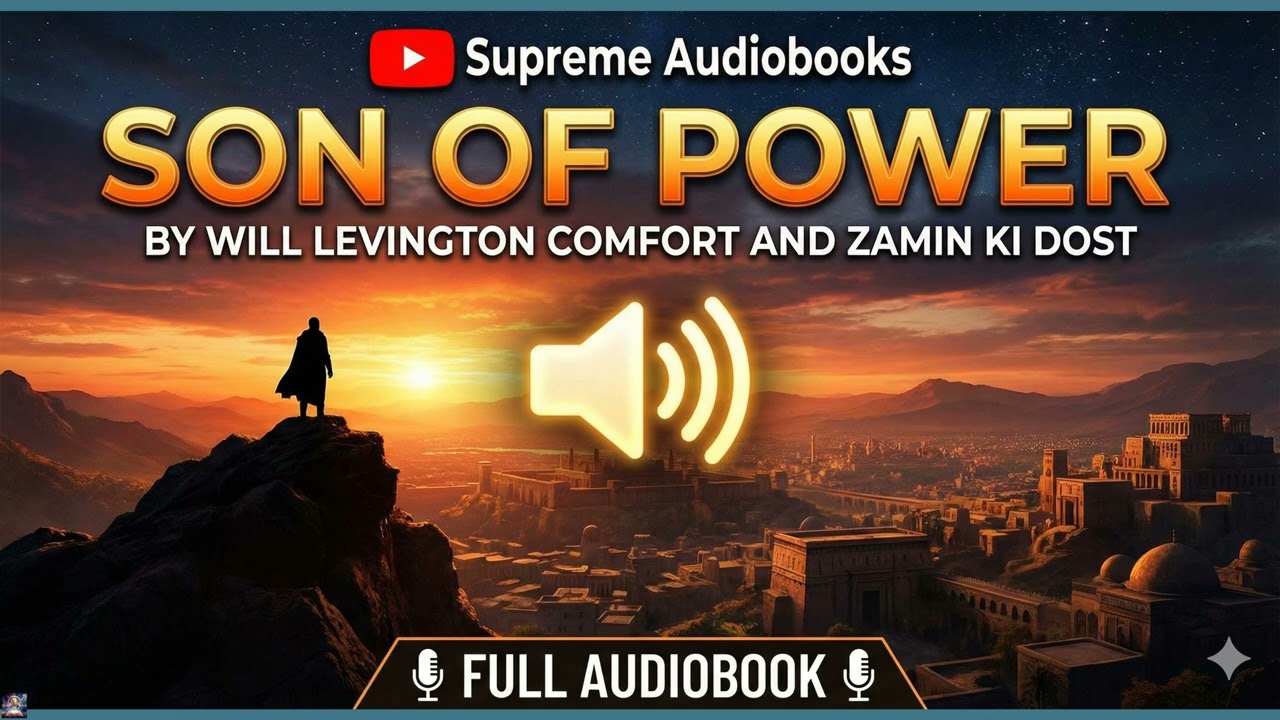
Son Of Power
Step into a world where spiritual awakening collides with earthly struggle, where inner strength is as potent as any physical weapon. "Son Of Power," by the distinctive hand of Will Levington Comfort and the guiding spirit of Zamin Ki Dost, introduces us to a protagonist whose destiny is etched in the stars but must be forged through the crucible of self-discovery. This isn't merely an adventure story; it’s an invitation to contemplate the nature of authority – both over oneself and over the world – and the profound responsibility that accompanies extraordinary ability. In an era marked by a renewed search for meaning and authentic leadership, this narrative offers a compelling reflection on what it truly means to come into one's own, balancing mystical insight with the demands of a material existence. The story unfolds in the sun-drenched and spiritually charged landscapes of India, a land that serves not just as a backdrop but as an active participant in the protagonist's development. Here, we meet Kered, a young man seemingly ordinary, yet bearing the potential for immense power, both psychic and physical. His early life is shaped by whispers of a greater purpose, a heritage that links him to an ancient lineage of those who wield influence beyond the common understanding. Kered is not born a master; rather, he is a vessel waiting to be filled, a mind waiting to be enlightened, and a spirit waiting to be ignited. Central to the narrative is Kered's arduous and often perilous education. He is guided by enigmatic mentors who recognize his latent abilities, subjecting him to trials designed to purify his motives and test his resolve. These challenges are not always external confrontations with adversaries, but often deeply personal struggles against doubt, fear, and the temptations of misused power. As Kered grapples with his emerging capacities, he confronts moral dilemmas that force him to understand the true cost and ethical implications of his growing influence. The arc of the story follows his transformation from an untested youth to a figure capable of extraordinary feats, always with the understanding that true power is tethered to wisdom and compassion, not mere dominance. Will Levington Comfort, born in Kalamazoo, Michigan, in 1878, lived a life as dynamic and varied as the tales he spun. Beginning his career as a journalist, he became a war correspondent, reporting from conflicts in the Philippines and later serving during World War I. His early experiences imbued his writing with a vivid sense of action and a keen eye for human nature under duress. Comfort’s shift from straightforward adventure writing to narratives infused with spiritual and Eastern philosophical elements marked a significant turn in his literary output. He was deeply interested in theosophy, mysticism, and the principles of self-mastery, themes that became increasingly prominent in his novels. His body of work often reflects a fascination with individuals who stand apart, those who pursue a higher consciousness or a unique path to understanding. Novels like "Routledge Rides Alone" and "Apache" showcase his ability to craft compelling narratives around strong, often solitary characters navigating challenging environments. The inclusion of "Zamin Ki Dost" as a co-author for "Son Of Power" is particularly telling. While not a conventional individual, this name—meaning "friend of the land" or "friend of the earth" in Urdu/Hindi—represents Comfort's profound respect for Eastern wisdom and traditions, suggesting a symbolic collaboration with an ancient, universal source of knowledge, or perhaps a literary persona that allowed him to express ideas beyond his own singular biography. Comfort spent his later years in southern California, continuing to write and teach, passing away in 1932, leaving behind a legacy of stories that fused the material world with the mystical. "Son Of Power" is a compelling study in several enduring themes. One significant thread is the concept of personal evolution and the cultivation of inner strength. Kered’s trials are explicitly designed to forge his character, demonstrating how true power is not an inherent gift but a skill honed through discipline and self-awareness. For example, early scenes show Kered struggling with impulses and uncertainties, only to find his resolve steeled through moments of deep introspection and mentorship, where he learns to quiet the noise of his own mind and connect with a deeper reservoir of calm. Another profound theme running through the narrative is the relationship between destiny and free will. Kered is portrayed as someone with a preordained path, yet the story consistently emphasizes his active choices and moral struggles, underscoring that even a fated existence requires conscious effort and ethical decision-making. The narrative often presents Kered with crossroads where the easier path diverges from the path of higher purpose, forcing him to choose the more arduous road to fulfill his true potential, illustrating that fate guides, but personal volition directs. This also ties into the idea of responsible leadership, as Kered must learn not only how to wield his power but why and for whom he wields it, understanding that true authority is rooted in service rather than domination. When "Son Of Power" was published in 1920, the world was reeling from the aftermath of the First World War. This period was characterized by a widespread sense of disillusionment with established institutions and a search for alternative forms of meaning and spiritual solace. In the West, there was a growing fascination with Eastern philosophies, mysticism, and esoteric movements, often fueled by increased global interconnectedness and a desire to look beyond conventional Western thought. Authors like Comfort tapped into this cultural yearning, offering narratives that combined exotic settings with profound spiritual quests, providing a different lens through which to view human potential and societal ills. The British Raj was still a dominant force in India, making the setting particularly poignant, as Western audiences engaged with narratives that both romanticized and intellectualized the spiritual traditions of the East. As an audiobook, "Son Of Power" finds a natural home. The immersive quality of spoken word lends itself perfectly to the novel's atmospheric descriptions of the Indian subcontinent, its philosophical musings, and the nuanced development of its central character. Listeners can fully absorb the rhythm of Comfort’s prose, allowing the unfolding narrative to transport them to distant ashrams and perilous mountain passes. The length, comprising several hours, makes it an ideal companion for extended periods of listening—whether on a long drive, during household chores, or as a calming presence during an evening of contemplation. Pay close attention to the narrator’s pacing, which will likely fluctuate between brisk adventure sequences and more deliberate, reflective moments, allowing the profound teachings woven into the story to truly resonate. The distinct voices given to Kered and his various teachers and adversaries will deepen the listener's connection to their individual philosophies and struggles, creating an experience that is both intellectually stimulating and emotionally engaging.
Enjoyed Son Of Power? A few ways to support us
Audible & Amazon links are affiliate; we may earn a small commission at no extra cost.
About this production
Human narration by a volunteer reader from LibriVox.org, the public-domain audiobook project. LibriVox volunteers record literary works whose copyright has expired in the United States, releasing the resulting recordings into the public domain.
Son Of Power by Will Levington Comfort And Zamin Ki Dost. The underlying text is in the U.S. public domain. We do not republish any modern copyrighted edition, translation, or commentary.
The 4K cinematic visuals accompanying this audiobook are generated by an AI image model from prompts derived from the source text. No copyrighted photos, paintings, or stock footage are used. AI generation is disclosed on every video on our YouTube channel as required by YouTube's altered/synthetic content policy.
English subtitles are transcribed from the LibriVox recording with OpenAI Whisper. Translations into the 11 other supported languages are produced by Meta's NLLB-200 neural translation model. No human translator's copyrighted translation is used.
Questions about sourcing or rights? See our DMCA & Sourcing policy or contact us.
Enjoyed this audiobook?
If you'd like to own a copy of Son Of Power or hear a professionally produced edition, the links below help support free audiobook production at no extra cost to you.
As an Amazon Associate we earn from qualifying purchases. Audible / print links are affiliate.