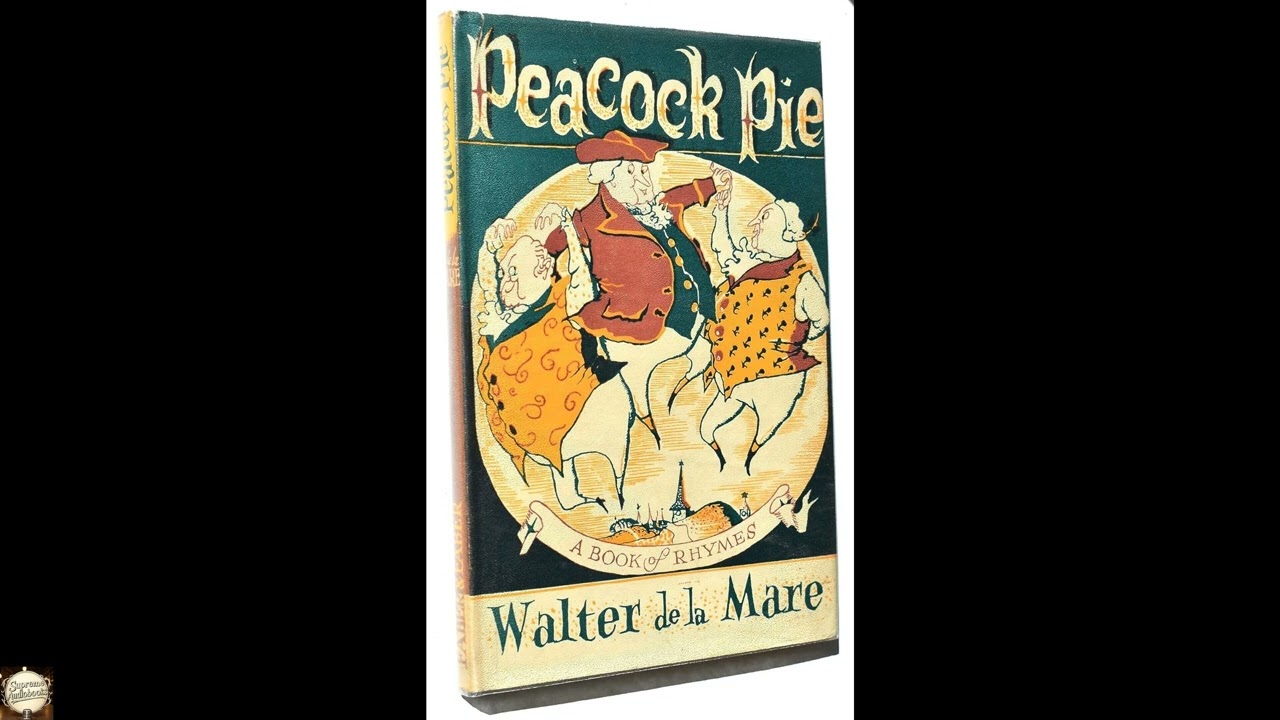
Peacock Pie: a Book of Rhymes
Step into a world woven from moonbeams and starlight, where the ordinary hums with secret life and imagination reigns supreme. Peacock Pie: a Book of Rhymes by Walter de la Mare is not merely a collection of poems; it is an invitation to rediscover the profound wonder of childhood, a window into a universe both familiar and enchantingly strange. This classic of English literature, beloved by generations, offers a respite from the clamor of the modern world, beckoning listeners to slow down, to listen with an inner ear, and to remember the magic that lingers just beyond the veil of everyday perception. In an age of relentless information, de la Mare’s verses provide a sanctuary of pure fancy, lyrical beauty, and quiet contemplation, proving that true enchantment never truly fades. The collection introduces listeners to a whimsical domain where reality gently bends to accommodate the fantastic. We drift through ancient, sleepy houses where unseen presences stir and whispers echo in shadowed halls. We meet a cavalcade of quirky figures: the lonely traveler knocking at a locked door, the enigmatic Miss T. who sits sewing on her stool, mischievous imps and goblins who flit through the twilight, and children who view the world with untroubled, perceptive eyes. There are talking animals with human concerns, trees that seem to converse, and the very air itself often seems alive with hidden stories. The narrative arc, rather than following a single character, is an expansive imaginative journey, guiding the listener through diverse moods and miniature dramas. From lighthearted ditties about everyday occurrences to verses imbued with a gentle sense of mystery or even a touch of melancholy, each poem is a vignette, building a cumulative sense of a singular, coherent world — a world brimming with curious details and whispered secrets, where the boundaries between dream and waking often blur. Listeners will find themselves transported to a landscape where the mundane transforms into the magical, where a garden gate might lead to a land of giants, or a simple nursery rhyme can evoke deep, resonant emotions. The "central conflict," if one could name it, resides in the interplay between the comforting known and the beckoning unknown, the lighthearted joy of play alongside the quiet contemplation of deeper, unspoken truths. There is no grand finale or dramatic twist to spoil, but rather a lingering sense of having visited a place utterly unique and unforgettable, a place that continues to unfold in the mind long after the final verse. Walter de la Mare, born in Charlton, Kent, England, in 1873, was a figure of quiet genius whose life story belied the otherworldly nature of his verse. The youngest of seven children, his father died when Walter was only four, leaving the family in straitened circumstances. Despite this, he received an education at St Paul's Cathedral School and then worked for two decades in the statistics department of Standard Oil — a decidedly prosaic occupation for a poet so attuned to the fantastic. It was during these years that he secretly honed his craft, writing poetry and short stories. His talent was eventually recognized, leading to a modest government pension in 1908 that allowed him to dedicate himself fully to writing. De la Mare’s career spanned decades, marking him as a significant literary voice from the early 20th century until his death in 1956. He first gained acclaim with Songs of Childhood in 1902, followed by the collection The Listeners and Other Poems in 1912, which cemented his reputation as a master of atmospheric verse. While often associated with the Georgian poets of his era, who sought to revive a more traditional, lyrical style in contrast to Victorian didacticism, de la Mare cultivated a highly individual voice. He was a meticulous craftsman, revered for his musicality and his ability to evoke profound depths from seemingly simple language. Though celebrated for his children's books, he also penned acclaimed novels such as Memoirs of a Midget and numerous short stories, all characterized by their dreamlike quality and psychological insight. Throughout his distinguished career, he was honored with numerous awards, including the Carnegie Medal and the Order of Merit, affirming his lasting place among England's most cherished poets. At its core, Peacock Pie champions the boundless power of imagination and the singular perspective of childhood wonder. De la Mare frequently invites listeners into a realm where the world is seen anew, free from adult cynicism. In verses like "Someone," the simple act of a knock at a door transforms into an encounter with a phantom presence, illustrating how the imaginative mind can populate the silence with possibility. Another recurring theme is the subtle presence of the supernatural and the unseen. De la Mare’s poems often hint at mysterious beings — fairies, goblins, or the quiet ghosts of memory — existing just beyond human perception. Poems like "The Phantom" or "The Goblin" don't terrify, but rather evoke a gentle eeriness, suggesting a world permeable to other dimensions and secret lives, reinforcing the notion that much of reality remains hidden. Beyond the fantastical, the collection also celebrates the delicate beauty of the natural world, often imbuing animals and landscapes with human-like sentience or a distinct magical aura. Bees, dormice, and owls are not merely creatures but characters in their own right, participating in the whimsical dramas of the poems. Finally, underneath the apparent lightness, de la Mare sometimes touches on a quiet melancholy, a gentle recognition of the fleetingness of time and the solitude of existence. This is not sadness, but a thoughtful awareness that deepens the emotional resonance of the verses, providing a counterbalance to the whimsicality. These various thematic threads intertwine to create a rich poetic experience that remains both accessible and profoundly moving. Peacock Pie emerged during a period of significant change in England, specifically in the years immediately preceding the First World War. Culturally, there was a growing fascination with folklore, fairy tales, and the psychology of the child's mind, perhaps as a response to rapid industrialization and societal shifts. While the Edwardian era was one of scientific and technological progress, there was also a yearning for a simpler, more pastoral past, a romantic inclination that de la Mare's work perfectly captured. In the literary world, the Georgian movement, of which de la Mare was a leading, if distinct, voice, represented a turning away from the moralizing and sometimes overwrought poetry of the Victorian age. Poets sought a return to lyricism, clarity, and a focus on nature and individual experience. De la Mare’s Peacock Pie, with its unpretentious language, musicality, and profound engagement with the imaginative life, offered a refreshing alternative to both the didacticism often found in children's literature of the time and the burgeoning realism and experimentalism of early modernism. It provided an imaginative escape and a reaffirmation of the enduring power of myth and wonder at a moment when the world was poised on the brink of dramatic upheaval. Listening to Peacock Pie as an audiobook unlocks a layer of appreciation for de la Mare's extraordinary craftsmanship. His poems are inherently musical, built on rhythm, rhyme, and subtle alliteration that truly sing when spoken aloud. The several hours of this collection allow for a sustained immersion into de la Mare’s unique soundscape. A skilled narrator will enhance the subtle shifts in tone – from the playful lilt of a nursery rhyme to the hushed reverence of a more mysterious verse – bringing out the distinct character of each miniature world. Listeners will find that the pacing of the narration can underscore the dreamlike quality of the poems, allowing moments of quiet reflection, while the voice artistry imbues the diverse cast of characters, both human and fantastical, with vivid life. It is an intimate experience, transforming the written word into a direct current of imaginative delight, making de la Mare’s elusive magic feel wonderfully present.
Enjoyed Peacock Pie: a Book of Rhymes? A few ways to support us
Audible & Amazon links are affiliate; we may earn a small commission at no extra cost.
About this production
Human narration by a volunteer reader from LibriVox.org, the public-domain audiobook project. LibriVox volunteers record literary works whose copyright has expired in the United States, releasing the resulting recordings into the public domain.
Peacock Pie: a Book of Rhymes by Walter de la Mare. The underlying text is in the U.S. public domain. We do not republish any modern copyrighted edition, translation, or commentary.
The 4K cinematic visuals accompanying this audiobook are generated by an AI image model from prompts derived from the source text. No copyrighted photos, paintings, or stock footage are used. AI generation is disclosed on every video on our YouTube channel as required by YouTube's altered/synthetic content policy.
English subtitles are transcribed from the LibriVox recording with OpenAI Whisper. Translations into the 11 other supported languages are produced by Meta's NLLB-200 neural translation model. No human translator's copyrighted translation is used.
Questions about sourcing or rights? See our DMCA & Sourcing policy or contact us.
Enjoyed this audiobook?
If you'd like to own a copy of Peacock Pie: a Book of Rhymes or hear a professionally produced edition, the links below help support free audiobook production at no extra cost to you.
As an Amazon Associate we earn from qualifying purchases. Audible / print links are affiliate.