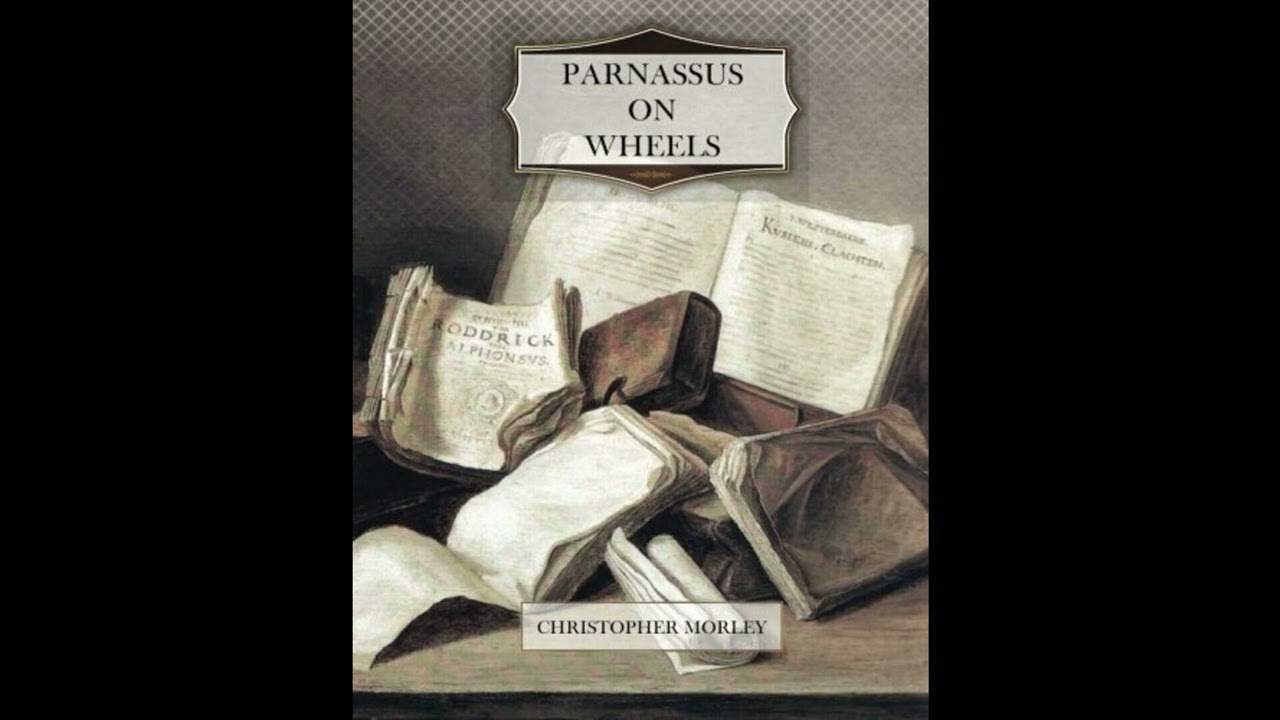
Parnassus on Wheels
Imagine a life, well-ordered and predictably tranquil, suddenly upended by an impulsive decision that leads straight to a horse-drawn caravan brimming with books and a cantankerous, philosophy-spouting bookseller. Such is the premise of Christopher Morley's delightful novella, Parnassus on Wheels, a story that invites listeners to consider the profound joy of intellectual freedom, the quiet revolution of a life deliberately unmoored, and the enduring magic found within the pages of a book. Written with a light touch and an observant eye, this charming tale remains as relevant today as it was over a century ago, offering a gentle escape from the demands of modern life and a compelling argument for the restorative power of literature and the open road. It’s a story for anyone who has ever dreamed of trading the mundane for the marvelous, even if only for a short, unexpected adventure. Our protagonist is Helen McGill, a forty-year-old spinster living a quiet, orderly existence on a farm in rural New England, where she dutifully cares for her brother, Andrew, a successful but rather conventional novelist. Helen's life is defined by domesticity and routine, until one fateful morning when a peculiar red wagon pulls up their lane. Inside is Roger Mifflin, a portly, middle-aged bookseller with a fiery beard and an even fierier passion for books, who has decided to sell his beloved mobile bookshop, "Parnassus," and settle down to write his memoirs. On a sudden, uncharacteristic impulse, Helen purchases the Parnassus, much to Mifflin’s astonishment and her brother’s dismay. What follows is Helen's unexpected transformation. Intending initially to drive Mifflin to his destination before returning home, she finds herself reluctantly pressed into service as the bookseller for a short stretch, learning the ropes of Mifflin's unique trade. As she trundles along country roads, dispensing literary advice and engaging in lively debates with Mifflin, Helen slowly sheds the constraints of her former life. She encounters a colorful cast of characters – farmers, housewives, children, and fellow intellectuals – each with their own stories and their own needs for the solace or stimulation that books provide. The narrative follows Helen's dawning realization that life beyond her farm is vast and surprising, filled with intellectual camaraderie and unforeseen personal growth, setting the stage for decisions that will forever alter her perception of herself and her future. Christopher Morley, the author, was an American essayist, novelist, and poet, born in Philadelphia in 1890. He attended Haverford College and, as a Rhodes Scholar, studied at New College, Oxford, immersing himself in the literary traditions that would deeply influence his work. Morley's early career saw him involved in journalism and publishing, working for Doubleday, Page & Co. and later becoming a contributing editor for The Saturday Review of Literature. He possessed a deep and abiding affection for books and the literary life, often reflecting on the joy of reading, the camaraderie of fellow book-lovers, and the simple pleasures of everyday existence. Morley was known for his genial, humorous, and intellectually curious style. While Parnassus on Wheels (1917) and its sequel, The Haunted Bookshop (1919), are perhaps his most beloved novels, he was a prolific writer across various forms. His novel Kitty Foyle (1939) notably won the Pulitzer Prize for Fiction. Morley was not aligned with the more experimental literary movements of his time; instead, he cultivated a warm, inviting prose that celebrated human connection, quiet introspection, and the enduring charm of the written word. He was a dedicated man of letters, deeply ingrained in the literary culture of the early to mid-20th century, and his works continue to charm readers with their wit and humanity, long after his passing in 1957. A central theme woven throughout Parnassus on Wheels is the liberating power of books and ideas. Roger Mifflin, with his fervent speeches, consistently articulates the belief that books are not mere objects but keys to understanding the world and oneself. He insists that the right book, placed in the right hands, can transform a life, and we see this enacted as Helen, initially skeptical, becomes increasingly engaged with her customers' desires for particular stories and knowledge. For instance, her early interactions with a farmer who wants to read about bees, or a lonely housewife seeking poetry, demonstrate how literature connects people across social divides and intellectual inclinations. Another significant theme is self-discovery and the rejection of societal expectations. Helen McGill begins the story as a woman confined by duty and expectation, largely invisible even to herself. Her decision to buy the Parnassus is a radical act of rebellion, even if she doesn't fully grasp it at first. On the open road, she sheds the persona of Andrew's housekeeper and embraces her own capabilities, learning to haggle, to drive a horse, and to confidently recommend books. Her journey is not just across the physical landscape of New England but across the inner landscape of her own potential, revealing a woman far more independent and resourceful than anyone, especially Helen herself, had previously imagined. This transformation highlights how stepping outside one's comfort zone can reveal hidden strengths and desires. Parnassus on Wheels appeared in 1917, a time when America was grappling with significant changes, both domestically and internationally. The shadow of World War I loomed large, injecting a sense of uncertainty and profound shifts in global order. While Morley’s novel doesn't directly confront the war, its whimsical, pastoral setting and focus on the simpler pleasures of life and literature can be seen as a gentle counterpoint to the era's turmoil – a nostalgic look at a more innocent time, or perhaps an escape from the burgeoning complexities of modern industrial society. The book also implicitly comments on the changing role of women, as Helen, a single woman, asserts her independence and navigates the world on her own terms, a quiet reflection of the broader suffrage movement and evolving social norms for women in the early 20th century. Furthermore, it speaks to a period when the romantic ideal of the traveling bookseller still held sway, predating the widespread commercialization of bookselling that would come later. Listening to Parnassus on Wheels as an audiobook allows the inherent charm and gentle humor of Christopher Morley's prose to truly shine. The narrative’s unhurried pace, much like the rhythmic clip-clop of a horse pulling a book wagon, makes it an ideal companion for moments of quiet contemplation, whether on a drive through the countryside or simply relaxing at home. A skilled narrator can perfectly capture the distinctive voices of Roger Mifflin, with his impassioned proclamations about the power of books, and Helen McGill, whose initial primness slowly gives way to a spirited independence. Pay attention to the subtle shifts in her tone and the way she learns to parry Mifflin's philosophical thrusts. The detailed descriptions of the New England landscape and the charming roadside encounters become vivid through spoken word, creating an immersive atmosphere that transports the listener directly into Helen's unfolding adventure, highlighting the warmth, wit, and wisdom embedded in Morley’s endearing story.
Enjoyed Parnassus on Wheels? A few ways to support us
Audible & Amazon links are affiliate; we may earn a small commission at no extra cost.
About this production
Human narration by a volunteer reader from LibriVox.org, the public-domain audiobook project. LibriVox volunteers record literary works whose copyright has expired in the United States, releasing the resulting recordings into the public domain.
Parnassus on Wheels by Christopher Morley. The underlying text is in the U.S. public domain. We do not republish any modern copyrighted edition, translation, or commentary.
The 4K cinematic visuals accompanying this audiobook are generated by an AI image model from prompts derived from the source text. No copyrighted photos, paintings, or stock footage are used. AI generation is disclosed on every video on our YouTube channel as required by YouTube's altered/synthetic content policy.
English subtitles are transcribed from the LibriVox recording with OpenAI Whisper. Translations into the 11 other supported languages are produced by Meta's NLLB-200 neural translation model. No human translator's copyrighted translation is used.
Questions about sourcing or rights? See our DMCA & Sourcing policy or contact us.
Enjoyed this audiobook?
If you'd like to own a copy of Parnassus on Wheels or hear a professionally produced edition, the links below help support free audiobook production at no extra cost to you.
As an Amazon Associate we earn from qualifying purchases. Audible / print links are affiliate.