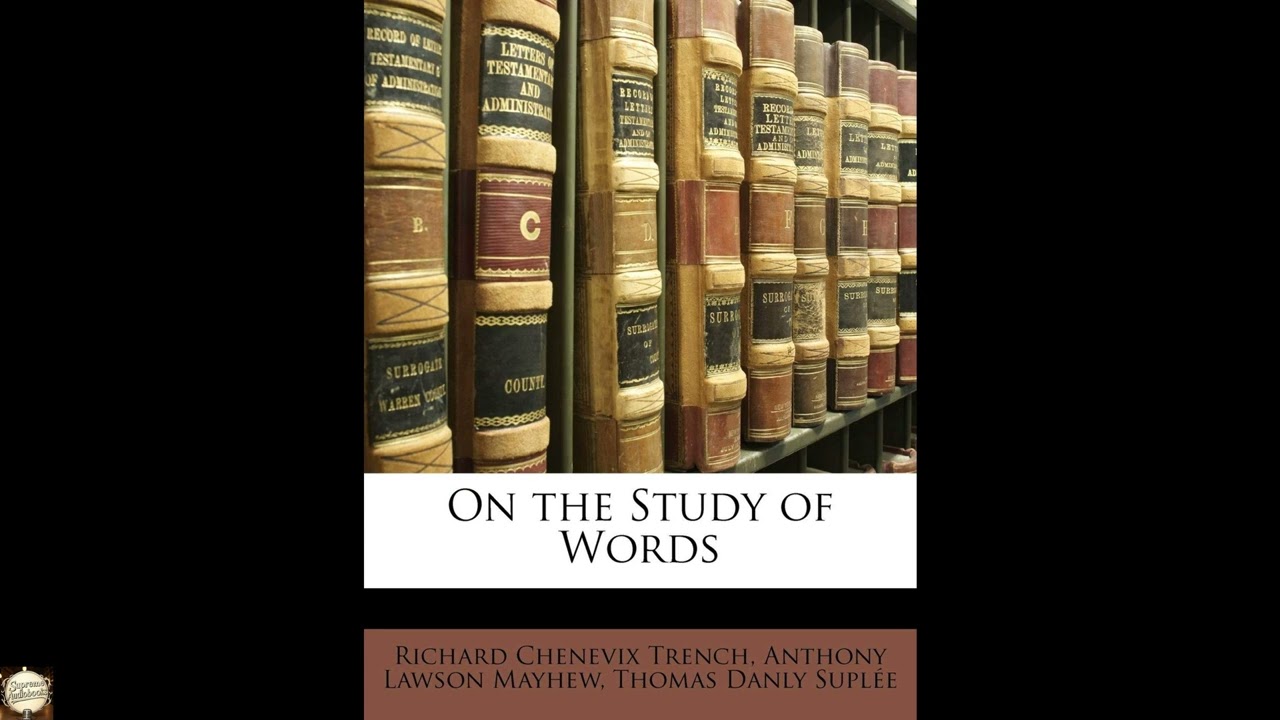
On the Study of Words
Every word we utter carries a secret history, a forgotten narrative echoing through centuries. These seemingly simple units of communication are not static containers for meaning; they are living relics, fossilized poetry, and condensed history waiting to be unearthed. Richard Chenevix Trench's "On the Study of Words," originally published in 1851, stands as a foundational text that awakened the English-speaking world to the profound revelations hidden within everyday language. This book isn't merely a dry linguistic treatise; it is an exhilarating invitation to view our vocabulary as an archaeological site, where each term reveals layers of human experience, shifting beliefs, and enduring truths. For anyone who has ever paused to consider the origin of a phrase, or felt the peculiar weight of a particular word, Trench offers a key to unlock a deeper appreciation for the very fabric of thought and expression. Trench commences his intellectual argument by asserting that words are more than arbitrary signs; they are monuments, some of them "ruined, but often magnificent ruins." He begins by illustrating how the language we speak today is saturated with wisdom and folly from past generations. He directs attention to how words often contain a moral lesson, a distilled judgment on human behavior. For instance, he points out how terms like "diligent" (from diligere, to love) suggest that true care and attention come from affection, while "trivial" (from trivium, a crossroads where idle chatter occurred) signals something common and unimportant. This opening establishes his central premise: that etymology is not an academic exercise but a moral and intellectual necessity. The book then systematically proceeds to categorize and analyze how words function as repositories of history, reflections of national character, and records of scientific discovery. Trench provides numerous examples to support his claims, drawing the listener's attention to how words preserve forgotten customs or beliefs. He shows how "supercilious" (from supercilium, eyebrow) connects to the haughty raising of an eyebrow, or how "sincere" (from sine cera, without wax) might refer to pure honey or unadulterated sculpture. He demonstrates how language mirrors the progress of human understanding, with words gaining or losing prestige and meaning as society evolves. Trench also dedicates sections to examining the corruption of words—how their meanings can be debased or confused over time, leading to imprecise communication and muddled thought. The book's progression is one of accumulating evidence, building a powerful argument for diligent word study as a means to understand not just language, but humanity itself. Richard Chenevix Trench, born in Dublin in 1807, was a remarkable figure whose life straddled the worlds of the church, academia, and letters. Educated at Trinity College, Cambridge, he initially pursued a career in poetry, publishing several volumes of verse before dedicating himself more fully to theology. He was ordained an Anglican priest in 1832, serving in various parishes across England before becoming a professor of Exegesis of the New Testament at King's College, London, in 1846. His scholarly pursuits were extensive, encompassing biblical studies, philology, and literary criticism. His appointment as Dean of Westminster in 1856 and subsequently as Archbishop of Dublin in 1864 underscored his prominence within the Church of England and Ireland. Beyond his ecclesiastical duties, Trench was a pivotal figure in the Victorian intellectual landscape. He is widely recognized for his profound influence on the Oxford English Dictionary. His "Proposal for the Publication of a New English Dictionary" (1857), which critiqued existing dictionaries for their inadequacies, laid the groundwork for what would become the OED, advocating for an exhaustive, historically grounded record of the English language. He passed away in 1886, leaving a legacy of both spiritual leadership and seminal contributions to linguistic scholarship. "On the Study of Words" enacts several profound themes that resonate far beyond its mid-19th century publication. First, it champions the idea that language is a living history book. Trench repeatedly illustrates this by showing how words retain vestiges of older civilizations, defunct technologies, or forgotten philosophical ideas. For example, he might point to the word "calculate," deriving from calculus, a small pebble used for counting, demonstrating how the very act of arithmetic is rooted in ancient, physical practices. This theme underscores the continuous, evolving relationship between language and human progress, reminding us that speech is a cumulative record of our collective past. Another significant theme is the moral dimension of language. Trench frequently argues that words carry inherent ethical weight, and their proper use or misuse reflects the moral state of a society. He suggests that careless language can lead to intellectual and ethical decay, while precision in speech fosters clarity in thought and righteousness in action. He might contrast a word like "awful," which once conveyed a sense of profound reverence and awe, with its modern, diluted meaning of merely "bad," thereby demonstrating a decline in our capacity to express or even feel truly sublime emotions. This concern for the moral integrity of language links his linguistic observations directly to the ethical fabric of human existence. The mid-nineteenth century, when Trench penned "On the Study of Words," was a period of intense intellectual curiosity and rapid societal transformation in Britain. It was the heart of the Victorian era, characterized by industrial expansion, imperial growth, and significant scientific advancements, most notably Darwin's theories on evolution, which profoundly influenced how scholars viewed development and change, even in language. Philology—the historical study of language—was gaining considerable momentum as a respected academic discipline, driven by German scholarship in comparative linguistics. Against this backdrop, Trench's book emerged as a timely intervention, making the insights of philology accessible to a broader English-speaking audience. It spoke to a cultural milieu that valued self-improvement, moral instruction, and a fascination with order and classification. "On the Study of Words" provided a framework for understanding the hidden structures and historical layers within the English language, aligning with the Victorian penchant for discovering systems and meaning beneath the surface of the everyday. It offered both an intellectual pursuit and a moral compass in a rapidly changing world. Listening to "On the Study of Words" as an audiobook transforms Trench's erudition into a personal, guiding voice. The spoken word brings a clarity and immediacy to his meticulously chosen examples, allowing the listener to absorb the nuances of etymology without the visual distraction of footnotes or cross-references. A skilled narrator can make Trench's often dense but always rewarding observations flow naturally, highlighting his quiet wit and his profound enthusiasm for his subject. This is a book meant to be pondered, perhaps during a leisurely walk, a long drive, or quiet moments at home, where the rhythm of the language itself reinforces the lesson that words are alive, deserving of our thoughtful attention and respect. The several hours of listening provide ample time to settle into Trench's worldview, letting his arguments about the power and precision of language reshape how one perceives every sentence spoken or read thereafter.
Enjoyed On the Study of Words? A few ways to support us
Audible & Amazon links are affiliate; we may earn a small commission at no extra cost.
About this production
Human narration by a volunteer reader from LibriVox.org, the public-domain audiobook project. LibriVox volunteers record literary works whose copyright has expired in the United States, releasing the resulting recordings into the public domain.
On the Study of Words by Richard Chenevix Trench. The underlying text is in the U.S. public domain. We do not republish any modern copyrighted edition, translation, or commentary.
The 4K cinematic visuals accompanying this audiobook are generated by an AI image model from prompts derived from the source text. No copyrighted photos, paintings, or stock footage are used. AI generation is disclosed on every video on our YouTube channel as required by YouTube's altered/synthetic content policy.
English subtitles are transcribed from the LibriVox recording with OpenAI Whisper. Translations into the 11 other supported languages are produced by Meta's NLLB-200 neural translation model. No human translator's copyrighted translation is used.
Questions about sourcing or rights? See our DMCA & Sourcing policy or contact us.
Enjoyed this audiobook?
If you'd like to own a copy of On the Study of Words or hear a professionally produced edition, the links below help support free audiobook production at no extra cost to you.
As an Amazon Associate we earn from qualifying purchases. Audible / print links are affiliate.