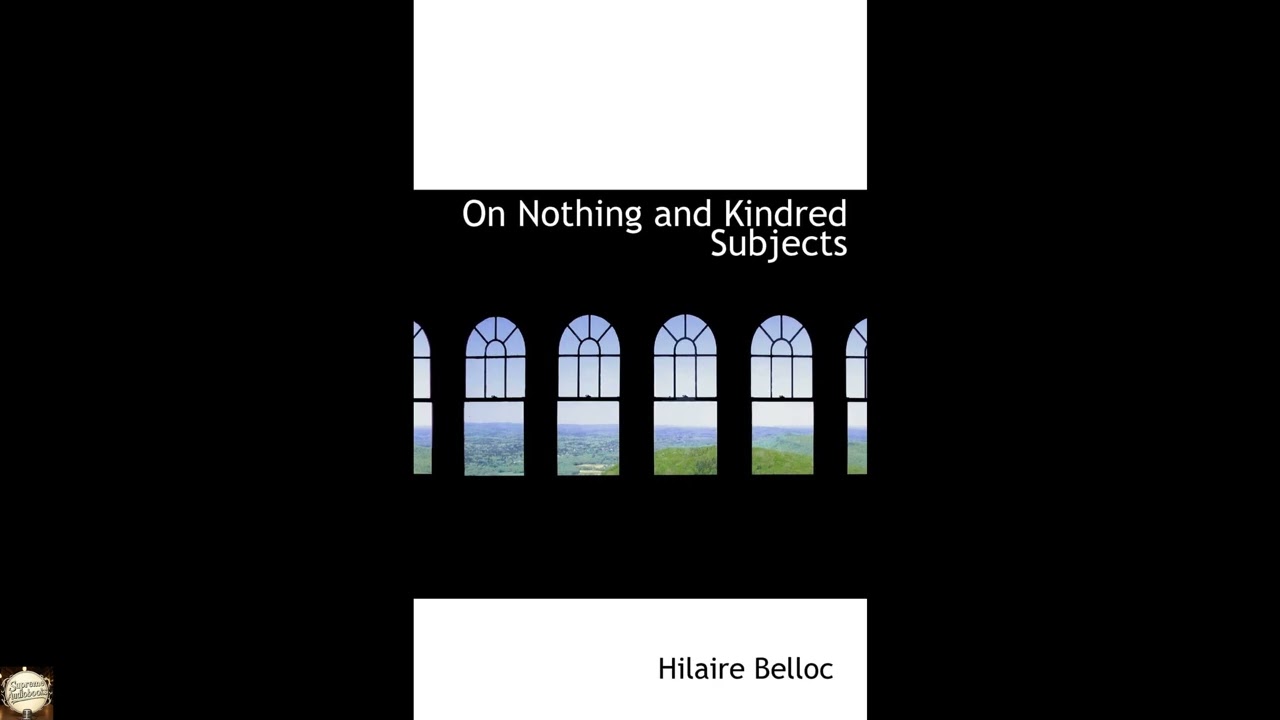
On Nothing and Kindred Subjects
Enter the distinctive, often cantankerous, always brilliant mind of Hilaire Belloc with "On Nothing and Kindred Subjects." This collection of essays offers a window into the observations and opinions of one of the Edwardian era's most engaging literary figures, a man renowned for his wit, his uncompromising perspectives, and his beautiful command of the English language. Rather than a mere diversion, these pieces invite the listener to pause and reflect on the overlooked corners of existence – the small absurdities, the profound truths hidden in plain sight, the persistent follies of humanity, and the enduring questions that define our lives. Belloc's genius lies in his ability to take a seemingly trivial idea, an everyday scene, or an abstract concept and dissect it with surgical precision, often to hilarious or deeply insightful effect. For anyone seeking a moment of intellectual companionship, a challenge to modern assumptions, or simply the pleasure of exquisite prose, these collected thoughts resonate just as strongly in our hurried world as they did in his. "On Nothing and Kindred Subjects" presents not a linear narrative, but rather a series of excursions into Belloc's philosophical garden. Each essay acts as a self-contained miniature, charting the author's contemplation of a diverse array of topics. One might find him musing on the elusive nature of "nothing" itself, pondering the paradoxes of emptiness and the human compulsion to fill every void. In another piece, the setting might shift to a dusty country road, where Belloc observes the habits of travelers or the enduring character of a particular landscape, drawing broader conclusions about human nature or the passage of time. He frequently casts himself as the keen-eyed observer, encountering various archetypes—the pompous academic, the earnest politician, the well-meaning but misguided enthusiast—and subjecting their foibles to his characteristic blend of irony and gentle scorn. The "plot" of this book, then, is the unfolding revelation of a singular mind grappling with the universe, moving from the purely abstract to the intensely personal, from the grand sweep of history to the fleeting sensation of a moment. The arc of the collection is one of widening perspective, as Belloc consistently demonstrates his capacity to connect the specific to the universal. He might begin with a whimsical anecdote about a forgotten custom, only to pivot gracefully into a sharp critique of contemporary societal trends, or to reflect on the deeper historical currents that shape human behavior. Throughout these varied disquisitions, the central conflict often arises from Belloc's own intellectual dissatisfaction with prevailing orthodoxies, whether they be political, social, or philosophical. He challenges assumptions, skewers pretension, and champions common sense and traditional values against what he perceives as the fleeting fads of his day. There is no single climax, but rather a continuous series of small revelations, each essay building upon the last to create a cumulative portrait of a penetrating intellect at work. The author, Hilaire Belloc (born Joseph Hilaire Pierre René Belloc in La Celle-Saint-Cloud, France, in 1870, and passing in King's Land, Sussex, in 1953), was a figure of immense intellectual and literary power, whose Anglo-French heritage profoundly shaped his worldview. Educated at The Oratory School in Edgbaston and later at Balliol College, Oxford, where he was a prominent figure in the Union debates, Belloc possessed a formidable intellect and a deep love for history and classical learning. He served as a Liberal Member of Parliament for Salford South from 1906 to 1910, but ultimately grew disillusioned with party politics, preferring the unfettered freedom of independent thought. His early career also included time as an artilleryman in the French army, an experience that instilled in him a lifelong appreciation for military strategy and discipline. Belloc was an extraordinarily prolific writer across numerous genres. His works include acclaimed historical analyses, such as "The French Revolution" and "A History of England"; travelogues like "The Path to Rome," a witty account of his walking pilgrimage; and whimsical, often dark, children's verses like "Cautionary Tales for Children." He was a close friend and intellectual ally of G.K. Chesterton, forming the famous "Chesterbelloc" partnership, a formidable duo who championed distributism – an economic theory promoting widespread ownership of productive assets – and a robust Catholic social doctrine. Belloc positioned himself as a defender of European Christendom and its traditions, often acting as a sharp critic of modernity, capitalism, and various forms of political collectivism. His essays, in particular, established him as a master of English prose, notable for their clarity, elegance, and often biting wit, securing his enduring place as a significant voice in early 20th-century literature. The essays in "On Nothing and Kindred Subjects" enact several significant themes. One prominent thread is the skepticism of progress, particularly when it threatens established wisdom or organic social structures. Belloc often uses specific examples to illustrate this. He might describe the destruction of an ancient rural pathway by new industrial development, not just lamenting the lost beauty, but arguing that the rapid, often thoughtless, advance of technology or bureaucracy erodes a deeper connection to history and community. Another pervasive theme is the celebration of the ordinary and the specific, elevating everyday observations into profound meditations. For instance, he might spend an entire piece dissecting the simple act of drinking wine, moving from its immediate sensory pleasure to its historical significance, its role in human conviviality, and even its spiritual dimension, thereby revealing the richness inherent in common experience. A third theme woven throughout these pieces is the critique of intellectual pretension and cant. Belloc, with his rapier wit, frequently targets figures who speak with unearned authority or who promote fashionable but ill-considered ideas. He might invent a caricature of a certain type of academic who uses needlessly complex language to obscure simple truths, or a politician whose pronouncements are full of sound and fury but signify very little. His method here is often to take their arguments to their logical, often absurd, conclusions, exposing the emptiness within. Underlying much of his writing is also a deep, though not always overtly stated, sense of moral order, informed by his Catholic faith and his belief in immutable truths. While the essays are rarely explicitly religious, his worldview informs his judgments on society, history, and human conduct, grounding his observations in a steadfast commitment to virtue and reason, often contrasting it with what he perceives as moral relativism or intellectual chaos. Belloc's most active period of writing and publication, when many of these essays would have first seen print, coincided with the early decades of the twentieth century, a period of immense upheaval and transformation. Culturally, Europe was grappling with the aftermath of the Victorian era's certainties, facing the rise of new scientific theories, artistic movements like Modernism, and profound social changes. Politically, the specter of global conflict loomed, and then tragically materialized in the First World War, irrevocably altering the geopolitical landscape. The rise of socialism, the expansion of the franchise, and debates over empire and national identity were all pressing concerns. Belloc's work emerged from this ferment, often as a direct response to these developments. He saw himself as a voice of tradition and reason amidst what he perceived as growing irrationality and decay, offering a counter-narrative to the prevailing currents of secularism and unfettered progress. His essays, therefore, function not just as personal reflections, but as critical interventions into the defining debates of his age, shaped by the anxieties and hopes of a continent on the cusp of profound change. Listening to "On Nothing and Kindred Subjects" as an audiobook offers a singular opportunity to engage directly with Belloc's distinctive voice and style. The very nature of the essay, designed for contemplation and argument, lends itself perfectly to the spoken word. A skilled narrator can amplify Belloc's characteristic dry humor, the subtle inflections of his sarcasm, and the resonant authority of his more serious pronouncements. Listen for the pacing, how the voice might quicken in moments of witty attack or slow for a profound, almost poetic, observation. The multi-hour length of this collection makes it an ideal companion for long drives, quiet evenings, or moments of focused reflection, allowing the listener to absorb the nuances of Belloc's often layered sentences and complex ideas without the visual distraction of a page. It's like having a brilliant, opinionated friend sharing his most intriguing thoughts, allowing you to appreciate the rhythm and musicality of his prose in a way that reading silently might sometimes obscure.
Enjoyed On Nothing and Kindred Subjects? A few ways to support us
Audible & Amazon links are affiliate; we may earn a small commission at no extra cost.
About this production
Human narration by a volunteer reader from LibriVox.org, the public-domain audiobook project. LibriVox volunteers record literary works whose copyright has expired in the United States, releasing the resulting recordings into the public domain.
On Nothing and Kindred Subjects by Hilaire Belloc. The underlying text is in the U.S. public domain. We do not republish any modern copyrighted edition, translation, or commentary.
The 4K cinematic visuals accompanying this audiobook are generated by an AI image model from prompts derived from the source text. No copyrighted photos, paintings, or stock footage are used. AI generation is disclosed on every video on our YouTube channel as required by YouTube's altered/synthetic content policy.
English subtitles are transcribed from the LibriVox recording with OpenAI Whisper. Translations into the 11 other supported languages are produced by Meta's NLLB-200 neural translation model. No human translator's copyrighted translation is used.
Questions about sourcing or rights? See our DMCA & Sourcing policy or contact us.
View 10 famous quotes from this book →
Enjoyed this audiobook?
If you'd like to own a copy of On Nothing and Kindred Subjects or hear a professionally produced edition, the links below help support free audiobook production at no extra cost to you.
As an Amazon Associate we earn from qualifying purchases. Audible / print links are affiliate.