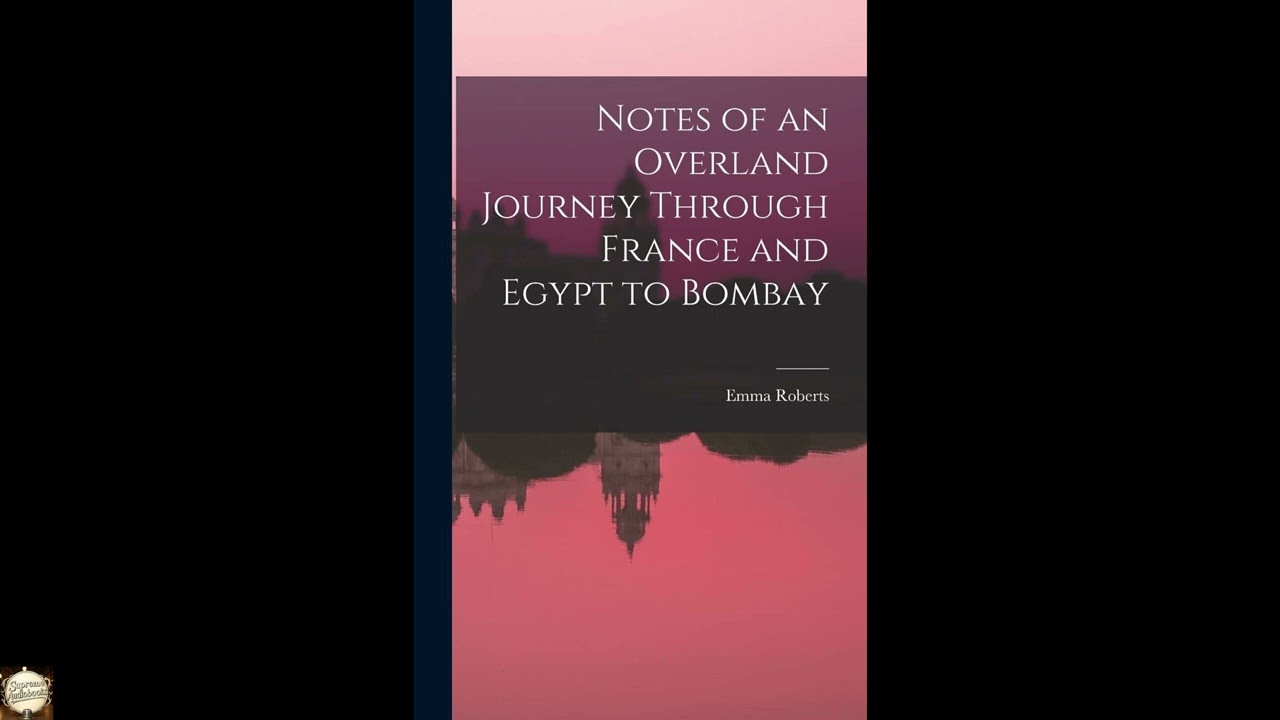
Notes of an Overland Journey Through France and Egypt to Bombay
Imagine crossing continents in an era when travel was not merely movement from one place to another, but a prolonged engagement with the world itself – a test of endurance, observation, and adaptability. Emma Roberts’s Notes of an Overland Journey Through France and Egypt to Bombay offers a rare, first-hand account of just such an undertaking. This remarkable travelogue, penned by a keen-eyed British woman in the late 1830s, invites us to witness a pivotal moment in global connection. It is more than a record of destinations; it is a direct window into the logistical complexities, cultural curiosities, and personal reflections that defined long-distance travel on the cusp of modernity. For anyone fascinated by the genesis of globalism, the challenges faced by women travelers, or the sheer spirit of human curiosity in a rapidly changing world, Roberts’s observations resonate with surprising immediacy even today. The story unfolds with Roberts’s departure from France, heading eastward towards the Mediterranean. Her initial observations capture the fleeting details of European life, a brief prelude to the dramatic shift in scenery and custom awaiting her. The true heart of her account begins as she sets foot in Egypt, then a crucial, bustling crossroads for British interests linking Europe to India. Here, Roberts navigates the ancient landscapes of Alexandria and Cairo, conveying the sensory overload of unfamiliar sights, sounds, and smells. She describes the architecture, the vibrant marketplaces, and the diverse populace – a mix of locals, transient Europeans, and other travelers – all filtered through her discerning gaze. The initial leg through Egypt involves a significant portion by riverboat along the Nile, presenting its own unique rhythm and array of passing scenes, from rural villages to monumental ruins. From the Nile, the narrative shifts to the arduous overland crossing of the Egyptian desert, a formidable challenge involving camels and local escorts, before reaching the Red Sea. This segment of the expedition highlights the raw physical demands of travel in an age before modern infrastructure, underscoring the contrast between European comfort and the rugged realities of distant lands. Her narrative then takes to the sea once more, a steam-powered vessel carrying her across the Red Sea and then the vast expanse of the Indian Ocean. The journey concludes with her much-anticipated arrival in Bombay, a key port of the British Empire in India. Throughout this epic passage, Roberts details not only the geography and methods of transit but also the fleeting encounters with fellow passengers and local inhabitants, each interaction adding a layer to her understanding of the world she traverses. Her focus remains steadfastly on the immediate experience, allowing the reader to share in the progression and accumulation of her observations. Emma Roberts, an accomplished English writer, was a figure of quiet determination in the early Victorian era, a period when women’s voices in public spheres were still finding their footing. Born around 1791, her life was marked by a profound connection to India. Her initial experience of the subcontinent came in 1828 when she moved there to live with her sister, whose husband was a British officer. This first residency in India provided the basis for her widely recognized work, Scenes and Characteristics of Hindostan, published in 1835. This earlier book established her as an astute observer of Indian life and customs, offering a rare perspective from a European woman living within colonial society. After a period spent back in England, Roberts embarked on her second voyage to India in 1839, a voyage that forms the basis of the Notes of an Overland Journey. Tragically, she would die in India shortly after her arrival in Bombay in 1840, making this account one of her final literary contributions. Her writing style, characterized by its clear prose and detailed observation, placed her within a growing tradition of women travel writers and ethnographers. Though she may not be as widely known as some of her male contemporaries, Roberts occupied an important space in the literary landscape, providing a meticulous, unvarnished look at the practicalities of travel and the complexities of colonial encounters, all from a distinctly female viewpoint. Her collected works offer invaluable social history and a unique angle on British imperial presence. One of the central themes running through Roberts’s account is the clash and convergence of cultures. Her descriptions of Egyptian towns and their inhabitants offer a fascinating glimpse into a non-European society through British eyes. For instance, she vividly contrasts the chaotic energy of an Alexandrian bazaar – with its unfamiliar languages, pungent spices, and distinct dress – against the more ordered, perhaps even sterile, environments of European port cities she had known. This theme is further highlighted in her interactions, or lack thereof, with local women, a subtle but persistent reminder of societal barriers and different ways of life. Another prominent theme is the human encounter with technological change. The very concept of the "overland route" through Egypt was a testament to the burgeoning power of steamships, dramatically shortening the journey to India compared to the traditional sea route around the Cape of Good Hope. Roberts’s narrative shows the practical implications of this shift, from the specific design of steam packets on the Nile and Red Sea to the coordinated logistics required to bridge the land gap, marking a clear moment when human ingenuity began to conquer geographical distance in new ways. Her writing also consistently addresses the resilience and adaptability of the traveler. Roberts herself, as a lone woman undertaking such an arduous passage, implicitly embodies this theme, but she also highlights it in others. Her observations often dwell on the various ways travelers, whether European or local, cope with discomfort, boredom, and the unexpected. We see this in her descriptions of cramped quarters on riverboats, the tedium of desert crossings, or the resourcefulness required when supplies are scarce. Finally, the book is a testament to the power of meticulous observation. Roberts is an empirical writer, dedicated to recording what she sees, hears, and even smells. Her descriptions are precise, whether she is detailing the architectural styles of ancient ruins, the peculiar habits of fellow passengers, or the specific types of flora and fauna encountered. For example, she might describe a particular type of dress worn by a Cairo merchant with the same care she gives to explaining the mechanics of a new steamboat, lending the text a documentary quality that makes it a valuable historical artifact. Roberts’s Notes emerged at a fascinating juncture in British imperial history. In the late 1830s, the British Empire was consolidating its hold on India, and rapid communication and efficient transit between the metropole and its most prized colonial possession were becoming paramount. The traditional sailing route around Africa was long and unreliable. The "overland route" through Egypt, while still challenging, offered a significantly faster alternative, enabling quicker troop movements, official dispatches, and commercial connections. This period also saw the expansion of British influence in the Middle East, particularly in Egypt, which, though nominally part of the Ottoman Empire, was increasingly becoming a strategic interest due to its geographical position. Culturally, there was a burgeoning public appetite for travel narratives. The rise of a literate middle class in Britain, coupled with a growing sense of national pride and curiosity about the Empire’s far-flung territories, meant that accounts like Roberts’s found a ready audience. Advances in printing technology also made such works more accessible. Furthermore, the genre of travel writing itself was evolving, moving beyond purely geographical or scientific reports to incorporate more personal reflections and cultural commentary. Emma Roberts’s work fits perfectly into this context, providing not just a practical guide to the route but also a personal testimony to the changing world, seen through the unique lens of an educated woman venturing far from home. Her book thus stands as both a practical guide and a social commentary on a world in rapid transition. Listening to Notes of an Overland Journey Through France and Egypt to Bombay as an audiobook offers a truly immersive experience. The narrator’s voice becomes your companion on this extraordinary expedition, breathing life into Roberts’s detailed observations and allowing you to perceive the world she describes through an almost personal lens. The pacing of the narration often mirrors the actual tempo of 19th-century travel – sometimes brisk with the excitement of a new arrival, other times measured and contemplative during long stretches of sea or desert. You can almost feel the sway of the ship or the slow plodding of camels as the narrator conveys Roberts’s carefully chosen words. The gentle rhythm and clear articulation of the narration enhance Roberts’s ability to create atmosphere, whether she is describing the bustling confusion of a foreign port or the serene solitude of the open sea. This format transforms the written word into a direct verbal transmission of her thoughts, making her journey and her unique perspective feel remarkably immediate and accessible across the centuries.
Enjoyed Notes of an Overland Journey Through France and Egypt to Bombay? A few ways to support us
Audible & Amazon links are affiliate; we may earn a small commission at no extra cost.
About this production
Human narration by a volunteer reader from LibriVox.org, the public-domain audiobook project. LibriVox volunteers record literary works whose copyright has expired in the United States, releasing the resulting recordings into the public domain.
Notes of an Overland Journey Through France and Egypt to Bombay by Emma Roberts. The underlying text is in the U.S. public domain. We do not republish any modern copyrighted edition, translation, or commentary.
The 4K cinematic visuals accompanying this audiobook are generated by an AI image model from prompts derived from the source text. No copyrighted photos, paintings, or stock footage are used. AI generation is disclosed on every video on our YouTube channel as required by YouTube's altered/synthetic content policy.
English subtitles are transcribed from the LibriVox recording with OpenAI Whisper. Translations into the 11 other supported languages are produced by Meta's NLLB-200 neural translation model. No human translator's copyrighted translation is used.
Questions about sourcing or rights? See our DMCA & Sourcing policy or contact us.
View 10 famous quotes from this book →
Enjoyed this audiobook?
If you'd like to own a copy of Notes of an Overland Journey Through France and Egypt to Bombay or hear a professionally produced edition, the links below help support free audiobook production at no extra cost to you.
As an Amazon Associate we earn from qualifying purchases. Audible / print links are affiliate.