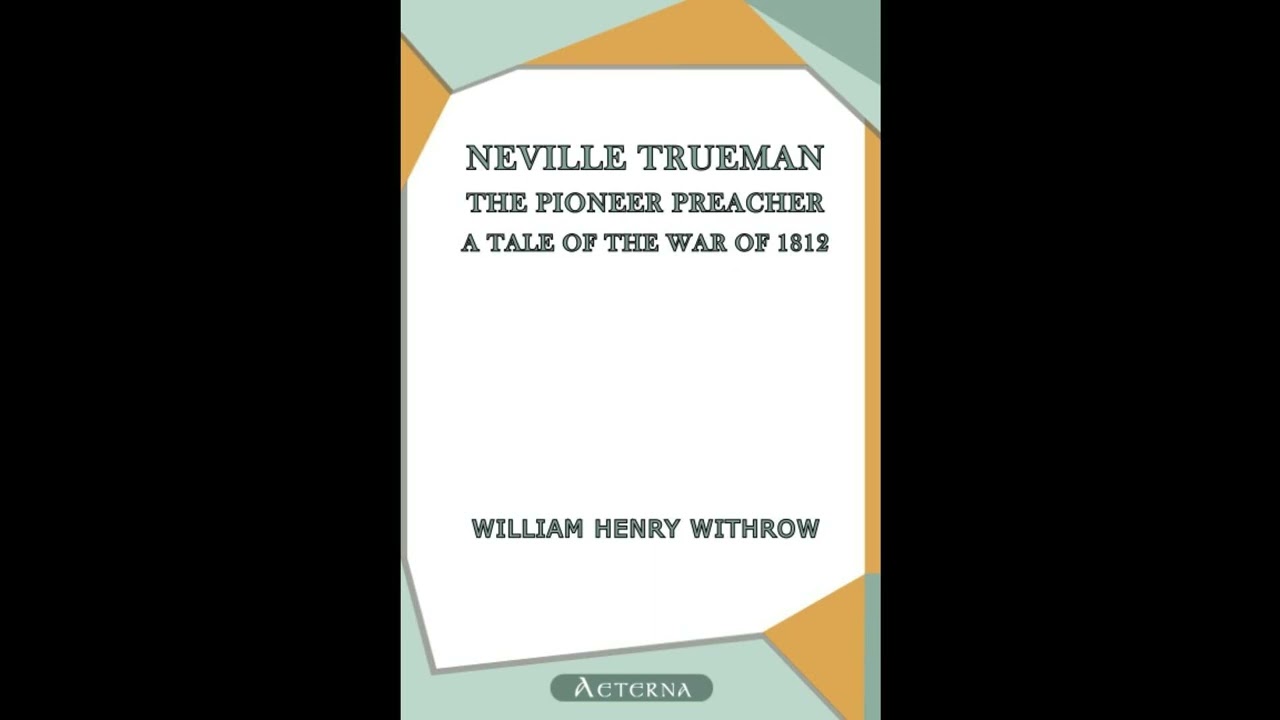
Neville Trueman, the Pioneer Preacher : a tale of the war of 1812
Neville Trueman, the Pioneer Preacher: a tale of the war of 1812 offers more than a simple historical account; it is a resonant portrait of conviction, courage, and community forged in the crucible of conflict. This classic novel transports listeners to a pivotal, often overlooked chapter of North American history, charting the experiences of settlers in Upper Canada during the War of 1812. Why should a story from two centuries ago matter now? Because it speaks to the enduring human need for purpose, for spiritual guidance, and for the unwavering strength found in one's beliefs when the world around is consumed by chaos. It shows how identity is shaped not just by grand battles, but by the quiet resolve of ordinary people and the steadfast spirit of those who minister to them. The narrative unfolds in the rugged, nascent settlements of Upper Canada, a frontier caught between the ambitions of the newly independent United States and the established power of Great Britain. Here, a diverse population of loyalists, immigrants, and Indigenous peoples carves out a precarious existence, their lives intrinsically tied to the land and the fragile peace that defines their borderlands. We meet Neville Trueman, a dedicated Methodist circuit preacher whose life's work is to spread the Gospel and minister to isolated communities. Trueman is not a soldier, but his mission requires a different kind of bravery, navigating the physical hardships of the wilderness and the spiritual challenges of a scattered, often struggling flock. As tensions escalate and the War of 1812 erupts, Trueman's personal calling becomes intertwined with the broader fate of his people. He finds himself ministering amidst the backdrop of skirmishes, the threat of invasion, and the displacement of families. The conflict forces tough choices, testing loyalties and faith alike. Trueman endeavors to be a beacon of hope and moral clarity, offering solace to the wounded, comfort to the grieving, and counsel to those torn by the demands of war. His journey reflects the tenacity of a community striving to define itself in the face of immense external pressure, striving to uphold values of peace and compassion even as cannons roar nearby. The author, William Henry Withrow (1839–1908), was a prominent Canadian Methodist minister, educator, and prolific writer. Born in Toronto, Ontario, Withrow dedicated his life to both the church and the literary world, leaving an indelible mark on Canadian letters. He was ordained into the Methodist ministry in 1864 and soon distinguished himself not only as a preacher but as a scholar and chronicler of his nation's past. For an impressive thirty-six years, Withrow served as the editor of The Methodist Magazine, a significant cultural and religious publication in Canada, and also edited The Christian Guardian. His literary output was substantial, encompassing travelogues such as Our Own Country: Canada, Historical and Descriptive, historical non-fiction, and several popular historical novels, including Barbara Heck: A Tale of the War of 1812 and Valeria, the Martyr of the Catacombs. Withrow belonged to a generation of Canadian authors who consciously worked to construct a national narrative, often through the lens of moral and religious fortitude. His fiction aimed to entertain while instilling virtues and a sense of Canadian identity rooted in historical perseverance and faith. At its heart, Neville Trueman acts as a powerful examination of faith and resilience. Trueman's steadfast adherence to his spiritual convictions, even when faced with the brutality of war—perhaps holding an impromptu sermon in the shadow of a battle, or offering comfort to a dying soldier regardless of uniform—shows how faith can be a profound source of strength and healing. The novel also powerfully illustrates the emergence of Canadian identity and a nascent sense of nationalism. Through the experiences of settlers defending their homes and way of life against external aggression, the book showcases the unifying force of a shared struggle and a collective desire for self-determination. Characters discuss their loyalty not just to a distant crown, but to their land and their burgeoning communities, highlighting the formative nature of the War of 1812 in shaping a distinct North American identity. Finally, the story paints a vivid picture of pioneer life and community spirit, detailing the sheer grit required to survive and build a society in the wilderness, emphasizing the reliance on mutual aid and shared burden that defined these early settlements. This novel first appeared in the late 19th century, a period of significant nation-building in Canada following Confederation in 1867. There was a burgeoning interest in historical narratives that could affirm a distinct Canadian heritage and identity. The War of 1812, in particular, was being reinterpreted and cemented as a foundational myth—a conflict that forged a sense of common purpose and distinction for British North America. Culturally, it was a time when historical fiction flourished as a popular genre, often serving a didactic purpose, blending entertainment with moral instruction. Withrow's work perfectly fit within this Protestant cultural landscape, using compelling storytelling to promote patriotism, faith, and moral fortitude, resonating deeply with readers seeking to understand their place in a young, evolving nation. Listening to Neville Trueman, the Pioneer Preacher as an audiobook brings the immediacy and atmosphere of the early 19th-century frontier into sharp focus. A skilled narrator can make the harsh realities of wilderness life and wartime struggle palpable, translating the period’s language and the characters’ earnest convictions into a compelling auditory experience. Over several hours, the listener can become fully immersed in Trueman’s world, following the measured cadence of his sermons contrasted with the raw urgency of wartime dialogue. Listen for the subtle shifts in the narrator's voice, distinguishing the preacher’s solemn resolve from the anxieties and hopes of his scattered flock, bringing the soundscapes of nascent settlements – the rustle of the forest, the crackle of a hearth, the distant thrum of conflict – directly to the ear. It is an opportunity to experience history not just as fact, but as a living, breathing story.
Enjoyed Neville Trueman, the Pioneer Preacher : a tale of the war of 1812? A few ways to support us
Audible & Amazon links are affiliate; we may earn a small commission at no extra cost.
About this production
Human narration by a volunteer reader from LibriVox.org, the public-domain audiobook project. LibriVox volunteers record literary works whose copyright has expired in the United States, releasing the resulting recordings into the public domain.
Neville Trueman, the Pioneer Preacher : a tale of the war of 1812 by W. H. Withrow. The underlying text is in the U.S. public domain. We do not republish any modern copyrighted edition, translation, or commentary.
The 4K cinematic visuals accompanying this audiobook are generated by an AI image model from prompts derived from the source text. No copyrighted photos, paintings, or stock footage are used. AI generation is disclosed on every video on our YouTube channel as required by YouTube's altered/synthetic content policy.
English subtitles are transcribed from the LibriVox recording with OpenAI Whisper. Translations into the 11 other supported languages are produced by Meta's NLLB-200 neural translation model. No human translator's copyrighted translation is used.
Questions about sourcing or rights? See our DMCA & Sourcing policy or contact us.
Enjoyed this audiobook?
If you'd like to own a copy of Neville Trueman, the Pioneer Preacher : a tale of the war of 1812 or hear a professionally produced edition, the links below help support free audiobook production at no extra cost to you.
As an Amazon Associate we earn from qualifying purchases. Audible / print links are affiliate.