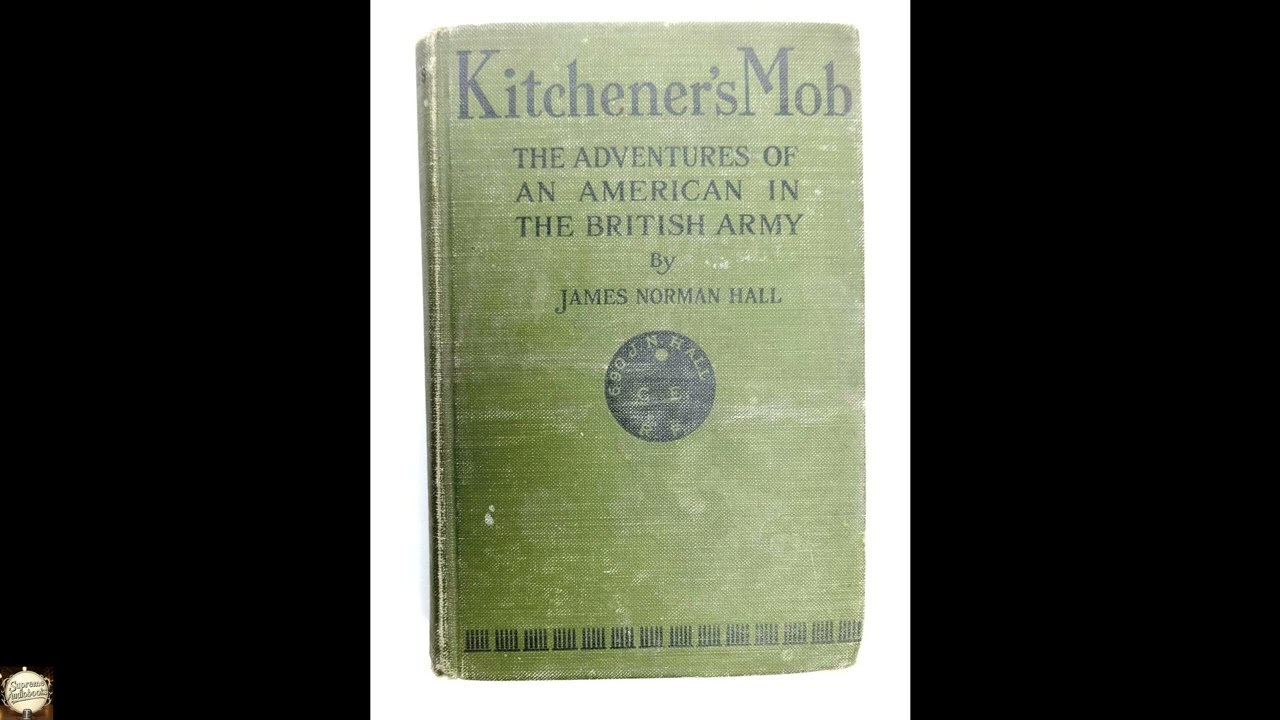
Kitchener's Mob: The Adventures of An American in The British Army
Amidst the torrent of literature that emerged from the crucible of the First World War, James Norman's Kitchener's Mob stands as a singular, often overlooked, account: the wartime experiences of an American who chose to fight for King and Country long before his own nation entered the fray. This isn't just another tale of trench warfare, but a rare cultural lens, offering a perspective shaped by a distinct American sensibility navigating the alien world of the British Tommy. The book provides an intimate, unvarnished look at the colossal human cost of the conflict, from the eager idealism of the recruitment office to the brutal disillusionment of the Western Front, revealing how one individual grappled with the mechanical slaughter and found enduring humanity amidst the mud and blood. Its relevance today persists not only as a historical document, but as a poignant study of allegiance, transformation, and the universal soldier's spirit, asking what it means to belong, to fight, and to endure. The story begins with the unnamed American protagonist, a young man drawn by a potent mix of adventure, idealism, and perhaps a touch of youthful naiveté, across the Atlantic to volunteer for the British Army. His decision places him squarely within the ranks of "Kitchener's Mob," the vast, rapidly assembled volunteer army raised by Lord Kitchener in the early days of the Great War. We witness his initial impressions of British military life, the stark differences in discipline and custom compared to what he knew, and the initial, almost festive, atmosphere of training. His journey quickly moves from the parade ground to the passenger ship, and then directly into the terrifying reality of the Western Front, where the romantic notions of war are swiftly pulverized by artillery barrages and the grim routine of trench living. The heart of the narrative beats in the desolate, muddy landscapes of Flanders and northern France, a labyrinth of trenches, barbed wire, and unremitting danger. The protagonist's personal struggle unfolds against a backdrop of constant shelling, desperate attacks across no-man's-land, and the unceasing vigilance required for survival. He encounters a colorful cast of characters among his fellow soldiers – men from all walks of British life, unified by the shared ordeal, and often defined by their humor, stoicism, and quiet despair. The central conflict lies not merely in facing the enemy, but in the internal battle to maintain sanity, hope, and a sense of self in a world designed to strip away individuality. The arc of the story tracks his transformation from an eager recruit to a hardened veteran, a testament to the grinding attrition of modern warfare and the profound psychological changes it wrought upon an entire generation, without revealing the specific outcome of his service. James Norman, the credited author of Kitchener's Mob, represents a fascinating voice from the early twentieth century, capturing the immediate human experience of a conflict that redefined global consciousness. While specific biographical details about Norman himself can be elusive, the very nature of Kitchener's Mob suggests an author intimately acquainted with the trials he describes. Many such accounts from the era, whether thinly veiled memoirs or fictionalized narratives based on firsthand witness, served as vital conduits for understanding the unprecedented scale and horror of the First World War. Authors of this period often grappled with the challenge of conveying experiences for which there was no precedent, crafting new forms of realism to articulate the breakdown of traditional values and the shock of industrialized warfare. Norman's work belongs to a significant current within early 20th-century literature, where individuals, often veterans themselves, sought to put words to the indescribable. This was a time when the personal narrative took on immense importance, providing a human scale to an otherwise incomprehensible tragedy. While not necessarily a part of a defined "literary movement" in the academic sense, authors like Norman contributed to a broad, international effort to document, understand, and perhaps come to terms with the war's enduring impact on the individual psyche. His contribution lies in offering a viewpoint that bridges national identities, showcasing how the universal truths of courage, fear, and camaraderie transcended political allegiances in the face of ultimate peril. The book enacts several profound themes that resonate far beyond its historical setting. One significant theme is the stark contrast between the idealized vision of war and its brutal reality. The initial patriotic fervor and the protagonist's eager decision to volunteer quickly dissolve into the visceral horror of the trenches. For example, his early descriptions of training, where drill and camaraderie dominate, sharply juxtapose with the graphic depictions of gas attacks or bayonet charges, illustrating how swiftly innocence is shattered and replaced by a grim pragmatism for survival. A second central theme is the profound sense of camaraderie and brotherhood that forms among soldiers facing unimaginable conditions. Despite their differing backgrounds, the men in Kitchener's Mob forge unbreakable bonds of loyalty and mutual support. This is evident in shared moments of gallows humor in a dugout under fire, or in the selfless acts of comrades aiding wounded friends amidst a deadly barrage, showcasing the enduring power of human connection in the most extreme circumstances. Another potent theme is the psychological toll exacted by continuous exposure to violence and death. The narrative subtly, yet powerfully, illustrates the creeping numbness, the hyper-vigilance, and the gradual erosion of the human spirit that marked so many who endured the front lines. The constant threat of annihilation, the loss of friends, and the dehumanizing conditions collectively create a sustained portrait of the mental burden carried by these men. Finally, the novel touches on the theme of national identity and cultural difference, as the American protagonist observes the distinctive customs, dialects, and stoicism of his British counterparts. His unique perspective allows for moments of wry observation and a subtle comparison of national characters, adding another layer to the human drama unfolding on the battlefield. Kitchener's Mob emerged during a period of unprecedented global upheaval, shaped by the First World War's cataclysmic impact. When the war began in 1914, there was widespread public enthusiasm and a general belief that it would be a short, glorious affair. Lord Kitchener's famous recruitment drive in Britain capitalized on this fervor, drawing millions of volunteers who answered the call with patriotic zeal. However, as the war bogged down into the static, brutal trench warfare of the Western Front, the initial idealism gave way to widespread disillusionment. The mechanized nature of the conflict, with its artillery, machine guns, and chemical weapons, defied all previous notions of heroism and combat. Culturally, this period marked a profound shift from the Romantic ideals of the late 19th century to the grittier realism and emerging modernism of the 20th. Literature from the early years of the war often reflected the initial patriotism, but as the scale of suffering became clear, a new wave of writing emerged—much of it from veterans themselves—that sought to convey the raw, unadulterated truth of the trenches. Kitchener's Mob fits squarely within this latter tradition, offering a corrective to earlier, more sanitized accounts. It provided a crucial voice in the burgeoning anti-war sentiment, born not of political ideology, but of firsthand experience, helping to shape public understanding of what the Great War truly meant for those who fought it. Listening to Kitchener's Mob as an audiobook offers a particularly immersive and evocative experience, transforming a historical text into a living narrative. The narrator's voice becomes the conduit for the protagonist's journey, capable of conveying the youthful enthusiasm of his early days, the mounting dread of the trenches, and the quiet resilience forged in battle. With several hours of run time, this is an ideal listen for daily commutes, long walks, or dedicated periods of focused attention, allowing the listener to truly settle into the rhythm of the narrative. Listen for the subtle shifts in pacing – the hurried chaos of battle scenes contrasted with the slow, grinding monotony of trench life or moments of poignant reflection. The narration can highlight the distinct voices and accents of the diverse soldiers, bringing their camaraderie and individual personalities to life. The atmosphere, from the biting cold and pervasive dampness of the front to the brief respites of leave, can be powerfully rendered through the narrator's interpretation, making the listener a direct witness to the adventures and harrowing realities faced by an American in Kitchener's Mob.
Enjoyed Kitchener's Mob: The Adventures of An American in The British Army? A few ways to support us
Audible & Amazon links are affiliate; we may earn a small commission at no extra cost.
About this production
Human narration by a volunteer reader from LibriVox.org, the public-domain audiobook project. LibriVox volunteers record literary works whose copyright has expired in the United States, releasing the resulting recordings into the public domain.
Kitchener's Mob: The Adventures of An American in The British Army by James Norman. The underlying text is in the U.S. public domain. We do not republish any modern copyrighted edition, translation, or commentary.
The 4K cinematic visuals accompanying this audiobook are generated by an AI image model from prompts derived from the source text. No copyrighted photos, paintings, or stock footage are used. AI generation is disclosed on every video on our YouTube channel as required by YouTube's altered/synthetic content policy.
English subtitles are transcribed from the LibriVox recording with OpenAI Whisper. Translations into the 11 other supported languages are produced by Meta's NLLB-200 neural translation model. No human translator's copyrighted translation is used.
Questions about sourcing or rights? See our DMCA & Sourcing policy or contact us.
Enjoyed this audiobook?
If you'd like to own a copy of Kitchener's Mob: The Adventures of An American in The British Army or hear a professionally produced edition, the links below help support free audiobook production at no extra cost to you.
As an Amazon Associate we earn from qualifying purchases. Audible / print links are affiliate.