My Friends at Brook Farm
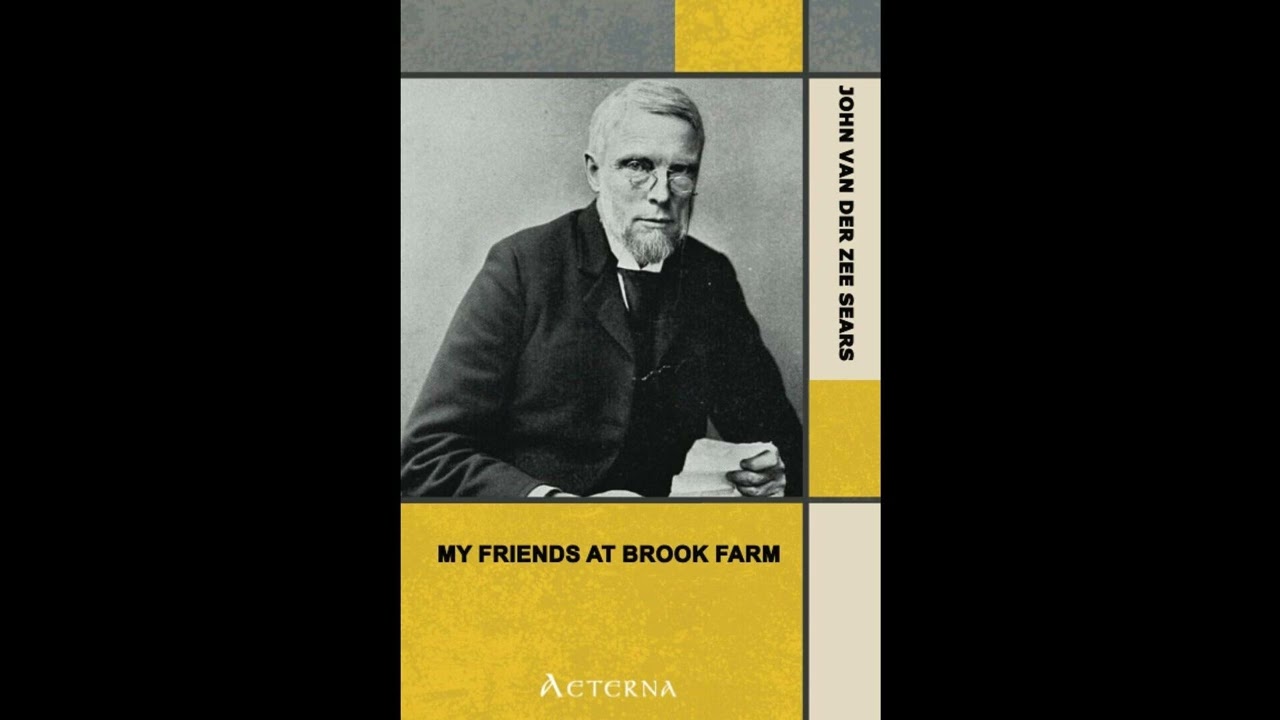
How do we build a better world? This question, as vital today as ever, captivated a generation of American intellectuals and reformers in the mid-nineteenth century, leading some to forge ambitious social experiments. Among the most renowned was Brook Farm, a transcendentalist communal living project in West Roxbury, Massachusetts, founded on principles of intellectual pursuit, manual labor, and social equality. John Van Der Zee Sears’s "My Friends at Brook Farm" offers a singularly intimate and deeply personal recollection of this famous utopian endeavor, not from the perspective of its celebrated founders, but through the wide, curious eyes of a child who called it home. It is a tender, insightful look at idealism put into practice, asking us to consider the enduring appeal and inherent difficulties of communal aspirations, and why the dreams of yesterday continue to echo in our present-day search for belonging and purpose. The story unfolds within the bucolic setting of Brook Farm, a parcel of land in the 1840s where men and women sought to harmonize mental and physical activity, creating a society where all members shared in both labor and leisure. Young John Sears, the central consciousness of the narrative, arrives at Brook Farm as a boy, observing the adults around him with a mixture of wonder and clear-eyed innocence. He introduces us to a community populated by earnest intellectuals, dreamers, and sometimes eccentric personalities, all striving to live out the transcendentalist creed. The daily routine is a curious blend of philosophical discussions in the parlor and strenuous work in the fields, alongside communal meals and lively artistic performances. Sears sketches portraits of the notable figures who graced Brook Farm's grounds—George Ripley, the community's founder, striving to manage its finances and ideals; the earnest and sometimes aloof Nathaniel Hawthorne, who briefly joined the experiment; the brilliant Margaret Fuller, lending her intellect to the conversations; and the pragmatic Charles A. Dana, overseeing practical affairs. Through Sears’s memories, these figures become more than just names in history books; they are individuals seen through the unfiltered lens of childhood, revealing their quirks, their commitments, and their humanity. The central arc of the account follows the community’s attempts to sustain itself against the odds, grappling with economic realities, human nature, and the sheer challenge of forging a new social order, all while the young narrator experiences childhood within this singular environment. John Van Der Zee Sears (1835-1910) was born in New York City, but his early formative years were spent amidst the intellectual and social ferment of Brook Farm, where his family resided between 1841 and 1847. This period, from the age of six to twelve, profoundly shaped his outlook and provided the unique perspective that imbues "My Friends at Brook Farm" with its authenticity. After the dissolution of the community, Sears went on to pursue a career in law and business, yet his connection to the transcendentalist movement and its ideals remained. He maintained correspondence with many former Brook Farmers and continued to engage with the philosophical questions that underpinned the experiment. While not a prolific author, Sears dedicated a significant portion of his later life to writing, primarily on historical and philosophical subjects. "My Friends at Brook Farm" stands as his most enduring and widely read contribution, published posthumously in 1912. It offers a crucial first-hand account, not from an adult participant or detached observer, but from someone whose entire childhood was immersed in the experiment. This singular vantage point ensures his book occupies a special place within the body of literature chronicling 19th-century American social reform and Transcendentalism, providing a personal counterpoint to more academic or polemical histories. The memoir enacts several potent themes, chief among them the tension between idealism and practical reality. Sears shows us how the lofty goals of shared labor and intellectual enrichment often collided with the mundane tasks of farming, carpentry, and cooking. He recounts scenes where esteemed intellectuals, accustomed to academic pursuits, struggled with the physical demands of rural life, illustrating the friction between theoretical principles and the grit of daily existence. Another prominent theme is the nature of community and individual identity. The Brook Farmers sought to foster a collective spirit, yet Sears’s recollections highlight the distinct personalities, sometimes clashing, sometimes harmonizing, that composed the whole. He observes the different ways individuals adapted to communal living—some thriving in the shared endeavor, others finding the lack of privacy or individual autonomy challenging. Furthermore, the book operates as a poignant meditation on memory and nostalgia. Written decades after the events transpired, Sears’s account is inherently filtered through the lens of time, offering a wistful reflection on a period of his youth and a social experiment that captured the hopes of a generation. His recollections are imbued with a tender fondness for the community he knew as a child, revealing how early experiences shape a life’s perspective and how the past can be both idealized and understood with greater clarity through retrospection. His child's perspective itself becomes a literary device, allowing for observations of character and situation that are direct, unburdened by adult cynicism, and often surprisingly insightful, cutting to the essence of the adults and their grand enterprise with an almost innocent truthfulness. "My Friends at Brook Farm" emerged from a distinct period in American history, reflecting both the aspirations and anxieties of the mid-19th century. The decade of the 1840s saw the rise of numerous social reform movements, including abolitionism, women's rights, and temperance, fueled by a spirit of moral conviction and a desire for societal betterment. Brook Farm itself was a direct outgrowth of Transcendentalism, an influential philosophical and literary movement pioneered by figures like Ralph Waldo Emerson and Henry David Thoreau. This movement emphasized intuition, the inherent goodness of humanity, the divinity of nature, and the importance of self-reliance and individual conscience. Brook Farm was an attempt to translate these abstract ideals into a concrete, lived experience, to create a society that would embody a more perfect union between intellectual pursuit and manual labor, between individual freedom and communal responsibility. The book’s later publication in 1912 also speaks to a particular moment when American society was beginning to look back at its foundational intellectual movements, seeking to preserve and understand the legacy of its reformist past. Listening to "My Friends at Brook Farm" as an audiobook offers a unique way to engage with this personal history. A skilled narrator can bring to life the gentle, reflective tone of Sears's prose, allowing listeners to settle into the perspective of a man recounting his childhood. The pacing will likely be measured, creating an atmosphere that encourages contemplation, much like listening to an elder share treasured memories. Pay attention to how the voice shifts when depicting the various personalities Sears encountered—the earnestness of Ripley, the quiet intensity of Hawthorne, the intellectual vigor of Fuller. The dialogue, as remembered and recreated by Sears, reveals the hopes and concerns of the Brook Farmers, providing an acoustic window into the intellectual discussions and everyday banter that filled their communal lives. The auditory experience allows the listener to feel transported to the pastoral setting and the unique social experiment unfolding within it, truly becoming a fly on the wall in this fascinating chapter of American intellectual history.
Enjoyed My Friends at Brook Farm? A few ways to support us
Audible & Amazon links are affiliate; we may earn a small commission at no extra cost.
About this production
Human narration by a volunteer reader from LibriVox.org, the public-domain audiobook project. LibriVox volunteers record literary works whose copyright has expired in the United States, releasing the resulting recordings into the public domain.
My Friends at Brook Farm by John Van Der Zee Sears. The underlying text is in the U.S. public domain. We do not republish any modern copyrighted edition, translation, or commentary.
The 4K cinematic visuals accompanying this audiobook are generated by an AI image model from prompts derived from the source text. No copyrighted photos, paintings, or stock footage are used. AI generation is disclosed on every video on our YouTube channel as required by YouTube's altered/synthetic content policy.
English subtitles are transcribed from the LibriVox recording with OpenAI Whisper. Translations into the 11 other supported languages are produced by Meta's NLLB-200 neural translation model. No human translator's copyrighted translation is used.
Questions about sourcing or rights? See our DMCA & Sourcing policy or contact us.
Enjoyed this audiobook?
If you'd like to own a copy of My Friends at Brook Farm or hear a professionally produced edition, the links below help support free audiobook production at no extra cost to you.
As an Amazon Associate we earn from qualifying purchases. Audible / print links are affiliate.