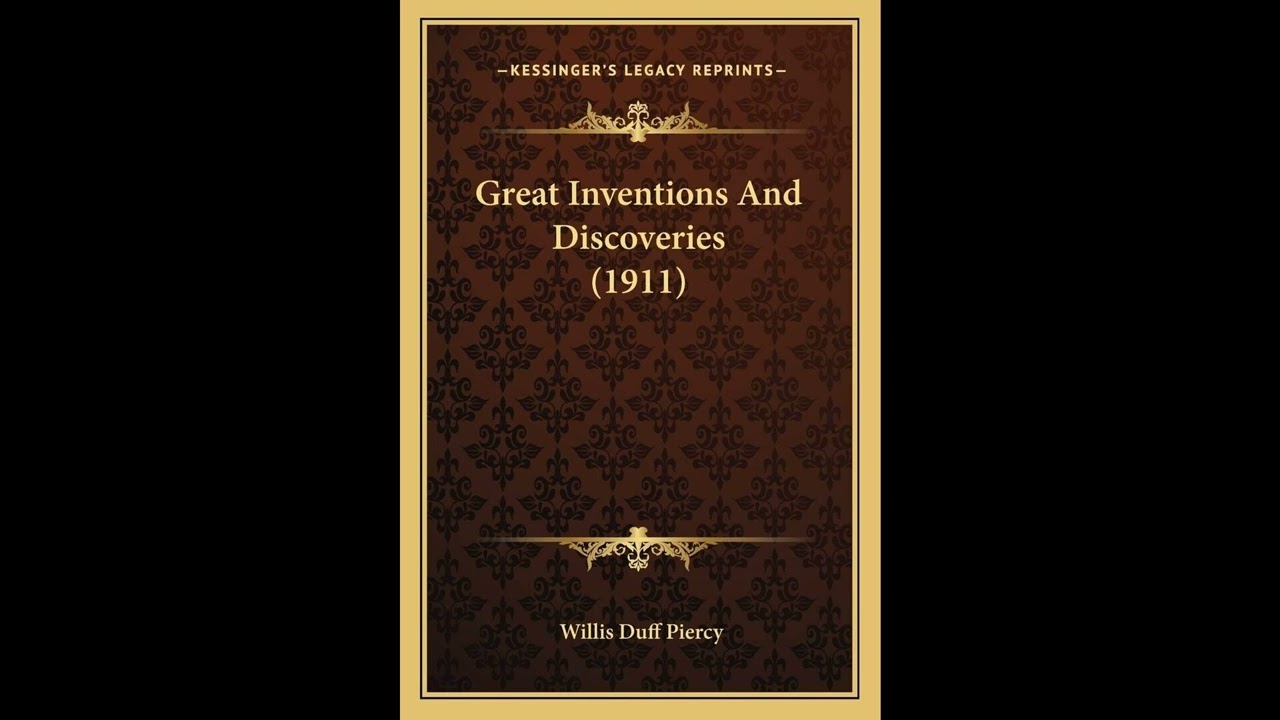
Great Inventions And Discoveries (1911)
Step into a world where the very foundations of modern existence were still being laid, and where human ingenuity was celebrated as the ultimate engine of progress. Willis Duff Piercy’s Great Inventions And Discoveries, first published in 1911, offers more than just a historical catalog of technological marvels; it provides a unique portal into the Edwardian mind, showcasing how an era on the cusp of unprecedented change viewed its own advancements. This is not merely a collection of facts, but a narrative of human striving, a chronicle of the brilliant minds and relentless spirits who shaped the world we inhabit. For today’s listener, this vintage account holds immense relevance, prompting reflection on our relationship with innovation, the ever-accelerating pace of discovery, and the cyclical nature of human ambition to overcome limits and reshape reality. It reminds us that every technological breakthrough, no matter how commonplace it seems now, began as a radical, often improbable, act of creation. Piercy’s work takes the form of a sweeping, chronological survey, beginning not with complex machinery, but with the fundamental concepts and elemental tools that first distinguished humanity from other creatures. He starts with the primal sparks of discovery: the taming of fire, the invention of the wheel, the first rudimentary implements for agriculture and construction. From these foundational innovations, the narrative gradually builds, tracking the lineage of interconnected ideas through millennia. We see the slow, painstaking evolution of early writing systems giving way to the transformative power of the printing press, a device that democratized knowledge and ignited intellectual revolutions across continents. The progression then moves into the more immediate past for Piercy’s original readers – the dramatic shifts brought about by the Industrial Revolution, with the steam engine standing as its emblematic powerhouse, forever altering industry, transportation, and daily life. The story continues through the scientific breakthroughs of the 19th century, chronicling the harnessing of electricity, the advent of telegraphy and telephony, and the burgeoning fields of photography and moving pictures. These were the inventions that, in 1911, represented the very cutting edge of human achievement, promising a future of unprecedented connection and spectacle. While there are no traditional "characters" in this non-fiction work, the spirit of the individual inventor – the solitary genius, the determined experimenter – shines through as a recurring motif. The central "conflict," if one can call it that, is humanity’s perennial struggle against the unknown, the natural world’s stubborn resistance, and the intellectual hurdles that demand creative solutions. The arc of this story is one of ever-increasing complexity and speed, showing how each invention builds upon the last, culminating in the exciting, bewildering, and sometimes unsettling technological landscape of the early 20th century. Willis Duff Piercy, born in 1866 and living until 1934, was an American author, editor, and compiler who dedicated much of his career to popularizing knowledge and making complex subjects accessible to a broad readership. While not a figure typically placed within the pantheon of literary giants or a pioneer of a specific literary movement, Piercy played an important role in the educational and self-improvement publishing trends of the late 19th and early 20th centuries. His work often focused on practical instruction, general history, and compilations designed to inform and uplift the general public. Beyond Great Inventions And Discoveries, Piercy also compiled and authored other volumes aimed at family enrichment and popular education. Titles like The Mother’s Book, The Father’s Book, and The Child’s Library of Work and Play illustrate his commitment to disseminating useful information and fostering a culture of learning within American homes. His approach was typically clear, methodical, and engaging, reflecting an era’s belief in the power of education to drive personal and societal betterment. Piercy’s place in the canon is perhaps not as an innovator of literary style, but as a diligent and effective communicator who helped shape the informational landscape for a generation eager to understand the world around them, particularly during a period of rapid social and technological change. A primary theme running through Piercy’s examination is the relentless march of human ingenuity. He demonstrates this through detailed accounts of how simple tools evolved into complex machines, how seemingly disparate discoveries converged to create entirely new fields, and how the drive to improve, to simplify, and to transcend limitations has been a constant in human history. For instance, in discussing the development of communication, Piercy would trace the progression from smoke signals to written letters, then to the telegraph and telephone. This progression isn't just a list; it’s an argument for humanity’s inherent capacity for problem-solving and our ceaseless desire to overcome distance and time. Another prominent theme is the interconnectedness of knowledge and discovery. Piercy often illustrates how one invention, like the development of metallurgy, provides the foundational materials or techniques necessary for an entirely different innovation, such as improved agricultural tools or more efficient weaponry. He shows how advancements in optics facilitated astronomy, which in turn informed navigation, creating a web of mutual reliance between seemingly distinct fields. The book also implicitly addresses the profound social and economic impact of technology. While Piercy primarily focuses on the mechanics and inventors, he cannot ignore the societal shifts brought about by, say, the steam engine’s capacity to power factories and transportation networks, which dramatically reshaped urban centers and labor practices. Similarly, the advent of global communication systems like the telegraph, which he would have covered, inherently speaks to the shrinking of the world and the acceleration of political and economic information exchange. This highlights a nascent awareness of technology not merely as a tool, but as a transformative force shaping civilization itself, altering daily routines, trade routes, and even geopolitical relationships. Great Inventions And Discoveries emerged from a specific moment in history – the Progressive Era in the United States, roughly from the 1890s to the 1920s. This was a period characterized by widespread optimism about human potential, a belief in progress through science and education, and a desire to use expert knowledge to solve societal problems. The rapid industrialization that had begun in the previous century was reaching new heights, with electrification transforming homes and cities, automobiles beginning to appear on roads, and the first airplanes taking to the skies. It was an age enthralled by invention and discovery, where figures like Thomas Edison and Alexander Graham Bell were national heroes. Culturally, there was a strong appetite for popular science and history, as people sought to understand the dizzying pace of change around them. Books like Piercy’s served this need, providing context and celebration of the very forces reshaping their lives. The work reflects an Edwardian confidence in human ingenuity, a largely unquestioned belief that technological progress inherently led to societal betterment. It was written before the full horrors of industrial warfare would cast a shadow on the more utopian visions of technology, offering a snapshot of an era’s bright-eyed enthusiasm for what humanity could achieve through intellect and application. Listening to Great Inventions And Discoveries as an audiobook transforms it from a historical text into an immersive experience. The narrator's voice becomes the guide through centuries of innovation, allowing the listener to absorb the detailed accounts at a measured, contemplative pace. The several-hour run length is perfectly suited for extended listening sessions – perhaps during a commute, while tending to household tasks, or on a long walk – giving ample time for reflection on the profound historical shifts described. Pay attention to the slightly formal yet engaging tone, typical of popular educational works of its time, which evokes a sense of bygone scholarship. The careful pacing allows each significant invention, from the simplest tool to the most complex machine of its day, to be properly appreciated, fostering a deeper understanding of the cumulative nature of human progress. It is a chance to hear history unfold, not just read about it, allowing the ingenuity of the past to resonate with the innovations of our present.
Enjoyed Great Inventions And Discoveries (1911)? A few ways to support us
Audible & Amazon links are affiliate; we may earn a small commission at no extra cost.
About this production
Human narration by a volunteer reader from LibriVox.org, the public-domain audiobook project. LibriVox volunteers record literary works whose copyright has expired in the United States, releasing the resulting recordings into the public domain.
Great Inventions And Discoveries (1911) by Willis Duff Piercy. The underlying text is in the U.S. public domain. We do not republish any modern copyrighted edition, translation, or commentary.
The 4K cinematic visuals accompanying this audiobook are generated by an AI image model from prompts derived from the source text. No copyrighted photos, paintings, or stock footage are used. AI generation is disclosed on every video on our YouTube channel as required by YouTube's altered/synthetic content policy.
English subtitles are transcribed from the LibriVox recording with OpenAI Whisper. Translations into the 11 other supported languages are produced by Meta's NLLB-200 neural translation model. No human translator's copyrighted translation is used.
Questions about sourcing or rights? See our DMCA & Sourcing policy or contact us.
Enjoyed this audiobook?
If you'd like to own a copy of Great Inventions And Discoveries (1911) or hear a professionally produced edition, the links below help support free audiobook production at no extra cost to you.
As an Amazon Associate we earn from qualifying purchases. Audible / print links are affiliate.