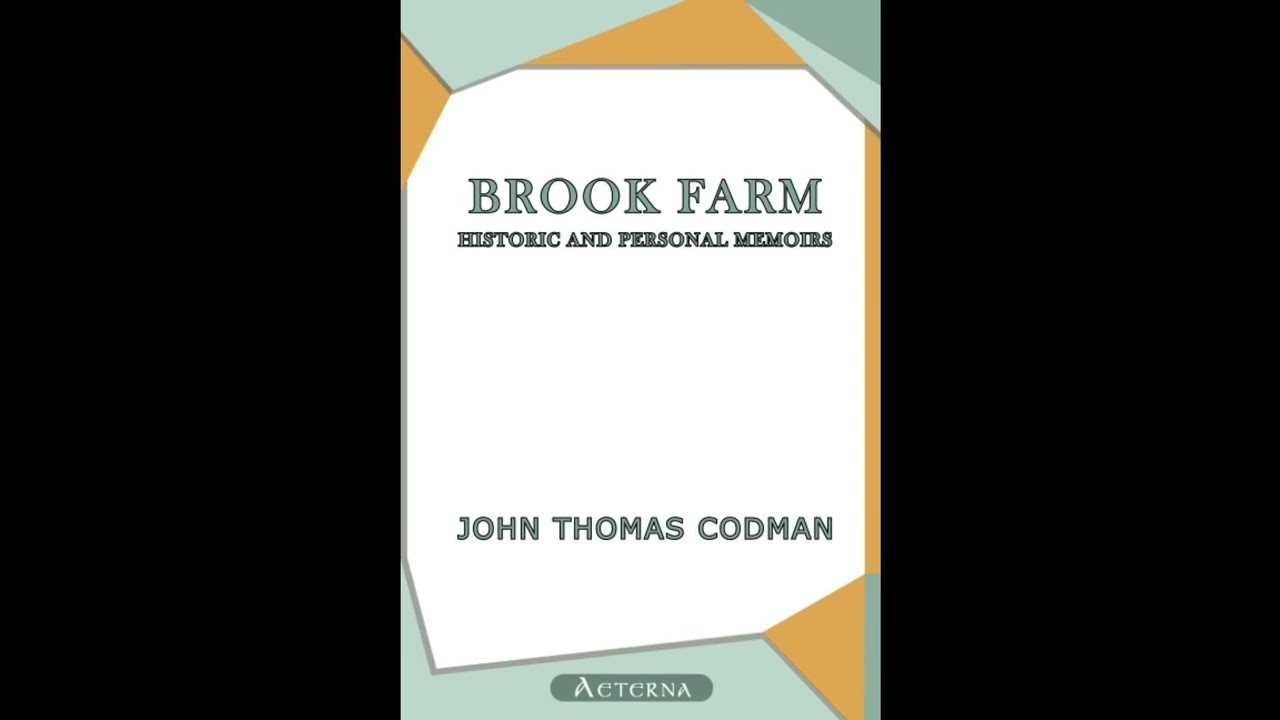
Brook Farm: Historic and Personal Memoirs
Step back into a pivotal moment of American intellectual history with John Thomas Codman's "Brook Farm: Historic and Personal Memoirs." This remarkable account transports listeners to a radical social experiment of the 1840s, a visionary community born from the fervent idealism of the Transcendentalist movement. More than just a dry historical record, Codman’s memoir offers a rare, first-hand look at daily life within one of America’s most famous utopian ventures, told with the unique clarity of a participant reflecting on his youth from the vantage point of later years. It asks enduring questions about the balance between individual ambition and communal good, the dignity of labor, and the elusive nature of a perfect society – questions that resonate profoundly even in our own era, as we continue to grapple with how best to live, work, and build community. Codman’s narrative unfolds within the pastoral landscape of West Roxbury, Massachusetts, where in 1841, a group of intellectuals, reformers, and artists established Brook Farm. The story begins with Codman, a young man, arriving at this self-proclaimed "Phalanx" – a communal society dedicated to harmonizing manual labor with intellectual pursuit. Listeners are immediately immersed in the routines and rhythms of the farm: mornings spent toiling in the fields, afternoons dedicated to study, evenings filled with lively discussions, lectures, and social gatherings. Codman paints vivid pictures of the residents, a diverse group drawn by the promise of a more equitable and fulfilling existence, all striving to live according to principles of cooperation and shared endeavor. The central arc of the memoir follows Codman’s personal observations and experiences as a member of this unique community. He recounts the efforts to establish a self-sufficient agricultural economy, the establishment of a progressive school that attracted students from far and wide, and the philosophical debates that animated the residents. He describes the initial enthusiasm and camaraderie, the belief that they were forging a new path for humanity, free from the societal ills of competition and materialism. The “plot,” therefore, isn’t one of external events so much as it is the unfolding reality of idealism meeting the hard ground of practicality, seen through the eyes of someone intimately involved. John Thomas Codman, born in Boston in 1828, was more than just a fleeting resident of Brook Farm; he was a keen observer and a committed advocate for social reform throughout his life. A practicing dentist by profession, Codman harbored a lifelong interest in progressive causes. He was an ardent abolitionist, a proponent of spiritualism, and a vocal critic of conventional medicine and social norms. His time at Brook Farm, though relatively brief, proved to be a profoundly formative experience, shaping his perspectives on community, labor, and human potential. Decades later, with the benefit of hindsight and a mature understanding of the world, Codman penned these memoirs. "Brook Farm: Historic and Personal Memoirs," published in 1894, positions Codman as an essential chronicler of a bygone era. While not a central figure in the Transcendentalist literary circle of Emerson and Thoreau, he lived alongside many who were, and his account provides invaluable texture to our understanding of that movement. His writing is not merely a nostalgic reminiscence but a thoughtful analysis, reflecting both the youthful optimism of the Brook Farmers and the complex realities that ultimately challenged their vision. This work stands as his most significant contribution to literature, solidifying his place as a primary source for understanding one of America's most fascinating social experiments. The book enacts several powerful themes, the most prominent being the enduring tension between utopian idealism and the stubborn realities of human nature and economic constraint. Codman illustrates this through countless small moments: the challenge of making manual labor appealing to intellectuals unaccustomed to it, the financial struggles that plagued the community despite their best efforts, and the inevitable disagreements that arose even among those committed to harmony. For instance, he recounts the humorous yet telling anecdotes of scholars grappling with farm implements or the earnest but ultimately insufficient attempts to market their produce effectively. Another key theme is the quest for a more holistic existence, one that dignifies labor and integrates it seamlessly with intellectual and artistic pursuits. The Brook Farmers believed in the concept of "attractive industry," where work itself would be fulfilling rather than alienating. Codman describes the daily rotation of duties, where a philosopher might spend the morning milking cows and the afternoon delivering a lecture on German philosophy. This commitment to breaking down traditional divisions between mental and physical work is a central thread, showing both the triumphs of this vision—in the camaraderie and shared purpose it sometimes fostered—and its inherent difficulties in practice. This memoir emerged from a unique crucible of American thought and society. The mid-19th century was a period of intense social ferment, marked by a blossoming of reform movements—abolitionism, women's rights, temperance, and educational innovation. Intellectually, it was the height of Transcendentalism, a philosophical movement that emphasized individual intuition, self-reliance, and a spiritual connection to nature, often leading its adherents to question established institutions and seek alternative ways of living. Brook Farm itself was a direct outgrowth of this intellectual climate, an attempt to put Transcendentalist ideals into practical, communal action. Codman’s work, written decades later, provided a crucial participant’s view into this moment of profound cultural and philosophical experimentation, offering an insider’s perspective that complements the more widely known literary accounts of the era. Listening to "Brook Farm: Historic and Personal Memoirs" as an audiobook offers a singular opportunity to connect with this history. A skilled narrator brings Codman’s observant, reflective voice to life, allowing his thoughtful commentary and vivid descriptions to unfold naturally. The several hours of listening time provide ample space to become truly immersed in the atmosphere of 19th-century New England, picturing the communal dining hall, the bustling classrooms, and the quiet fields where intellectuals labored alongside farmers. Listen for the subtle shifts in Codman’s tone, from the youthful excitement of his arrival to the more measured, experienced perspective of his later reflections. The pacing of the narration can echo the measured, deliberate tempo of life on the farm, inviting listeners to contemplate the lofty ideals and human efforts that shaped this remarkable chapter in American history.
Enjoyed Brook Farm: Historic and Personal Memoirs? A few ways to support us
Audible & Amazon links are affiliate; we may earn a small commission at no extra cost.
About this production
Human narration by a volunteer reader from LibriVox.org, the public-domain audiobook project. LibriVox volunteers record literary works whose copyright has expired in the United States, releasing the resulting recordings into the public domain.
Brook Farm: Historic and Personal Memoirs by John Thomas Codman. The underlying text is in the U.S. public domain. We do not republish any modern copyrighted edition, translation, or commentary.
The 4K cinematic visuals accompanying this audiobook are generated by an AI image model from prompts derived from the source text. No copyrighted photos, paintings, or stock footage are used. AI generation is disclosed on every video on our YouTube channel as required by YouTube's altered/synthetic content policy.
English subtitles are transcribed from the LibriVox recording with OpenAI Whisper. Translations into the 11 other supported languages are produced by Meta's NLLB-200 neural translation model. No human translator's copyrighted translation is used.
Questions about sourcing or rights? See our DMCA & Sourcing policy or contact us.
Enjoyed this audiobook?
If you'd like to own a copy of Brook Farm: Historic and Personal Memoirs or hear a professionally produced edition, the links below help support free audiobook production at no extra cost to you.
As an Amazon Associate we earn from qualifying purchases. Audible / print links are affiliate.