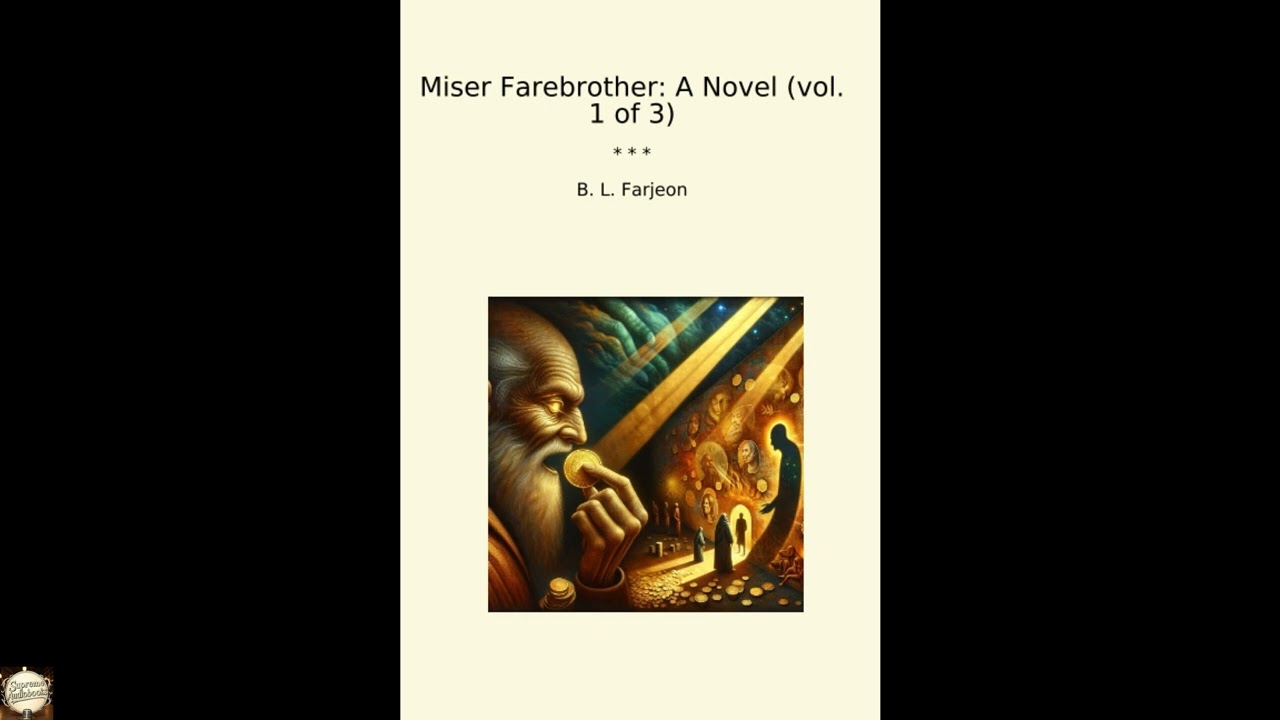
Miser Farebrother: A Novel (vol. 1 of 3) (Classic Books)
Step into the shadowed lanes and gaslit drawing rooms of Victorian England with B. L. Farjeon’s Miser Farebrother, the compelling first volume of a sweeping three-part novel. This is more than just a story about a man and his money; it is a meticulous study of the human condition, a chilling portrait of avarice, and a vivid evocation of an era grappling with its own moral compass. Farjeon, a masterful storyteller of his time, invites listeners to confront the insidious nature of greed and its far-reaching consequences, presenting a narrative that remains remarkably resonant as it lays bare the complex interplay between wealth, power, and the secret lives of individuals. What drives a man to such parsimony, and what dark truths lie beneath the surface of a seemingly quiet existence? This audiobook offers the chance to find out, allowing the listener to absorb the intricate details and emotional weight of a classic novel as it unfolds. Our story introduces us to the enigmatic figure of Mr. Farebrother, a man whose very name has become synonymous with extreme frugality throughout the London community he inhabits. He is a formidable presence, his reputation for wealth matched only by his legendary meanness. From the meticulous care with which he guards his possessions to his stringent treatment of those unfortunate enough to owe him even the smallest sum, Farebrother’s influence casts a long shadow. He lives a solitary life, devoid of apparent affection or companionship, yet his considerable fortune inevitably draws others into his orbit, often with tragic or desperate outcomes. The narrative begins to sketch the contours of this peculiar man’s existence, revealing glimpses into his past and the mysterious source of his vast accumulation. We meet individuals whose lives are inextricably bound to Farebrother—a young, struggling family on the brink of destitution, an ambitious acquaintance seeking to profit from his reputation, and perhaps even a distant relative who harbors a secret hope of inheritance. As the plot thickens in this initial volume, the seemingly impregnable walls of Farebrother’s private world begin to show cracks. Whispers of a forgotten deed, an injustice in the distant past, or a hidden connection to a long-lost fortune start to circulate, creating an undercurrent of suspense. Farjeon carefully constructs a landscape of suspicion and social observation, where every interaction with Farebrother carries the weight of potential manipulation or moral judgment. The central conflict emerges from the tension between Farebrother’s absolute control over his wealth and the various forces—both overt and subtle—that seek to challenge or exploit it. What is the true origin of Farebrother's fortune? What secrets does he guard, and what price will he demand from those who cross his path? This initial installment draws us into a world where outward respectability often masks inner turmoil and where the pursuit of money can corrupt the soul and ripple through generations. Benjamin Leopold Farjeon, born in London in 1838, was a prolific and celebrated novelist during the latter half of the nineteenth century. His early life was marked by diverse experiences; he spent a significant period in Australia, where he worked as a journalist and even held a position in the civil service. This time abroad provided him with a broad perspective on human nature and social structures, which he would later skillfully weave into his fiction. Upon returning to England, Farjeon committed himself to a literary career, quickly establishing a reputation for his vivid characterizations, intricate plots, and keen eye for social detail. Farjeon produced a substantial body of work, often publishing multiple novels a year, alongside numerous short stories, especially popular Christmas tales that earned him comparisons to Charles Dickens. Notable among his other works are Grif, a story of Australian life, and Blade-o'-Grass, a poignant social commentary. He was a master of the sensation novel, a popular genre that combined elements of romance, mystery, and dramatic social commentary, often focusing on hidden crimes, family secrets, and psychological suspense. Farjeon’s enduring appeal lies in his ability to craft narratives that were both entertaining and thought-provoking, securing him a significant place among the popular Victorian authors who captured the imagination of a rapidly changing society. At its core, Miser Farebrother enacts a compelling study of avarice and its corrosive impact. The character of Farebrother himself serves as a living embodiment of this theme; his every action, from his threadbare clothing to his calculated dealings, illustrates how the obsessive accumulation of wealth can strip away empathy and human connection. One might observe, for instance, his callous dismissal of a young widow’s desperate plea for a small extension on her rent, demonstrating how his self-interest blinds him to the suffering of others. Another significant theme is the pervasive influence of social hypocrisy and the judgmental nature of Victorian society. While many might privately condemn Farebrother’s behavior, his immense wealth ensures a certain outward deference, highlighting the era’s complicated relationship with money and morality. The novel also touches upon the power of the past, with hints of unresolved history connected to Farebrother’s fortune or origins, suggesting that past actions cast long shadows, inevitably shaping the present. The novel also illuminates the precariousness of life for the working poor and the stark social inequalities of the period. Farjeon often portrays characters who are utterly dependent on figures like Farebrother, illustrating the vulnerability of those without means in a society where charity was often scarce and social safety nets virtually non-existent. A particular scene might depict a desperate clerk, trapped by an unfair debt, forced to submit to Farebrother’s cruel whims, thereby exposing the brutal realities faced by many. Through these intertwined threads, Farjeon constructs a narrative that not only entertains but also subtly critiques the societal structures and moral failings of his age. When Miser Farebrother was published in 1888, the late Victorian era was a time of immense social and economic transformation. The Industrial Revolution had created unprecedented wealth, but also stark divisions between the affluent and the impoverished. London, in particular, was a city of stark contrasts, with opulent mansions existing alongside overcrowded slums. This period saw a heightened awareness of social issues, leading to reforms and burgeoning calls for greater justice, yet also a fascination with crime, mystery, and the hidden lives within society’s many layers. Literature of the time frequently mirrored these concerns, with authors like Farjeon often blending entertainment with social commentary. His novel emerged within a literary landscape where realism was gaining traction, but the appetite for suspenseful, character-driven narratives remained strong, offering a mirror to the anxieties and moral dilemmas of a nation rapidly modernizing. Listening to Miser Farebrother as an audiobook offers a singular opportunity to fully immerse oneself in Farjeon’s detailed world. The narration breathes life into the nuanced Victorian dialogue, rendering each character's voice distinct and memorable—from Farebrother’s clipped, calculated pronouncements to the earnest appeals of those who seek his aid. The pacing of the story, characteristic of its serialized origins, allows for a gradual unfolding of events, building suspense with each chapter and drawing the listener into the atmosphere of nineteenth-century London. Pay close attention to the narrator’s delivery of descriptive passages, which paint vivid pictures of the era’s streets, interiors, and social interactions, enhancing the sense of place. The multi-hour run length of this first volume invites a deep engagement, allowing the listener to absorb the psychological depth of the characters and the intricate machinations of the plot at their own pace, making it an ideal companion for extended periods of focused listening.
Enjoyed Miser Farebrother: A Novel (vol. 1 of 3) (Classic Books)? A few ways to support us
Audible & Amazon links are affiliate; we may earn a small commission at no extra cost.
About this production
Human narration by a volunteer reader from LibriVox.org, the public-domain audiobook project. LibriVox volunteers record literary works whose copyright has expired in the United States, releasing the resulting recordings into the public domain.
Miser Farebrother: A Novel (vol. 1 of 3) (Classic Books) by B. L. Farjeon. The underlying text is in the U.S. public domain. We do not republish any modern copyrighted edition, translation, or commentary.
The 4K cinematic visuals accompanying this audiobook are generated by an AI image model from prompts derived from the source text. No copyrighted photos, paintings, or stock footage are used. AI generation is disclosed on every video on our YouTube channel as required by YouTube's altered/synthetic content policy.
English subtitles are transcribed from the LibriVox recording with OpenAI Whisper. Translations into the 11 other supported languages are produced by Meta's NLLB-200 neural translation model. No human translator's copyrighted translation is used.
Questions about sourcing or rights? See our DMCA & Sourcing policy or contact us.
Enjoyed this audiobook?
If you'd like to own a copy of Miser Farebrother: A Novel (vol. 1 of 3) (Classic Books) or hear a professionally produced edition, the links below help support free audiobook production at no extra cost to you.
As an Amazon Associate we earn from qualifying purchases. Audible / print links are affiliate.