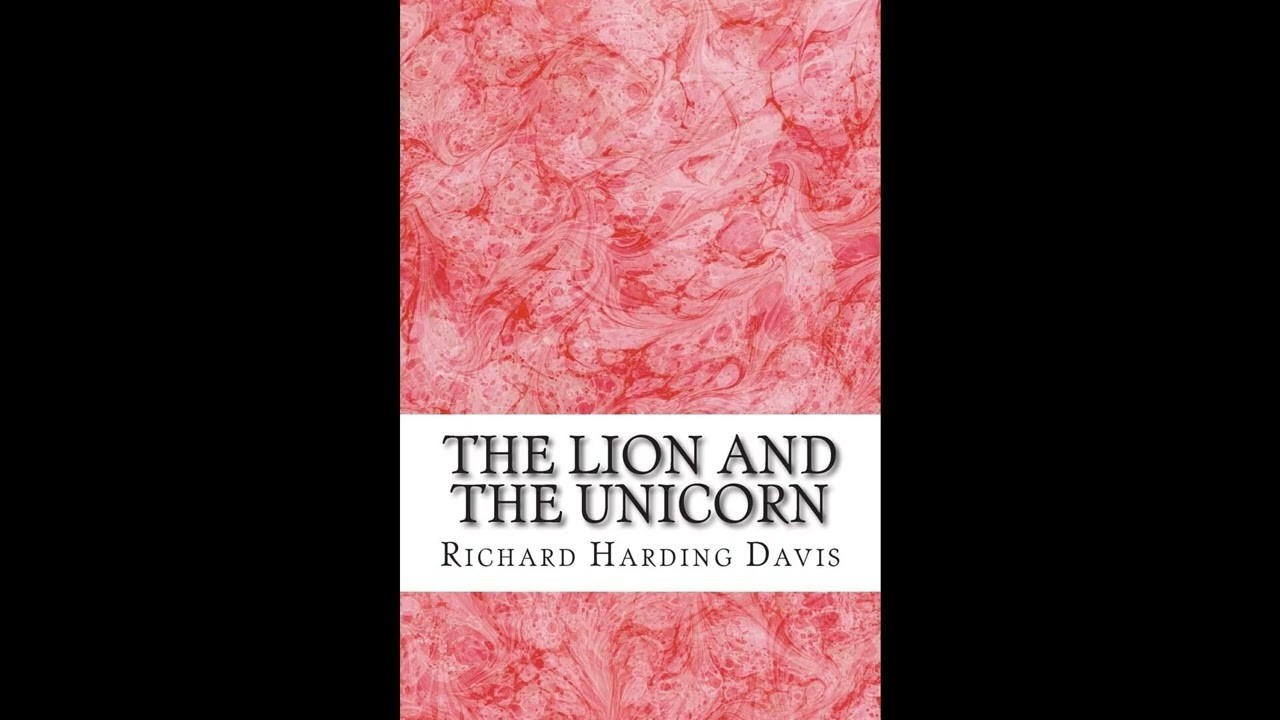
The Lion And The Unicorn
Enter the gilded drawing rooms and bustling avenues of turn-of-the-century London, where fortunes and reputations were made and lost with equal speed, and where matters of the heart frequently found themselves entangled with the strictures of society. Richard Harding Davis's The Lion And The Unicorn invites listeners into a world brimming with wit, romance, and the quiet struggle of individuals asserting their will against a backdrop of rigid convention. It’s a story that, despite its specific historical setting, resonates profoundly today, questioning the price of ambition, the nature of true love, and the complex interplay between personal desire and public expectation. In an age still grappling with identity and belonging, this narrative offers a window into the enduring human quest for authenticity amidst the clamor of external demands. The story introduces us to a world vibrant with social currents, primarily centering on the spirited American protagonist, Esme Chalmers, an artist of considerable talent and independent spirit. She arrives in England, not as a tourist, but with a serious professional purpose, intent on refining her craft and making her mark in the competitive London art scene. Her ambition, however, soon brings her into contact with an unexpected figure: Geoffrey, a charming yet enigmatic Englishman whose family lineage and social standing represent the very core of British tradition. Their initial interactions are marked by a fascinating friction, a clash between Esme's American directness and Geoffrey's more reserved, often ironic, demeanor. This cultural dynamic forms the crucible in which their relationship begins to forge, setting the stage for deeper entanglements. As Esme navigates the intricacies of London's high society and the competitive art world, she discovers that Geoffrey carries burdens far heavier than his outward charm suggests. He is bound by familial expectations and a sense of duty that threatens to overshadow his personal happiness and even his own dreams. The central conflict of the story crystallizes around the burgeoning affection between Esme and Geoffrey, an affection challenged by the divergent paths they seem destined to follow. Can Esme's independent spirit find a place within Geoffrey's world of inherited responsibility, or will the weight of tradition prove too formidable an obstacle? Davis masterfully builds the tension, revealing the sacrifices demanded by both love and loyalty, all while carefully keeping the ultimate choices and their consequences just beyond the listener's grasp. Richard Harding Davis was one of the most celebrated and dashing figures in American letters at the turn of the 20th century. Born in Philadelphia in 1864, the son of two notable writers—Rebecca Harding Davis, a groundbreaking realist novelist, and L. Clarke Davis, a journalist and editor—he inherited a keen intellect and a talent for observation. After studying at Lehigh University and Johns Hopkins, Davis launched his career in journalism, quickly establishing himself as a star reporter for various New York newspapers. His energetic prose and eye for detail brought him national fame, transforming him into a literary celebrity. He became synonymous with the "new journalism" of his era, blending factual reporting with a storytelling flair. Beyond his groundbreaking work as a journalist and war correspondent—covering conflicts from the Spanish-American War to the Boer War and the early days of World War I—Davis was a prolific writer of fiction. His novels and short stories, often featuring adventurers, soldiers, and strong-willed women, captivated a wide readership. Works like Gallegher, and Other Stories, Soldiers of Fortune, and the beloved Van Bibber and Others cemented his reputation as a master storyteller. He was a keen observer of social change, particularly the evolving role of American culture on the global stage, and his fiction often reflected a certain romantic idealism paired with a pragmatic understanding of the world. Davis's untimely death in 1916 at the age of 51 left a significant void in American popular literature. The Lion And The Unicorn thoughtfully explores several enduring themes, most notably the clash between American dynamism and European tradition. Through Esme, Davis contrasts the perceived earnestness and ambition of the New World with the established customs and sometimes stifling expectations of the Old. An early scene, for example, might find Esme quietly amused or even frustrated by the elaborate social rituals surrounding a simple afternoon tea, which she contrasts with the more direct, merit-based interactions she's accustomed to. This cultural friction provides both humor and serious dramatic tension, highlighting the difficulties of bridging such disparate worlds for the sake of love or personal fulfillment. Another prominent theme is the perpetual conflict between individual aspiration and societal expectation. Geoffrey, for instance, represents the burden of duty and lineage, potentially sacrificing personal happiness for the sake of his family's honor or financial stability. There might be a poignant dialogue where he articulates the invisible chains that bind him, making his connection with the free-spirited Esme all the more poignant and challenging. The narrative also touches on the struggle for artistic integrity in a commercial world, as Esme strives to prove her worth as a painter, contending with the patronizing attitudes of some art dealers and the fickle tastes of London society. Davis subtly foregrounds the internal battles characters face when their deepest desires run counter to the paths laid out for them. This novel emerged from a specific cultural moment, the fin de siècle and early Edwardian era, a period marked by tremendous social and technological change, and an increasing awareness of America's rising prominence on the international stage. It was a time when the transatlantic flow of people and ideas was at its peak, with wealthy Americans often traveling to Europe for cultural refinement or to marry into aristocratic families, and European artists and intellectuals looking to America for fresh perspectives. The "international novel," a subgenre popularized by authors like Henry James, was particularly fashionable, often examining the often-humorous and sometimes tragic misunderstandings between American innocence and European sophistication. Davis, with his journalistic eye, brought a uniquely American, often more direct and adventurous, sensibility to this tradition, making his characters and their dilemmas relatable to a broad audience eager for stories of romance and adventure set against exotic backdrops. Listening to The Lion And The Unicorn as an audiobook offers a unique opportunity to immerse oneself fully in Davis's world. The narrator's voice brings to life the crisp dialogue and the subtle inflections that define characters from both sides of the Atlantic, allowing the listener to truly distinguish between Esme's forthright speech and Geoffrey's more nuanced expressions. Over several hours of listening, the listener can settle into the rhythmic prose, appreciate the vivid descriptions of London’s social landscape, and allow the period atmosphere to wash over them. The pacing of the narration enhances the gradual build-up of the central romance and the mounting pressure of the characters’ dilemmas, ensuring that every turn of events, every witty exchange, and every moment of emotional resonance lands with its intended impact, making for an unforgettable experience.
Enjoyed The Lion And The Unicorn? A few ways to support us
Audible & Amazon links are affiliate; we may earn a small commission at no extra cost.
About this production
Human narration by a volunteer reader from LibriVox.org, the public-domain audiobook project. LibriVox volunteers record literary works whose copyright has expired in the United States, releasing the resulting recordings into the public domain.
The Lion And The Unicorn by Richard Harding Davis. The underlying text is in the U.S. public domain. We do not republish any modern copyrighted edition, translation, or commentary.
The 4K cinematic visuals accompanying this audiobook are generated by an AI image model from prompts derived from the source text. No copyrighted photos, paintings, or stock footage are used. AI generation is disclosed on every video on our YouTube channel as required by YouTube's altered/synthetic content policy.
English subtitles are transcribed from the LibriVox recording with OpenAI Whisper. Translations into the 11 other supported languages are produced by Meta's NLLB-200 neural translation model. No human translator's copyrighted translation is used.
Questions about sourcing or rights? See our DMCA & Sourcing policy or contact us.
Enjoyed this audiobook?
If you'd like to own a copy of The Lion And The Unicorn or hear a professionally produced edition, the links below help support free audiobook production at no extra cost to you.
As an Amazon Associate we earn from qualifying purchases. Audible / print links are affiliate.