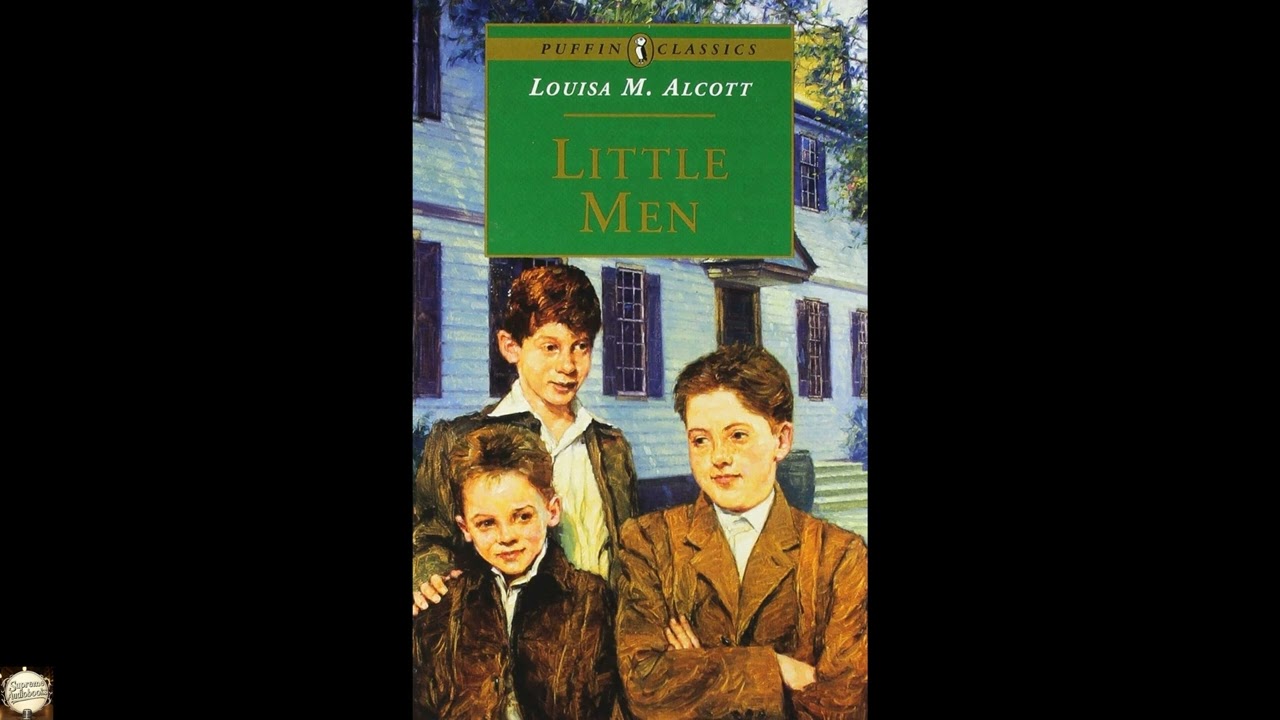
Little Men: Life at Plumfield with Jo's Boys (Puffin Classics)
Return to the cherished world of Louisa May Alcott, not with the familiar March sisters in their youthful endeavors, but with the spirited Jo, now grown and guiding a new generation. Little Men: Life at Plumfield with Jo's Boys invites listeners into a bustling, unconventional boarding school where kindness and character often trump rote learning. This is a story about the messy, joyous, and often challenging work of raising children, especially boys, with a philosophy that was revolutionary for its time and still resonates powerfully today. It asks what it truly means to educate the whole child, to mend broken spirits, and to build a community founded on love and understanding. The story opens some years after the events of Little Women, finding Jo Bhaer happily married to Professor Friedrich Bhaer and running the Plumfield school on the sprawling estate inherited from Aunt March. Their home is far from a typical rigid institution; instead, it is a haven for a dozen or so boys (and a couple of girls, notably the sweet Daisy, Plumfield's little homemaker), many of whom are orphans, mischievous, or in need of a gentler hand than the world has offered them. Among the colorful cast are Nat, a shy, musical orphan who arrives first, followed by the rough-and-tumble street boy Dan, whose arrival tests the Bhaers' open-hearted philosophy to its limits. There are also boisterous Tommy Bangs, studious Franz, the artistic Demi, and the adventurous Rob, Jo and Friedrich’s own son. Life at Plumfield is a lively succession of lessons learned through experience—sometimes painful, often amusing. Jo, with her characteristic warmth and flashes of temper, acts as a mother figure, while Professor Bhaer provides a steady, intellectual, and profoundly kind presence. Together, they navigate the daily squabbles, the occasional acts of rebellion, and the many triumphs of their charges. The central "conflict" isn't a single antagonist, but rather the ongoing challenge of molding young characters, encouraging each child's unique talents, and teaching them responsibility, empathy, and self-control. The narrative follows the rhythms of the school year, illustrating how the Bhaers strive to instill moral values and practical skills, shaping the "little men" into honorable individuals ready for the world. Louisa May Alcott, born in 1832 in Germantown, Pennsylvania, grew up deeply immersed in the Transcendentalist movement through her father, Amos Bronson Alcott, a philosopher, educator, and friend of Ralph Waldo Emerson and Henry David Thoreau. Her early life in Concord, Massachusetts, was marked by intellectual curiosity, but also by periods of poverty, which forced her to work from a young age to support her family. She served as a nurse during the American Civil War, an experience that profoundly affected her and found expression in her Hospital Sketches. Alcott's literary career truly began to flourish after the war. Though she initially wrote sensationalist fiction under pseudonyms to earn money, it was the publication of Little Women in 1868 that brought her widespread fame and financial stability. This beloved novel, loosely based on her own family life, cemented her reputation as a chronicler of domestic life and female development in nineteenth-century America. She followed its success with sequels like Good Wives (often published as the second part of Little Women) and Little Men in 1871, and later Jo's Boys in 1886. Other notable works include An Old-Fashioned Girl and Eight Cousins, establishing her as a foundational figure in children's literature, though her writing often pushed against conventional expectations for women and children's roles. She was also a vocal advocate for women's suffrage and abolition, embodying the progressive ideals of her upbringing until her death in 1888. At its core, Little Men is a profound meditation on the power of unconventional education. Jo and Professor Bhaer reject rigid discipline and rote memorization, favoring instead a philosophy rooted in practical experience, freedom tempered by responsibility, and a deep respect for individual differences. For instance, instead of punishment for mischief, boys might face natural consequences or be encouraged to make amends, such as when Tommy Bangs must repair the garden damage he causes. The school also fosters a broader understanding of "family," demonstrating that chosen kinship can be as strong, if not stronger, than blood ties. The boys, from diverse backgrounds, learn to live together, support each other, and form bonds that transcend their initial differences, creating a true community under the Bhaers' care. Another central theme is the development of moral character and the capacity for redemption. Characters like Dan, initially presented as a rough and potentially incorrigible boy from the streets, slowly begin to shed his hardened exterior under the consistent kindness and belief shown by Jo and Friedrich. His journey highlights the importance of patient guidance and the recognition of an individual's inherent worth, even when obscured by difficult circumstances. The book also subtly questions traditional notions of masculinity prevalent in the era, suggesting that boys can be strong and honorable not through aggression or stoicism alone, but through empathy, creativity, and a willingness to show their vulnerability—lessons beautifully exemplified by the Bhaers' gentle influence. When Little Men was published in 1871, America was still grappling with the aftermath of the Civil War. The nation was undergoing a period of significant social and industrial change, and there was a growing interest in child psychology and progressive educational reform. Alcott's depiction of Plumfield as a co-educational, democratic institution, where children were encouraged to think for themselves and learn by doing, reflected and contributed to these evolving ideas. Her Transcendentalist background, which emphasized individualism, intuition, and the inherent goodness of humanity, directly shaped the Bhaers' educational philosophy. The popularity of the "family story" genre during this period, particularly those offering moral guidance and depicting wholesome domestic life, also contributed to the book's enthusiastic reception. It emerged as a comforting, yet subtly progressive, counter-narrative to the anxieties of a rapidly modernizing world. Listening to Little Men as an audiobook offers a unique opportunity to immerse oneself fully in the warm, lived-in atmosphere of Plumfield. The story's episodic nature, with each chapter often presenting a new lesson or adventure, lends itself perfectly to audio, allowing for natural pauses or extended listening sessions. A skilled narrator brings each boy's distinct personality to life, from Nat's quiet sensitivity to Dan's gruff exterior and Tommy's boisterousness, enhancing the vivid dialogue and the charming interplay between the characters. The pacing of the prose, often gentle but punctuated with bursts of youthful energy and humor, translates beautifully, creating an engaging and comforting experience that evokes the laughter, tears, and enduring wisdom found within Jo's extraordinary household.
Enjoyed Little Men: Life at Plumfield with Jo's Boys (Puffin Classics)? A few ways to support us
Audible & Amazon links are affiliate; we may earn a small commission at no extra cost.
About this production
Human narration by a volunteer reader from LibriVox.org, the public-domain audiobook project. LibriVox volunteers record literary works whose copyright has expired in the United States, releasing the resulting recordings into the public domain.
Little Men: Life at Plumfield with Jo's Boys (Puffin Classics) by Louisa May Alcott. The underlying text is in the U.S. public domain. We do not republish any modern copyrighted edition, translation, or commentary.
The 4K cinematic visuals accompanying this audiobook are generated by an AI image model from prompts derived from the source text. No copyrighted photos, paintings, or stock footage are used. AI generation is disclosed on every video on our YouTube channel as required by YouTube's altered/synthetic content policy.
English subtitles are transcribed from the LibriVox recording with OpenAI Whisper. Translations into the 11 other supported languages are produced by Meta's NLLB-200 neural translation model. No human translator's copyrighted translation is used.
Questions about sourcing or rights? See our DMCA & Sourcing policy or contact us.
Enjoyed this audiobook?
If you'd like to own a copy of Little Men: Life at Plumfield with Jo's Boys (Puffin Classics) or hear a professionally produced edition, the links below help support free audiobook production at no extra cost to you.
As an Amazon Associate we earn from qualifying purchases. Audible / print links are affiliate.