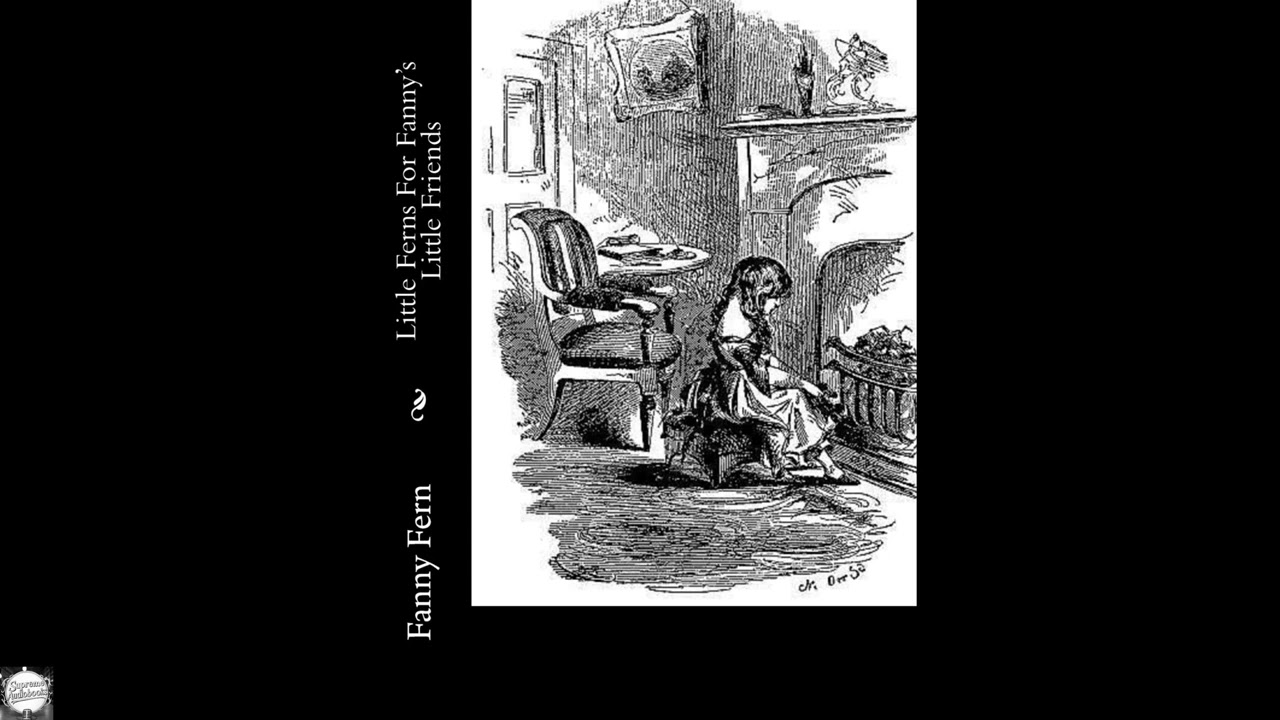
Little Ferns For Fanny's Little Friends
Step into the charming, yet surprisingly shrewd, world of Fanny Fern with her delightful collection, Little Ferns For Fanny's Little Friends. This audiobook offers a rare chance to reconnect with one of the mid-nineteenth century's most beloved and commercially successful writers, whose voice, once ubiquitous in American households, speaks with surprising clarity and relevance even today. More than just a relic of a bygone era, these short pieces — whether whimsical sketches of childhood, poignant domestic observations, or gently satirical social critiques — reveal an author ahead of her time, someone whose wit and wisdom still resonate in our complex world, reminding us of the enduring power of empathy, humor, and a keen eye for human nature. This collection unfurls a series of vignettes, character studies, and moral reflections, presented through the perceptive and often humorous lens of Fanny Fern herself. Listeners are invited into the everyday settings of mid-nineteenth-century American life: bustling city streets, quiet family parlors, sun-dappled gardens, and the lively imaginations of children. There isn't a singular overarching plot in the traditional sense, but rather a progression of small, self-contained narratives that collectively paint a vivid picture of the human condition. We meet a cast of archetypal figures: the well-meaning but sometimes exasperated parent, the boisterous or contemplative child, the gossiping neighbor, the pompous dignitary, and the earnest seeker of truth and beauty. The central thread holding these diverse pieces together is Fern's characteristic blend of sentiment and sharp social commentary. The "conflict" in these stories often arises from the gentle clashes of everyday expectations versus reality, the gap between appearance and truth, or the simple struggles of navigating the world with kindness and integrity. Each "little fern" offers a moment of reflection, a chuckle, or a pang of recognition, culminating not in a dramatic climax, but in a deeper understanding of the values and foibles that shape our lives. The overall arc is one of sustained observation, inviting the listener to consider the myriad small moments that constitute a life, always guided by Fern's distinctive, warm, yet never sentimentalized, perspective. The author behind these insightful pieces was Sara Payson Willis Parton, better known by her pen name, Fanny Fern. Born in Portland, Maine, in 1811, she hailed from an intellectually prominent New England family; her brother was the celebrated editor and poet Nathaniel Parker Willis. Despite a comfortable upbringing and a good education, Fern's life was marked by significant personal hardship. After the premature death of her first husband and two of her children, she found herself in dire financial straits and estranged from much of her family. It was out of this necessity, and a potent desire for self-expression, that her writing career began in the early 1850s. Fern quickly became a sensation, securing unprecedented contracts and becoming, for a time, the highest-paid female writer in America. Her frank, conversational columns, first published in Boston newspapers and then widely syndicated, captured the hearts of millions. Her semi-autobiographical novel, Ruth Hall (1855), further cemented her reputation, openly critiquing the patriarchal structures of publishing and society that sought to control women's voices and livelihoods. Through her prolific output of essays, sketches, and novels, Fanny Fern defied conventional expectations for women writers, forging a path that blended popular appeal with an often cutting social critique, influencing generations of female journalists and authors until her death in New York City in 1872. One of the prominent themes running through Little Ferns For Fanny's Little Friends is the authentic lived experience of women and children within the domestic sphere. Fern challenges the idealized notions of home life by presenting the daily realities—the joys, frustrations, and quiet triumphs—of mothers, daughters, and young boys. For instance, a sketch might depict a mother's silent struggle to maintain composure amidst household chaos, subtly revealing the emotional labor often invisible to others. Another piece might capture a child's unique logic or innocent perspective, such as a youngster earnestly trying to understand an adult social custom, thereby highlighting its inherent absurdity through the pure lens of childhood. Another significant theme is social observation tempered with gentle critique. Fern was a master of using humor and seemingly innocuous scenarios to point out human follies and societal hypocrisies. She frequently commented on pretense, class distinctions, and the artificiality of certain social conventions. A story might feature a group of ladies gossiping with false piety, or a scene where a seemingly respectable gentleman reveals a less admirable character trait through a minor interaction. These moments, while often amusing, serve to underscore Fern's underlying call for authenticity, sincerity, and a more compassionate public discourse, advocating for kindness and understanding as antidotes to the era's pervasive judgmentalism. This collection emerged during a period of immense social and cultural transformation in America, roughly spanning the 1850s and 1860s. The mid-nineteenth century witnessed a rapid expansion of print culture, with newspapers and magazines becoming increasingly central to daily life. There was a burgeoning demand for popular literature that could entertain, instruct, and reflect the experiences of a diverse and growing readership. Women, in particular, were gaining more access to education and public life, and their voices, both as writers and readers, were becoming increasingly influential. Fanny Fern's work fit perfectly into this landscape, offering a unique blend of the prevailing sentimentalism—which valued emotion, morality, and domestic virtues—with a fresh, often irreverent journalistic style. Her success was a testament to her ability to tap into the anxieties and aspirations of her time, providing comfort and validation to many, while subtly challenging the status quo for others. Her columns offered a space for readers to see their own lives and observations reflected, providing both escape and a quiet call for social improvement in an era grappling with issues ranging from abolition to women's rights, and the shifting dynamics of industrialization and urbanization. Listening to Little Ferns For Fanny's Little Friends as an audiobook offers a particularly intimate and rewarding experience. Fanny Fern's writing style is inherently conversational, as if she is confiding directly in the listener. This makes it ideal for audio, allowing her distinctive voice—witty, warm, and occasionally mischievous—to come alive through a skilled narrator. The episodic nature of the collection, with each piece acting as a self-contained meditation, makes it perfect for dipping in and out during a commute, while performing household tasks, or for longer, reflective listening sessions. A good narrator will bring out the subtle humor and tender pathos embedded in Fern's prose, allowing listeners to fully appreciate the comfortable pacing and the nuanced characterizations that define her enduring charm and quiet brilliance.
Enjoyed Little Ferns For Fanny's Little Friends? A few ways to support us
Audible & Amazon links are affiliate; we may earn a small commission at no extra cost.
About this production
Human narration by a volunteer reader from LibriVox.org, the public-domain audiobook project. LibriVox volunteers record literary works whose copyright has expired in the United States, releasing the resulting recordings into the public domain.
Little Ferns For Fanny's Little Friends by Fanny Fern. The underlying text is in the U.S. public domain. We do not republish any modern copyrighted edition, translation, or commentary.
The 4K cinematic visuals accompanying this audiobook are generated by an AI image model from prompts derived from the source text. No copyrighted photos, paintings, or stock footage are used. AI generation is disclosed on every video on our YouTube channel as required by YouTube's altered/synthetic content policy.
English subtitles are transcribed from the LibriVox recording with OpenAI Whisper. Translations into the 11 other supported languages are produced by Meta's NLLB-200 neural translation model. No human translator's copyrighted translation is used.
Questions about sourcing or rights? See our DMCA & Sourcing policy or contact us.
Enjoyed this audiobook?
If you'd like to own a copy of Little Ferns For Fanny's Little Friends or hear a professionally produced edition, the links below help support free audiobook production at no extra cost to you.
As an Amazon Associate we earn from qualifying purchases. Audible / print links are affiliate.